




Related: Students Win National Contest for Flashing School Bus Stop Sign
Students, Community Raise Funds for Extended Stop Arms
The group of Maine students, with support from school staff and community members, is working to raise nearly $33,000 to add 15 extended stop arms to buses on routes with the highest number of illegal passing incidents.

Nicole Schlosser・Former Executive Editor
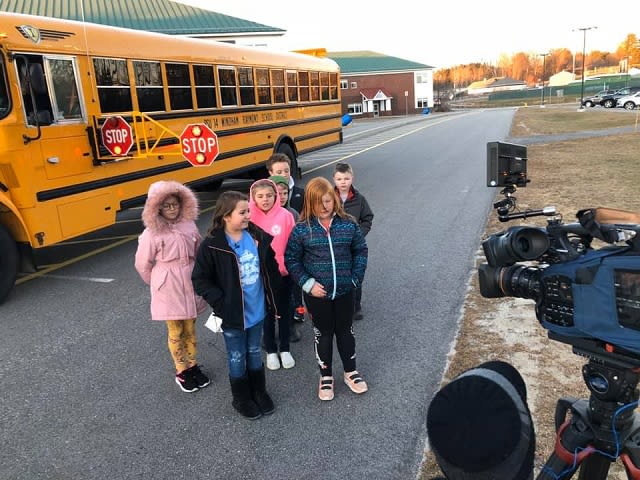
A group of RSU 14 Windham Raymond (Maine) Schools students, with support from school staff and community members, are working to raise nearly $33,000 to add 15 extended stop arms to buses on routes in their district with high numbers of illegal passing incidents. Photo courtesy Carrie Menard
4 min to read

A group of RSU 14 Windham Raymond (Maine) Schools students, with support from school staff and community members, are working to raise nearly $33,000 to add 15 extended stop arms to buses on routes in their district with high numbers of illegal passing incidents. Photo courtesy Carrie Menard
WINDHAM, Maine — A group of elementary school students, school officials and community members here are raising money to put extended stop arms on many of their district’s buses to deter stop-arm running.
The 7-and 8-year-olds, who attend Windham Primary School, which is part of the RSU 14 Windham Raymond Schools district, are working to raise nearly $33,000, WGME reports. The students have been collecting items from the community to put up for auction on Jan. 18 and plan to use funds for the cause, according to the newspaper.
Dr. Kyle Rhoads, the district’s principal, told School Bus Fleet that the team of seven students is working on the fundraising project as part of the Odyssey Angels program for Odyssey of the Mind, an international education organization that aims to provide students with creative problem-solving opportunities. The team’s two coaches, Carrie Menard and Lily Cooper, are helping, but the kids are doing most of the work, Rhoads added.
According to Operation: Stop Arm, a website created to gather donations for the cause, the students are aiming to fund 15 extended stop arms to be placed on buses that are on routes that experience the highest number of illegal passing incidents. The rest of the buses in the fleet will be equipped with the stop arms as money in the school budget becomes available for them.
A letter to community members from the “Operation Stop Arm Committee” intended to raise donations for the extended stop arms describes motorists illegally stopping for school buses as a “major problem” in Windham, and states that community organizations are collaborating to help with a solution.
Although 10 of the district’s buses would need a complete retrofit to accommodate the stop arms, most of the fleet’s buses already have camera systems on them and just need a $500 upgrade, according to the letter.
Several community organizations, along with the towns of Raymond and Windham, are also joining the students’ and district PTA’s efforts to raise the money, the letter stated.
The letter also points out that two new state laws that were passed last year intend to make it easier to catch stop-arm violators and deter the practice. Motorists caught on camera passing a stopped school bus can now be ticketed due to a law passed in June allowing the use of stop-arm and exterior cameras to catch stop-arm runners. Another new law permits school districts to “install a physical barrier that extends 6 feet off the bus into the adjacent lane,” according to the committee. However, since the laws went into effect after the school board passed the budget for the 2019-20 school year, money was not allocated for the extended stop arms in the budget.
The stop arms are being supplied by School Bus Solutions and are distributed by W.C. Cressey and Son Inc., Mike Kelly, the transportation director for RSU 14 Windham Raymond Schools, told SBF.
Donations for the extended stop arms that have been turned over to the district as of Tuesday total nearly $10,000, with the understanding that additional funds are forthcoming, Kelly said. Menard, one of the Odyssey Angels coaches, told SBF that with the funds that have come in so far, the district has been able to install extended stop arms on about three buses and four more have been ordered.
“The initiative by the Odyssey of the Mind team has directly supported the everyday safety of transporting the students of our district,” Kelly said. “This effort greatly assists us in making the motoring public aware of their legal obligations when approaching a stopped school bus and causes the driver to be more aware of surrounding traffic conditions."
Kelly added that he is grateful for the team’s efforts, and that it is “a tribute to what our youth can accomplish when working together.”
Rhoads agreed, adding the project is a good example of how the school values teamwork and creativity to not only enhance learning but improve the community as well.
“Odyssey of the Mind is an important part of our school’s support of these values,” Rhoads said. “This Odyssey of the Mind team has gone further than most teams by using creativity to improve the safety of all students. I am very proud of their efforts and commitment.”
More Safety

How to Build a Better School Bus Driver Training Program
Is it time to strengthen your driver training? Here’s how to pick the right talent and improve recruitment, retention, and safety. This video is brought to you by IC Bus.
Read More →
Recent School Bus Accidents Leave 2 Dead, 2 Injured
Four school bus crashes in Florida, Illinois, and Georgia highlight risks in transportation lots, at bus stops, and during student loading and unloading.
Read More →
Sponsored•September 8, 2026
When Every Second Matters, Clarity Keeps Routes Moving
From routine delays to urgent incidents, strong communication practices help drivers, dispatchers, schools, and families respond with confidence.
Read More →

What Happens When a School Bus Catches Fire — and What Can Help
School bus fires are rare but can be devastating. Learn how advances in fire suppression and asset protection help fleets detect fires earlier, reduce damage, and improve safety.
Read More →
Geotab Launches Tool to Help Fleets Investigate Road Incidents
Geotab Investigations combines telematics data, video, documents, and other evidence to help fleets reconstruct incidents, resolve claims, and determine what happened.
Read More →
Texas Sixth Grader Wins 2026 National School Bus Safety Poster Contest
Sai Darshana Yekolu of Moseley Middle School in Prosper, Texas, was named the newest winner for her artwork, bringing the theme of “Safe Rides, Everyday Heroes” to life.
Read More →
Sponsored•August 27, 2026
Doing More With Less: How Transportation Directors Can Prioritize Safety Amid Budget Uncertainty
With diesel prices soaring and nearly one-third of transportation directors expecting budget cuts, maintaining student safety has never been more challenging. Download this guide to learn how leading districts are prioritizing risk, funding critical safety technology, and building stronger budget cases with data.
Read More →
Walton County Schools Adds Gatekeeper Stop-Arm Enforcement System
The Florida district will deploy Gatekeeper’s updated Student Protector technology, which now incorporates AI to improve video evidence.
Read More →
How To Build a More Secure School Bus Yard During and After Hours
As thefts and overnight security threats continue, school transportation leaders are combining stronger operational practices with AI-enabled surveillance to better protect buses, facilities, and staff.
Read More →
FMCSA Names New Chief Safety Officer: What School Bus Operators Should Know
Steve Dowling is set to lead the federal agency's efforts to advance commercial motor vehicle safety and reduce crashes, fatalities, and injuries on the nation's roadways.
Read More →