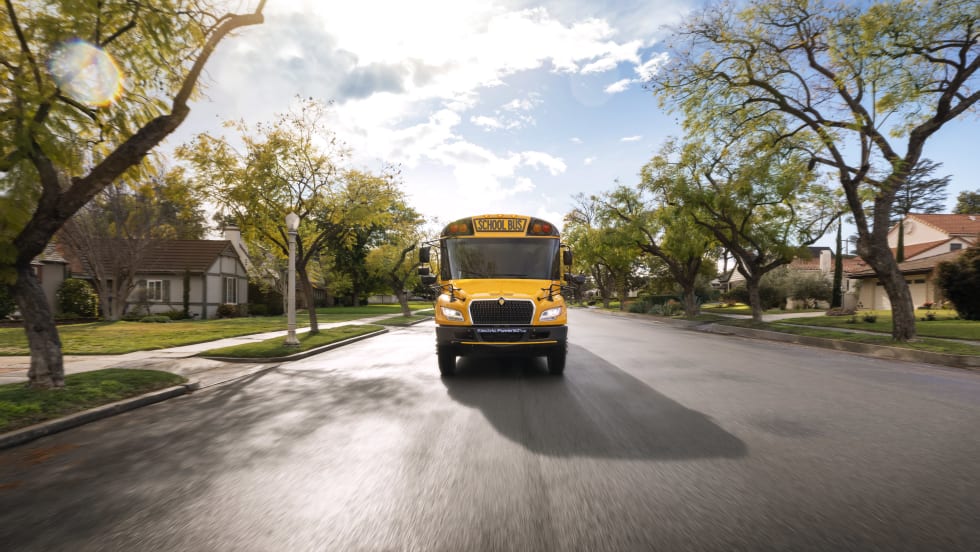
As school districts face growing budgetary concerns, fleet operators are cutting costs by using green technology and implementing eco-friendly policies.
by Brittany-Marie Swanson
June 7, 2011Creating a “green” fleet can be both challenging and rewarding, especially when school districts around the country are facing serious budget constraints.
SCHOOL BUS FLEET spoke with transportation officials at three districts to find out how utilizing green technology and practices is benefi ting their department.
Alternative fuel costs less, is cleaner
For Clay Community Schools in Brazil, Ind., Napa (Calif.) Valley Unified School District (USD) and Brevard Public Schools in Cocoa, Fla., alternative fuel is an important part of bus operation.
“We use biodiesel to run a cleaner fuel, and it’s better for the environment,” says Frank Misner, director of transportation for Clay Community Schools. All of the department’s 75 buses use 2 percent biodiesel, which can be used in diesel-run vehicles with no or only minor modifications to the engines.
The fuel, he adds, “helps cut down on overall pollution … and costs.”
Cutting expenditures on fuel is especially important as prices continue to soar.
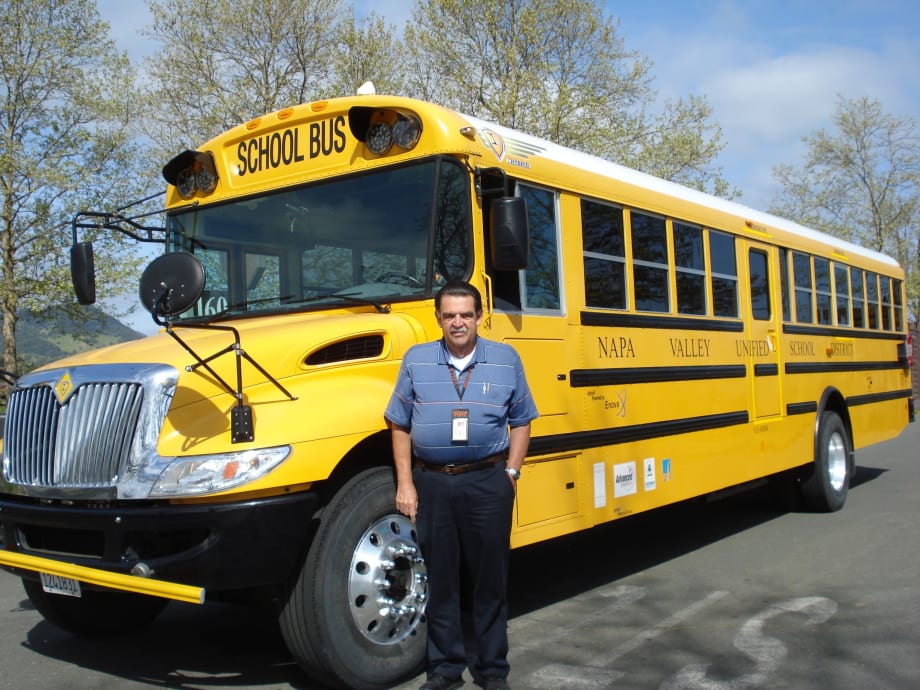
“When [fuel prices rose] a few years ago, my diesel price got up to close to $5.40 a gallon, and at that time I was paying $2.40 a gallon for natural gas,” explains Ralph Knight, director of transportation for Napa Valley USD. The department, according to Knight, no longer uses diesel-powered buses — although the staff keeps a few on hand in case they’re needed.
“Having as many buses as we do running on natural gas, that’s a big savings,” he says. “That’s 50 percent that I saved in fuel costs right there, just during that time frame. Now we’re facing that again.”
In addition to its compressed natural gas buses, Napa Valley runs a hybrid bus and a wheelchair lift-equipped hybrid bus. Knight says the department has applied for a grant and hopes to replace its spare buses with alternative-fuel vehicles as well.
For Brevard Public Schools’ transportation department, selecting fuel is all about cost savings.
“What we do is we compare the price [of biodiesel] with ultra low sulfur diesel, and as long as biodiesel is equal to or less than the price of ultra low sulfur diesel, we will buy it. But once regular diesel [costs less than] biodiesel, we revert back to regular diesel,” explains Mike Connors, director of transportation for the district.
Switching between different fuels, he says, is not a problem. “I can confirm that despite going from one fuel to another, we’ve experienced no significant engine problems,” Connors says.
District green initiatives can alleviate budget constraints
For many, the implementation of green fleet practices is linked to budgetary concerns.
In fact, the most important reason to concentrate on green transportation initiatives, according to Knight, is cost. “We’re all trying to survive out here. [With budget cuts], transportation departments are usually the first to get hit,” he says.
“We know that we are looking at some severe budget cuts for next school year, but we’re going forward to replace these old school buses that we’ve got sitting around out here. And I think the more we just get rid of the old equipment, the better gas mileage we get — it’s going to save us money,” Knight continues.
Misner agrees — Clay Community Schools is focused on eco-friendly bus operation primarily to meet its budget requirements.
In addition, he says, any policy changes in the transportation department “would have to be cost-driven. We are strapped for money, just like everyone else. Any [changes we make] would have to be less expensive” than current practices, he explains.
For Connors, cutting costs in transportation is a great way to help the district as a whole.
“In transportation, we’re doing our best to be as efficient with the dollar as possible, and every dollar we save is a dollar that can go back to the classroom,” he explains.
Our transportation staff “knows that the more we do to protect the dollars we spend by being economically efficient means the more secure they are in their jobs. In other words, we’d rather do the right thing policy-wise and save money with our operations than revert to layoffs or reduction of forces,” Connors adds.
However, budget cuts have forced Brevard Public Schools to hold off on expanding its green initiatives.
“If we were to convert to another type of eco-friendly system, be it ethanol or electric buses — it would take a very, very signifi cant investment. Right now, school districts in Florida are economically strapped. We’re struggling to find money to buy new school buses, so there’s no way we can start using resources for a greener-type operation. We just cannot afford it at this point,” Connors says.
[PAGEBREAK]
Implementing green policies can help
Clay Community Schools enforces a 15-minute maximum on bus idling, according to Misner. Policies like this can help reduce emissions and fuel-related expenditures.
“In the state of Florida, we’re mandated to have an antiidling policy,” says Connors, whose department instructs drivers to turn off their engines when they arrive at school, and leave them off until they are ready to depart. “We ask for support from school staff members to help us enforce it, and it’s been very effective.”
Drivers who operate buses for students with special needs — such as buses with wheelchair lifts — are exempt from this policy.
“Another exception is if they’re dealing with exceptional education students that have environmental issues,” Connors continues. “In other words, they have to have a cool, air-conditioned bus. That bus would be allowed to idle. But we allow them no more than five minutes’ warm-up time in the morning when they do their pre-trip inspection.”
While Napa Valley does not enforce any “green” policies, drivers for the district take the initiative to go green anyway.
“Our drivers who are driving the natural gas buses compete to see who’s getting the best miles per gallon,” Knight says. “I think that the competition to be greener will move to the office staff once we see solar power coming into the office and things of that sort.”
Napa plans to go solar
Knight’s department is looking to use solar panels to help run its office and buses.
“We’re going to look really hard into solar charging … and we’re going to test it on our plug-in hybrid bus,” he says. “We think that with the solar charging we can keep [the hybrid bus] off the grid entirely during the day.”
The department also recently demolished its outdated facility that was built in the 1930s. Now, transportation personnel work out of a portable classroom.
Since moving into the portable classroom “our heat and cooling efficiency has improved 300 percent,” Knight says.
“We’re also going to put some solar panels onto our office. We think it’s a two-phase thing,” he adds. “We want to build a solar panel big enough that it will take care of the hybrid bus charging during the day, plus also take care of what we’re using during the day in our office.”