




Zum Seeks to Use Electric School Buses as Virtual Power Plant Resources
Student transportation company Zum is partnering with AutoGrid, a provider of AI-powered energy software solutions, to use its fleet of 10,000 electric school buses to deliver power back to the electrical grid.

Student transportation company Zum is partnering with AutoGrid, a provider of AI-powered energy software solutions, to use its fleet of 10,000 electric school buses to deliver power back to the electrical grid.
Photo courtesy Zum
Student transportation company Zum has partnered with AutoGrid, a provider of AI-powered energy software solutions, to use electric school buses as virtual power plant resources.
The partnership will leverage AutoGrid's Virtual Power Plant (VPP) technology platform to deploy 10,000 electric school buses managed by Zum in the next four years to create over one gigawatt of flexible capacity — the equivalent of powering more than one million homes for one to four hours — when the electricity grid is overloaded, according to a news release from Zum. When fully deployed, this is expected to be one of the largest VPPs in the world, according to the company.
"School buses have predictable daily schedules and are typically used only a few hours each day, making them an ideal resource as part of a virtual power plant,” said Rahul Kar, general manager of new energy at AutoGrid. “Virtual power plants play a crucial role in providing stability to a renewable-powered grid and the extra revenues from these grid services enable school districts and electric vehicle fleet owners to reduce the total cost of ownership as they strive to meet their sustainability goals.”
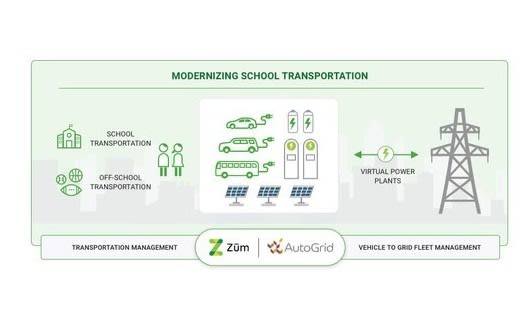
The partnership will leverage AutoGrid's Virtual Power Plant technology platform to deploy 10,000 electric school buses managed by Zum in the next four years to create over one gigawatt of flexible capacity.
Graphic courtesy Zum
Zum currently works with more than 4,000 schools and school districts to offer optimized transportation routes and best-sized vehicles including buses, cars, and vans to help reduce costs, maximize route coverage, and address vehicle underutilization, according to the company.
"We're committed to making it easy for districts to evolve their fleets to 100% electric through a powerful combination of technology and innovation,” said Vivek Garg, president and chief operating officer at Zum. “Beyond that, we are taking vehicles that have traditionally spent the majority of their lifetime stalled or parked and expanding their use in multiple ways — from leveraging them for trips beyond home-to-school routes to optimizing the electric grid.”
With over 5,000 megawatts of assets under contract, AutoGrid has experience managing distributed energy resources in 12 countries.
According to Zum, utilizing the sizable batteries of electric school buses for distributed energy storage and grid services has the potential to make a significant contribution to cleaning up the electricity grid in North America.
Additionally, the electric grid services revenues available through VPP programs reportedly not only help lower the cost of energy for school districts, they also help lower the overall cost of operating the grid by avoiding and deferring expensive infrastructure upgrades and reducing the need to purchase cost-prohibitive peak power, according to Zum.
More Alternative Fuels

CALSTART and Forth Combine to Form Catalyst Mobility
The new name represents a renewed vision for the nonprofit focused on advancing clean, equitable, and affordable transportation solutions that move people and goods.
Read More →
Alt-Fuel Moves: New Buses, Charging Hubs & Real-World EV Testing
Propane and electric school bus deployments continue to grow as districts add new vehicles, expand charging infrastructure, and gather more real-world operating data.
Read More →
Fewer Electric School Bus Models Reshape the U.S. Market
WRI’s latest buyer’s guide points to a consolidating electric school bus market, but fewer options may reflect a maturing industry rather than fewer meaningful choices for school bus operators.
Read More →
The Fuel Budget You Can Actually Predict: How Propane Autogas Keeps Money in the Classroom
Learn how propane autogas helps school districts manage fuel costs with predictable pricing, lower maintenance, and reduced emissions from former transportation director Joel Stutheit.
Read More →
Hendrickson, Driventic Introduce New Electric Powertrain for School Buses
ELECTRAAX, the electrified, lightweight drive axle offers integrated ePowertrain efficiency and modular flexibility for Class 6–7 school bus use.
Read More →
The Mobility House Joins PowerFlex in Fleet Electrification Deal
The acquisition combines intelligent charging software, bidirectional charging expertise, and fleet electrification services to support the growing adoption of electric school buses across North America.
Read More →
Alt-Fuel Moves: Electric School Bus Investments Hit the Road
See which districts across the U.S. are putting electric school buses into service, expanding charging infrastructure, and planning the next phase of fleet electrification.
Read More →
With Fuel Volatility Ahead, School Districts Turn to Propane
While diesel prices peaked above $5 this spring, districts with propane autogas-powered fleets paid under $2 per gallon, according to PERC.
Read More →
EPA Unveils Proposed Changes to 2027 Heavy-Duty Engine Rules
The federal agency has proposed changes to next year’s targets that would eliminate DEF derates, ease warranty requirements, and retain current NOx emissions standards.
Read More →
Alt-Fuel Moves: EV Charging & Infrastructure Projects Gain Momentum
The latest developments include new funding, charging infrastructure, utility investments, and fleet technologies designed to support the transition to electric school buses nationwide.
Read More →