




Transportation department is key in tsunami evacuation
After the devastating tsunami hit Japan in March, the West Coast of the U.S. braced for impact. The director of transportation and a driver from a California district share details with SBF on their department's role in evacuating local residents before the surges hit.

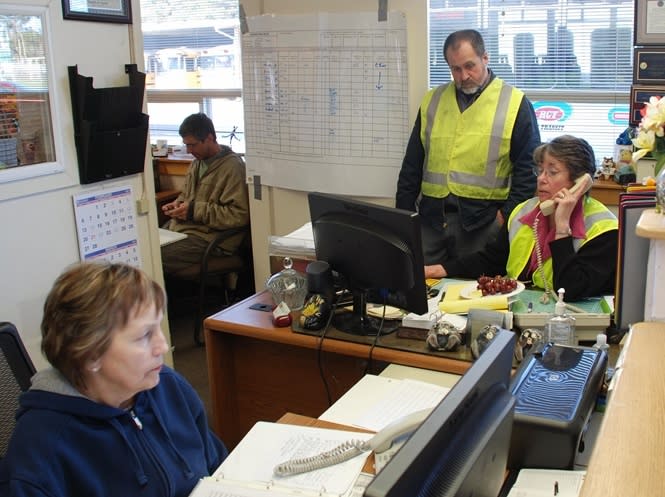
The Del Norte district's transportation office was the incident command center for evacuating residents before a tsunami hit. Pictured are (clockwise from top) lead mechanic Jess Bigham, driver instructor Carlina Horn, dispatcher Ellen Lemrise and Gary Gleason, vice president of NUSURA, who had been working with the district in training and planning for evacuations.
CRESCENT CITY, Calif. — After the devastating 9.0 earthquake and tsunami hit Japan on March 11, the West Coast of the U.S. was on alert for a possible tsunami headed its way.
In Crescent City, on the Northern California coast near the Oregon border, the transportation department at Del Norte County Unified School District had been training for just such an emergency.
Evacuations orders were put in place for the Crescent City fishing harbor and other low-lying areas, and the Del Norte district's transportation staff, office and buses were key players in getting residents to safe ground.
The district joined forces with Redwood Coast Transit and Coastline Transit for the evacuation, with the district's transportation office serving as the incident command (IC) center. In all, there were 21 buses on the road — nine of the district's school buses, nine of Redwood Coast Transit's buses and three of Coastline Transit's buses.
Residents in the tsunami inundation areas were picked up in buses in the early morning hours, with the drivers being told to get out by 6:30 a.m. The buses evacuated about 300 people, mostly door-to-door but also from pickup points around the county.
The tsunami surges that hit Crescent City that morning didn't come up as far as expected. But the eight-foot waves battered the harbor.
"It was a big one," Pat Jensen, the Del Norte district's director of transportation, told SBF in an interview. "We were really lucky that it didn't come up more than the harbor."
[IMAGE]381[/IMAGE]
The tsunami surges caused an estimated $5 million in damage in the harbor. About 16 boats were sunk.
"I was in the IC center, and you could see the water suck out of the harbor," Jensen said. "You could see the boats on the ground, and then the surge came in."
The event brought back memories of a more-powerful 1964 tsunami that came up into the downtown area of Crescent City and destroyed buildings.
"They were warning that this one was going to be like that," Jensen noted. Although it wasn't of that magnitude, the district and other agencies were prepared.
Read on for a report from George Layton, one of the district's school bus drivers, on his experience in the evacuation.
Evacuation report: "We had been training for this moment"
By George Layton
The phone rang about, or maybe a little before, 3 in the morning. When I answered it, a voice said, “This is not a drill! This is not a drill! This is not a drill! There has been a large earthquake in Japan, and we are on alert. You don’t have to report right now, but be prepared.” The voice was Carlena Horn, our school bus trainer, dispatcher and second in command at the DNCUSD (Del Norte County Unified School District) transportation compound.
I got up and headed for the shower. I had just gotten out when the phone rang again. It was Carlina again, this time telling me we had been activated. I got dressed, made sure the dog had food and water, tossed a change of clothes into a bag and called my wife, who was out of town, and told her what was happening, then headed to work.
Fortunately, we had been training for this moment for a few years, with some FEMA management training, some information on knowing the tsunami inundation zones, knowledge of the evacuation sites and which roads and highways were in and out of the inundation zones, and the knowledge that we would be working with a couple of other transportation agencies.
This was, however, the real thing, with real evacuations and a tsunami of unknown proportions. Thank goodness for that advance training!
I got to work and checked in. About half the drivers were already there. I was given the keys to a van and told to take the RCT (Redwood Coast Transit) drivers to their bus parking area. A bunch of folks climbed into the van, and we went to get the buses.
They brought the RCT buses to our school district bus compound because the school district site is the command center for all transportation in an emergency situation, and RTC's parking area was on the edge of the possible inundation zone.
Our director of transportation, Pat Jensen, had reported to the incident command center at about 1:30 a.m. She was in radio contact with our dispatch leaders. Handling the direct dispatching of the drivers were Carlina Horn for the school district drivers, Jody McNamera for the RCT drivers, and Diane Dickey for the Coastline drivers.
The RTC has a policy of fueling every day after the shift, but our district policy was to fuel whenever the tank got to the halfway point. A group of us got busy and fueled the school buses that were near the half mark.
We didn’t know when we would have another chance, or how long we would be on duty, or much of anything at that time, except that we were ready.
We were finishing the fueling when we started getting dispatched. It was about 3:30 or 4 a.m. by then. The buses were sent to the downtown areas, to several housing units and to other low-lying areas. We had 18 school buses, 11 RCT buses and five Coastline buses either on the streets or ready to roll throughout the county.
All were evacuated, and we were told to get out of the tsunami inundation areas at about 6:30 a.m. Then we waited, and waited.
We moved from the small confines of the district transportation office to a much larger space in the school district administration area. The dispatchers kept vigil in the office and had several runners to keep the rest of us up to date, or to dispatch us if necessary.
Coffee and food were finally brought to us along with some cots, blankets and pillows. I think it was the cots that really confirmed that we could be there for a long time. We listened to the local radio station as the first surges came and went.
About 10 a.m., it was decided to let about half of us go home and get some rest. Ha! Who could sleep? But rest we did — at least I did. I finally had time to call my wife and let her know what was happening. Her place of employment was in the heart of the evacuation zone, and she was headed home.
Those of us who had been sent home got a call later to hang tight for a while longer. The call to come back came in the early evening. We were to return the evacuees — at least most of them. There were some who lived next to the harbor area, and they had to stay and sleep at the evacuation center at our local high school if they had nowhere else to go.
We were dispatched to the high school in the evening, and we took all who were able back to their homes.
Although the mass destruction the area had experienced some decades earlier did not happen this time, we were much more prepared for it. The three transportation agencies working together did so seamlessly. We all knew that whoever the dispatcher in charge was — whether it was Jody, Carlina or Diane (they worked in shifts throughout the day) — we simply did what was asked without any question of who was in charge.
We know that when — not if — the next disaster happens, we can function seamlessly as a single unit again, if we continue to train and practice.
It is a well-known fact that some of us will move on or will retire as we grow older, and newer drivers will take our places. It is imperative, in my opinion, that the community and agencies involved continue to fund the necessary training for the transportation and evacuation of any and all disasters, be they tsunamis, earthquakes, floods or any other unforeseen event in or around our county.
More Management

Meet the 2025 School Bus Driver Hero Winner: Annette Brown
We caught up with Wa-Nee Community Schools' Annette Brown on site at SBFX, where she was named the 2026 School Bus Driver Hero Award winner. Hear about her reaction, what she loves most about being a school bus driver, and more!
Read More →
Predictability Is Like Ketchup (According to 6-Year-Olds)
To students, a different school bus can feel like a full-blown crisis. One driver reflects on why familiar routines, showing up on time, and being reliably boring matter more than we think.
Read More →
Samsara Launches Free Driver Rewards Program
The new Driver Perks program gives eligible professional drivers access to discounts and offers without adding a cost for participating fleets.
Read More →

How Tax-Exempt Municipal Leases Can Help Finance School Buses
Let’s explore school bus financing options, including municipal leases, vendor payable accounts, and balloon payments, and how they can help stretch fleet budgets.
Read More →
Nominate Rising School Transportation Pros Under 40!
We’re searching for the next generation of leaders making an impact across the K-12 student transportation industry to recognize as SBF’s 2027 Trailblazers. Nominations are open now!
Read More →
Changing Lanes: BusWhere, EverDriven, InterMotive, Summit School Services, Switzer-Carty & Thomas Built Buses
Check out who's been hired, promoted, and appointed to leadership positions at various school transportation suppliers, contractors, and manufacturers.
Read More →
The Most Expensive Thing You Do Before Selling a School Bus: Wait
When should you sell an aging school bus? Learn how maintenance, mileage, corrosion, specifications, and timing can affect resale value long before the auction.
Read More →
American Student Transportation Partners Acquires AJ Myers and Sons
A new deal brings a 75-year Pennsylvania student transportation provider into one of the nation’s largest private school bus contracting groups.
Read More →
What I Brought Home From SBFX: Relationships, Leadership, and Preparing What's Next
Who could lead your transportation operation tomorrow if you couldn't? Bernando Brown explores succession planning, mentorship, and preparing emerging leaders to step up.
Read More →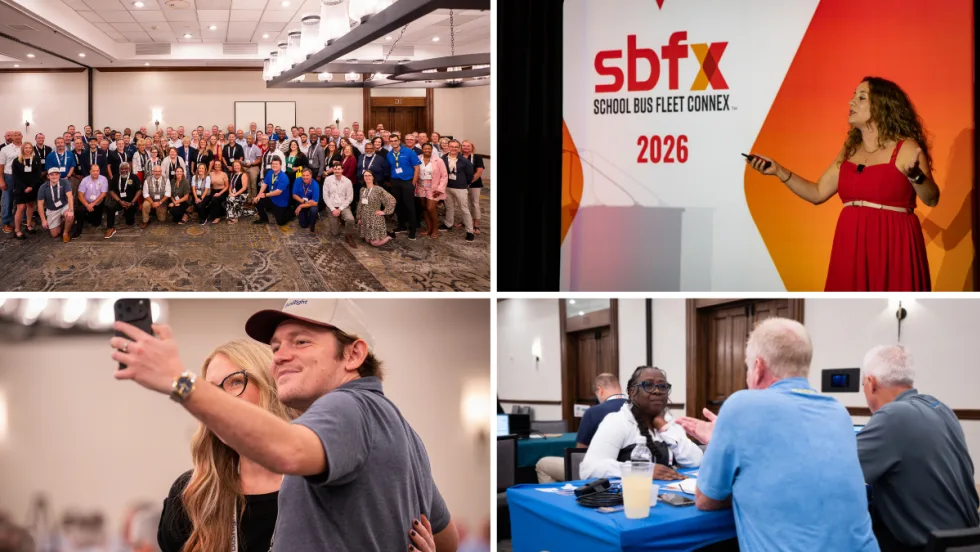
Inside School Bus Fleet ConneX 2026: Industry Leaders Connect in Scottsdale [Photos]
See highlights from SBFX 2026 in Arizona, where school bus operators and suppliers gathered for meetings, education, networking, awards, and more.
Read More →