





Looking for the Next Round of Trailblazing School Transportation Leaders
September 2023: Fleet Fuel Price Trends [Updated 09/27]
The average price for gasoline and diesel fuel dropped during the past week across the United States, but how likely is that trend to continue?
September 27, 2023
![September 2023: Fleet Fuel Price Trends [Updated 09/27]](https://assets.bobitstudios.com/image/upload/f_auto,q_auto,dpr_auto,c_limit,w_920/20230925-sbfdiesel-fuel-prices_1768118629719_wjx1mn.png)
The cost of diesel fell on average across the United States.
Image: Canva/EIA
5 min to read
Fuel prices appeared to cool like the coming of autumn after weeks of increases, with the average cost of gasoline falling to about $3.84 at the pump, while diesel fell almost a nickel to $4.59, according to the U.S. Energy Information Administration.
Here are the latest diesel fuel and gasoline statistics:
U.S. Regional Diesel Fuel Prices as of Sept. 18, 2023
East Coast: $4.52
Midwest: $4.44
Gulf Coast: $4.28
Rocky Mountain: $4.80
West Coast: $5.69
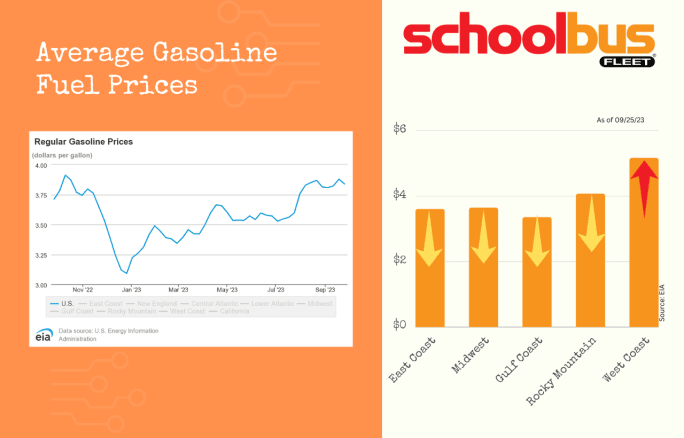
Average gasoline prices fell in most regions except for the West Coast.
Image: Canva/EIA
U.S. Regional Gasoline Prices as of Sept. 25, 2023
East Coast: $3.60
Midwest: $3.64
Gulf Coast: $3.35
Rocky Mountain: $4.00
West Coast: $5.26
“It’s been a mostly quiet week for the national average price of gasoline, with most states seeing gas prices cool off. But new and continued refinery issues in some regions have had an oversized effect on gas prices in some states, especially in Southern California, Arizona, and Nevada,” said Patrick De Haan, head of petroleum analysis at GasBuddy. “While most states are likely to continue seeing gasoline prices fall in the week ahead, any new refinery issues as others begin maintenance could be problematic. For diesel prices, however, the opposite is playing out, with prices that continue to rise as demand for diesel strengthens. Overall, the largest issues impacting gas prices remain refinery disruptions, but also the price of oil, which has held around $90 per barrel as Saudi Arabia and Russia maintain significant production cuts.”
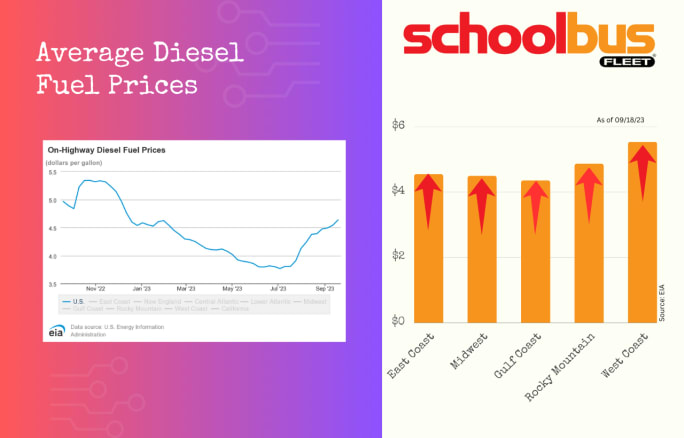
The average cost of diesel, although still down compared to last year, rose by about 9 cents across the United States.
Image: Canva/EIA
Gasoline is now 22 cents more expensive than it was this time last year on average, according to the U.S. Energy Information Administration. Diesel climbed more than 9 cents per gallon during the past week, but remains 33 cents lower than it was in 2022.
Here are the latest diesel fuel and gasoline statistics:
U.S. Regional Diesel Fuel Prices as of Sept. 18, 2023
East Coast: $4.54
Midwest: $4.49
Gulf Coast: $4.35
Rocky Mountain: $4.86
West Coast: $5.69
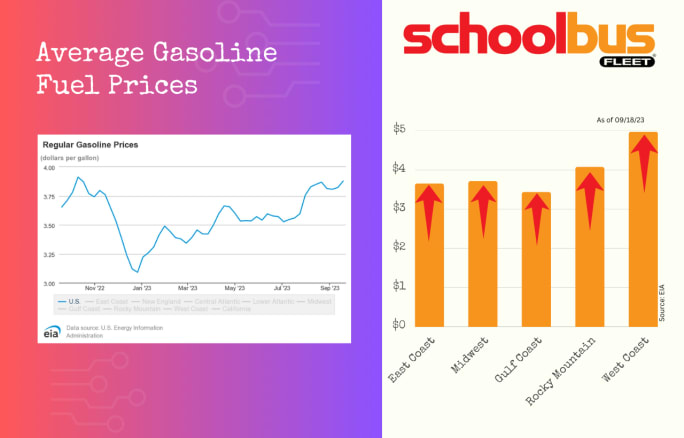
Gasoline rose by more than 5 cents on average across the United States, and is now 22 cents higher than it was this time in 2022.
Image: Canva/EIA
U.S. Regional Gasoline Prices as of Sept. 18, 2023
East Coast: $3.65
Midwest: $3.71
Gulf Coast: $3.43
Rocky Mountain: $4.07
West Coast: $5.16
Gas price increases during the past week are attributable to ongoing refinery challenges in the western United States, according to Patrick De Haan, head of petroleum analysis at GasBuddy:
“With the transition back to cheaper winter gasoline now upon us in nearly every state, we should see prices eventually cooling back off. But if refinery issues continue to develop or linger, especially now that we’re entering maintenance season with less available capacity online, the expected decline could certainly be offset. In addition, with oil prices now above $91 for the first time in nearly a year, there remains some offset from the rising price of oil thanks to Saudi Arabia and Russia’s war on low oil prices, now in its third month.”
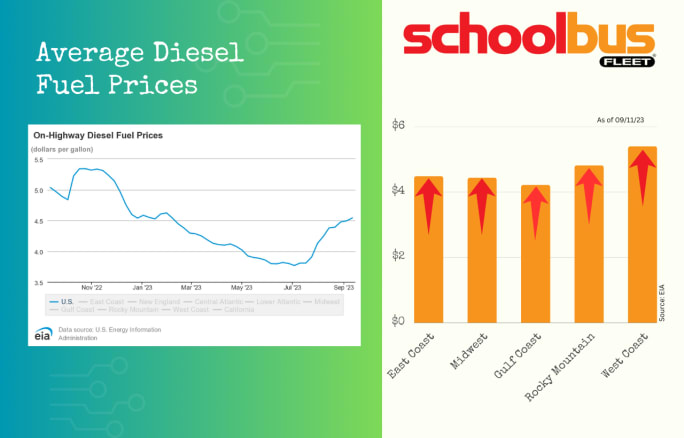
On average, diesel prices rose about a nickel across the United States.
Image: Canva/EIA
On average, gasoline and diesel prices continued to climb across the United States, according to the U.S. Energy Information Administration.
Here are the latest diesel fuel and gasoline statistics:
U.S. Regional Diesel Fuel Prices as of Sept. 11, 2023
East Coast: $4.48
Midwest: $4.43
Gulf Coast: $4.21
Rocky Mountain: $4.81
West Coast: $5.53
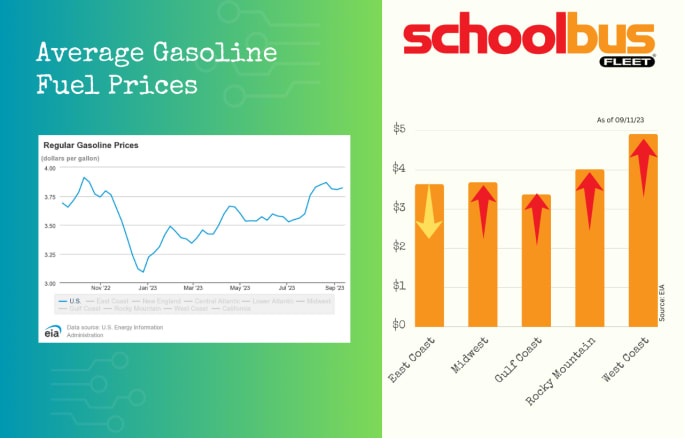
Gasoline was down in price along the East Coast, but rose in the Midwest, Gulf Coast, Rocky Mountain, and West Coast regions.
Image: Canva/EIA
U.S. Regional Gasoline Prices as of Sept. 11, 2023
East Coast: $3.63
Midwest: $3.68
Gulf Coast: $3.37
Rocky Mountain: $4.01
West Coast: $4.97
“The national average hit some road bumps over the last week after starting to decline early in the week. The second half saw the national average rise as gas prices in the Corn Belt started spiking, pulling the average price in the US along with it,” said Patrick De Haan, head of petroleum analysis at GasBuddy. “In addition, the West Coast saw more refinery snags, pushing gas prices higher, and so areas of the West Coast got punched along with the Corn Belt states. Over 10 states saw prices rise by over 10 cents per gallon compared to last week, while some like Iowa and Minnesota have seen average prices spike by over 30 cents per gallon. There is some good news for those in the hardest hit states in the Midwest, however, as gasoline prices should start to level off and even decline by mid-week."
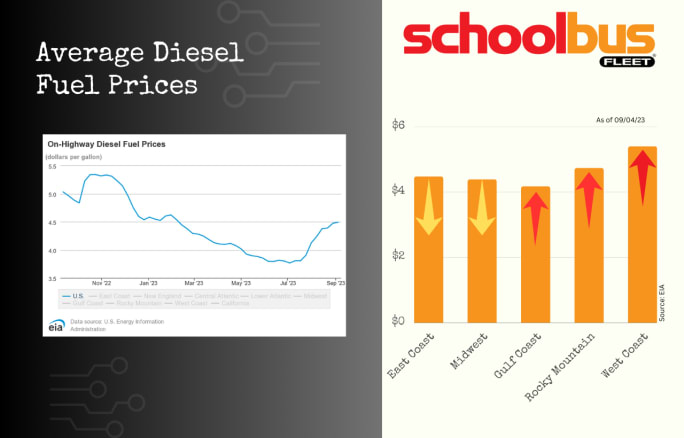
Diesel prices rose about 2 cents on average across the United States.
Image: Canva/EIA
The month of September started mixed for school bus fleet fuel prices across the United States, with gasoline down slightly and diesel creeping upward just a bit on average, according to the U.S. Energy Information Administration. Gasoline prices increased in the Rocky Mountain and West Coast regions, while diesel saw mild decreases along the East Coast and in the Midwest.
Here are the latest gasoline and diesel fuel statistics:
U.S. Regional Diesel Fuel Prices as of Sept. 4, 2023
East Coast: $4.47
Midwest: $4.38
Gulf Coast: $4.17
Rocky Mountain: $4.73
West Coast: $5.39
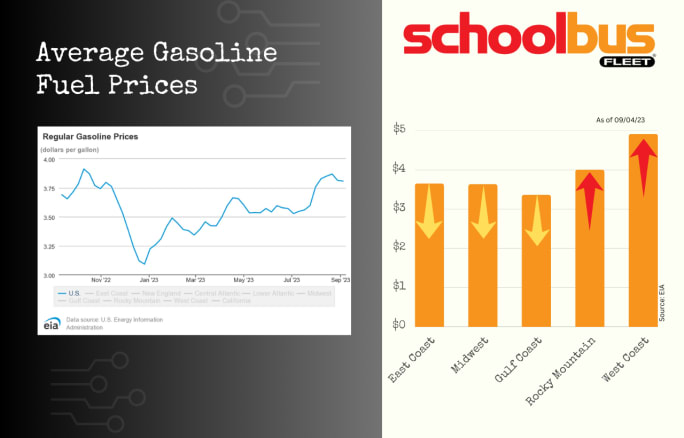
On average, the price of gasoline fell less than a penny. It actually went up in the Rocky Mountain and West Coast regions.
Image: Canva/EIA
U.S. Regional Gasoline Prices as of Sept. 4, 2023
East Coast: $3.65
Midwest: $3.63
Gulf Coast: $3.36
Rocky Mountain: $4.00
West Coast: $4.91
The slight relief may be due to the fact Hurricane Idalia didn't inflict any damage on vital energy infrastructure. Wrote Patrick De Haan, head of petroleum analysis at GasBuddy:
"Hurricane Idalia steered well clear of significant energy infrastructure, leading to zero impact on gas prices. With the switch back to winter gasoline less than two weeks away, we could eventually see more downward pressure on gas prices. However, any disturbances that threaten the Gulf could delay any decline between now and then, creating a bit of a bumpy ride for the next week or two before more relief arrives toward late September.”
More Maintenance
Sponsored•September 8, 2026
The Essential Guide to School Bus Maintenance and Student Safety
Your district's buses carry students to school every day. This guide shows how predictive maintenance powered by fleet data helps keep buses reliable, drivers accountable and students safer from the first bell to the last stop.
Read More →
Kerry Brothers Grows Michigan School Bus Repair Network
The acquisition of Downriver Truck and Bus expands Kerry Brothers’ school bus maintenance footprint across southeast Michigan, adding repair capacity, diagnostic resources, and state inspection support.
Read More →
Noregon Introduces CAN Bus Diagnostic Tool, Expands JPRO Features
CAN Mentor and the latest JPRO update aim to simplify vehicle network diagnostics and improve repair efficiency for technicians of all experience levels.
Read More →
Cummins on Smarter, Simpler Engine Innovation
Cummins discusses its first-ever gasoline engine for school buses, EPA 2027, and why bus fleets still want durable, simpler internal combustion options.
Read More →
Report: 72% of Diesel School Buses Now Use Advanced Low-Emission Engines
New data shows advanced low-emission diesel technology continues expanding across school bus fleets, even as electric bus adoption gains momentum.
Read More →
Vampire Tools' CAIMAN 7.5-Inch Multi-Purpose Screw Extractor Long-Nose Pliers with Crimper
Vampire Tools introduced the VAMPLIERS Caiman 7.5-inch multi-purpose pliers, combining screw extraction, cutting, crimping, and gripping functions into a single tool designed for fleet maintenance professionals.
Read More →
How Advanced Diagnostics Helps Bus Fleets Stay Ahead of Repairs
Chat with Noregon’s Kevin Smallhorn at ACT Expo about bus diagnostic tools, telematics integration, CNG maintenance support, and strategies to help reduce downtime and improve uptime.
Read More →
How School Bus Fleets are Getting Ahead of Breakdowns
Don’t let bus downtime wear you down. Here’s how bus operators are shifting from manual processes to AI-powered, data-driven maintenance systems for improved reliability and safety.
Read More →
Pennsylvania School Bus Maintenance Team Praised for Dedication to Safety
Matthews Bus Company’s West Jefferson received a letter of commendation from the Pennsylvania State Police for their fleet inspections.
Read More →
Sponsored•April 16, 2026
From Chaos to Clarity: How School Districts Are Running Leaner Transportation Operations
Covering 38 routes on a Friday afternoon. Buses idling while routes overlap. Parents calling nonstop about late arrivals. Sound familiar? This whitepaper explores how district transportation leaders solved these exact problems — and what measurable results followed.
Read More →