





Did You See? How to Find Funding for Alt-Fuel School Buses
Propane Key Solution in Latest Clean School Bus Funding Round
With dedicated propane autogas school buses or propane-powered recharging infrastructure, reliable solutions are available today
May 22, 2023
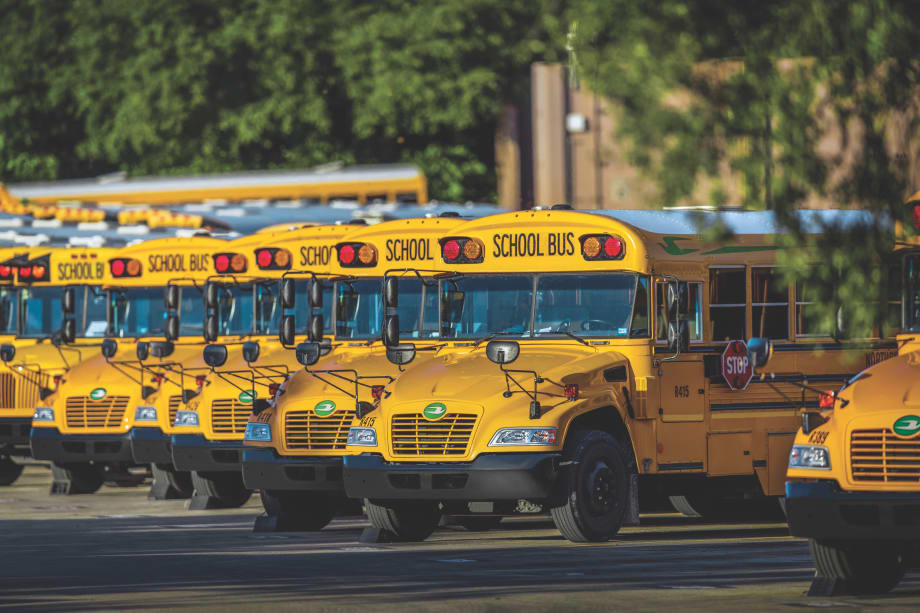
For every propane bus purchased through the Clean School Bus Program's second round of funding, approved districts receive up to $35,000.
Photo: PERC
2 min to read
In the latest round of Clean School Bus funding announced by the Environmental Protection Agency (EPA), school transportation directors once again have the power to take advantage of propane’s benefits through dedicated propane autogas school buses or propane-powered recharging infrastructure.
For every propane autogas bus purchased through the program, the EPA will provide transportation directors with up to $35,000. The program prioritizes high-need local educational agencies, rural, and tribal school districts. As an affordable, portable, and available energy source, propane is an ideal solution for these prioritized categories.
“Every child deserves to have a safe, clean, healthy ride to school. If we keep pouring money only into expensive electric buses—even with rebates or grants—only a select number of students will be able to see that reality. We need to face facts that it will take a mix of energy sources to achieve that goal,” said Steve Whaley, director of autogas business development with the Propane Education & Research Council.
In 2022, the EPA solicited applications for $1 billion for zero-emission and low-emission school bus rebates. The $1 billion from this first round of funding paid for 2,350 electric school buses. The funding also awarded 109 low-emission propane buses. The same amount of money distributed for electric buses could have helped fund as many as 29,000 propane buses, assuming each bus received the $30,000 incentive from the program.
When considering well-to-wheel emissions, the 2,350 diesel buses the grant replaced with electric will reduce nitrogen oxide (NOx) emissions by just 665 metric tons per year and carbon dioxide emissions by only 36,870 metric tons. If the funds had gone toward the 29,000 propane buses to replace diesel, it would have reduced nearly 10 times the amount of NOx emissions and three times the amount of carbon dioxide emissions.
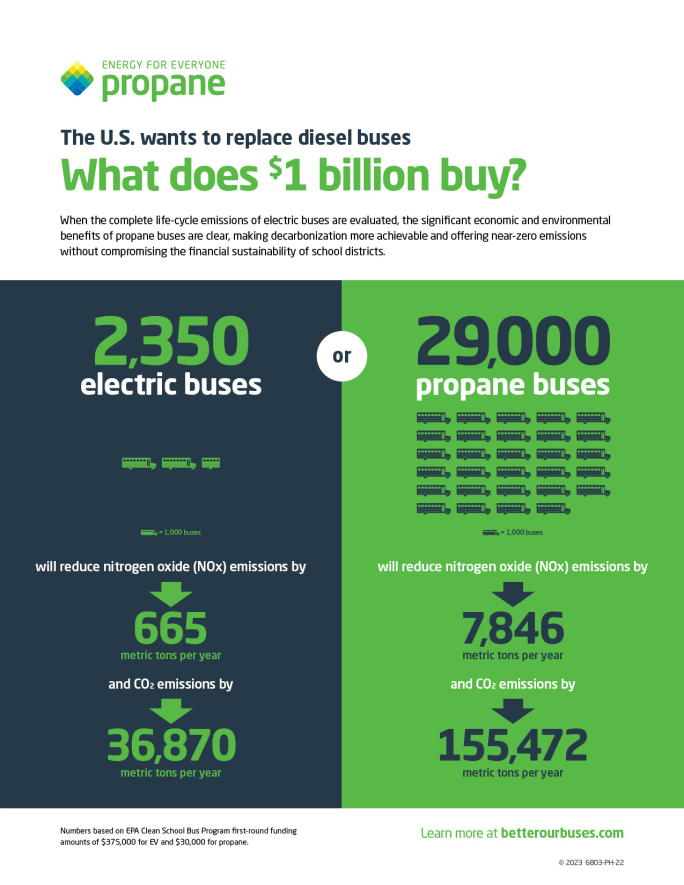
PERC touts the economic and environmental benefits of propane buses.
Image: PERC
“The true energy mix lies somewhere between all propane autogas or all electric buses,” Whaley said. “To further lower the cost for school districts applying for electric buses, the propane industry is now providing propane-powered recharging systems as an affordable and resilient infrastructure solution.”
Propane-powered charging infrastructure uses microgrid technology powered by renewable energy sources like solar, wind, and a propane generator to reliably recharge school buses independent of the grid, providing a portable option that can be installed in as little as 24 hours. With the grant, school districts can apply for up to $395,000 that can be split between an electric bus and its charging infrastructure, including propane-powered options.
Applications must be submitted electronically through Grants.gov no later than 11:59 p.m. EST on Tuesday, Aug. 22, 2023.
More Alternative Fuels

CALSTART and Forth Combine to Form Catalyst Mobility
The new name represents a renewed vision for the nonprofit focused on advancing clean, equitable, and affordable transportation solutions that move people and goods.
Read More →
Alt-Fuel Moves: New Buses, Charging Hubs & Real-World EV Testing
Propane and electric school bus deployments continue to grow as districts add new vehicles, expand charging infrastructure, and gather more real-world operating data.
Read More →
Fewer Electric School Bus Models Reshape the U.S. Market
WRI’s latest buyer’s guide points to a consolidating electric school bus market, but fewer options may reflect a maturing industry rather than fewer meaningful choices for school bus operators.
Read More →
The Fuel Budget You Can Actually Predict: How Propane Autogas Keeps Money in the Classroom
Learn how propane autogas helps school districts manage fuel costs with predictable pricing, lower maintenance, and reduced emissions from former transportation director Joel Stutheit.
Read More →
Hendrickson, Driventic Introduce New Electric Powertrain for School Buses
ELECTRAAX, the electrified, lightweight drive axle offers integrated ePowertrain efficiency and modular flexibility for Class 6–7 school bus use.
Read More →
The Mobility House Joins PowerFlex in Fleet Electrification Deal
The acquisition combines intelligent charging software, bidirectional charging expertise, and fleet electrification services to support the growing adoption of electric school buses across North America.
Read More →
Alt-Fuel Moves: Electric School Bus Investments Hit the Road
See which districts across the U.S. are putting electric school buses into service, expanding charging infrastructure, and planning the next phase of fleet electrification.
Read More →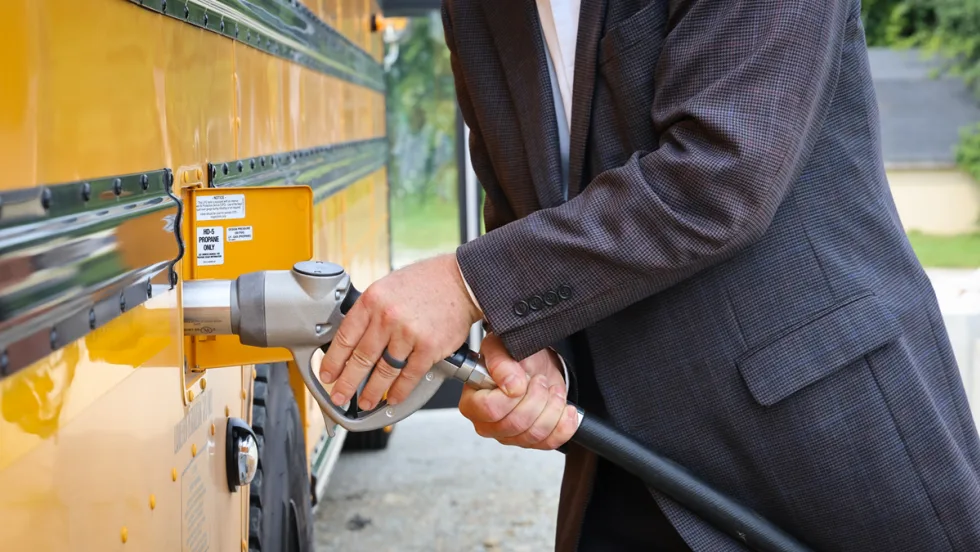
With Fuel Volatility Ahead, School Districts Turn to Propane
While diesel prices peaked above $5 this spring, districts with propane autogas-powered fleets paid under $2 per gallon, according to PERC.
Read More →
EPA Unveils Proposed Changes to 2027 Heavy-Duty Engine Rules
The federal agency has proposed changes to next year’s targets that would eliminate DEF derates, ease warranty requirements, and retain current NOx emissions standards.
Read More →
Alt-Fuel Moves: EV Charging & Infrastructure Projects Gain Momentum
The latest developments include new funding, charging infrastructure, utility investments, and fleet technologies designed to support the transition to electric school buses nationwide.
Read More →