




PBS Probes School Bus Seat Belt Debate
The PBS NewsHour piece looks at safety benefits and financial concerns involved in the issue. Interviews include transportation directors and NHTSA’s former administrator.

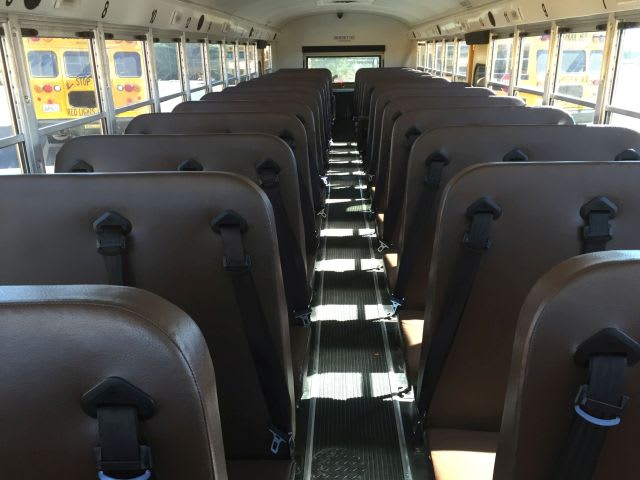
A <I>PBS NewsHour</i> piece looks at the safety benefits and financial concerns involved in the issue of seat belts on school buses.
A PBS NewsHour piece looks at the safety benefits and financial concerns involved in the issue of seat belts on school buses.
The safety benefits and the financial concerns involved in school bus seat belts are the focus of a report that aired Tuesday night on PBS NewsHour.
The piece, which is part of the program’s “Making the Grade” series on education, takes on a topic that has long been debated among transportation officials and legislators.
In the wake of the Nov. 21 crash in Chattanooga, Tennessee, in which six students were killed, school bus-related bills were introduced in numerous states. Many of those proposals aim to require restraints on school buses.
For the PBS NewsHour segment, correspondent Lisa Stark of Education Week visited Austin (Texas) Independent School District (ISD), which five years ago decided to equip all of its new school buses with lap-shoulder belts, at an extra cost of $8,000 per bus.
“You feel safe when you put your seat belt on,” a school bus passenger says in the NewsHour segment.
Stark also interviewed Kris Hafezizadeh, the director of transportation for Austin ISD, who said that the lap-shoulder belts provide a consistent message to students while enhancing their protection.
“We always ask our kids when they get inside the car [to] put on their seat belts,” Hafezizadeh tells Stark. “So to carry the culture inside of our school buses — it does add to additional safety.”
As School Bus Fleet previously reported, Texas passed legislation 10 years ago that required three-point belts on school buses starting in 2010, but only if the state Legislature appropriated money to reimburse school districts for the cost of the restraint systems. Since state funding is not being provided, school districts don’t have to comply. Austin ISD is one of a few Texas districts that have begun voluntarily equipping their new buses with three-point belts.
A new proposal in Texas calls for three-point belts on school buses beginning with model year 2018. The bill would not be contingent on funding from the Legislature, but it would allow school boards to opt out due to budgetary constraints.
In the PBS NewsHour piece, another school transportation director, Todd Watkins of Montgomery County (Md.) Public Schools, points to financial considerations in his assessment of school bus seat belts.
“I’m not against it, I just don’t think it is the best use of money right now because the safety is at such a high level on school buses as it is,” Watkins says in the NewsHour segment.
Stark's report also includes an interview with Mark Rosekind, former administrator of the National Highway Traffic Safety Administration. During his tenure, Rosekind said that the agency had adopted a new position on the issue: “Every child on every school bus should have a three-point seat belt.”
Charlie Hood, executive director of the National Association of State Directors of Pupil Transportation Services (NASDPTS), said in an email to members that NASDPTS provided Stark with its 2014 position paper on lap-shoulder belts, which Hood said she reviewed but didn’t specifically cite in the report.
Tuesday night’s full PBS NewsHour program is embedded below. The school bus seat belt report begins just before the 39-minute mark.
More Safety

Geotab Expands Fleet Safety Tools With Video Coaching, Risk Insights
New safety and video capabilities aim to help fleet managers assess risk, support drivers, and take targeted action through video coaching, red-light violation detection, and more.
Read More →
How to Build a Better School Bus Driver Training Program
Is it time to strengthen your driver training? Here’s how to pick the right talent and improve recruitment, retention, and safety. This video is brought to you by IC Bus.
Read More →
Recent School Bus Accidents Leave 2 Dead, 2 Injured
Four school bus crashes in Florida, Illinois, and Georgia highlight risks in transportation lots, at bus stops, and during student loading and unloading.
Read More →

When Every Second Matters, Clarity Keeps Routes Moving
From routine delays to urgent incidents, strong communication practices help drivers, dispatchers, schools, and families respond with confidence.
Read More →
What Happens When a School Bus Catches Fire — and What Can Help
School bus fires are rare but can be devastating. Learn how advances in fire suppression and asset protection help fleets detect fires earlier, reduce damage, and improve safety.
Read More →
Geotab Launches Tool to Help Fleets Investigate Road Incidents
Geotab Investigations combines telematics data, video, documents, and other evidence to help fleets reconstruct incidents, resolve claims, and determine what happened.
Read More →
Texas Sixth Grader Wins 2026 National School Bus Safety Poster Contest
Sai Darshana Yekolu of Moseley Middle School in Prosper, Texas, was named the newest winner for her artwork, bringing the theme of “Safe Rides, Everyday Heroes” to life.
Read More →
Doing More With Less: How Transportation Directors Can Prioritize Safety Amid Budget Uncertainty
With diesel prices soaring and nearly one-third of transportation directors expecting budget cuts, maintaining student safety has never been more challenging. Download this guide to learn how leading districts are prioritizing risk, funding critical safety technology, and building stronger budget cases with data.
Read More →
Walton County Schools Adds Gatekeeper Stop-Arm Enforcement System
The Florida district will deploy Gatekeeper’s updated Student Protector technology, which now incorporates AI to improve video evidence.
Read More →
How To Build a More Secure School Bus Yard During and After Hours
As thefts and overnight security threats continue, school transportation leaders are combining stronger operational practices with AI-enabled surveillance to better protect buses, facilities, and staff.
Read More →