




New York transportation director earns doctorate
After four years and countless hours of academic work, Peter Lawrence of Fairport Central School District achieves the title doctor of education. Here, he discusses the challenging process of getting the degree, how his dissertation tied in with pupil transportation and the skills he built that can help him in his career.

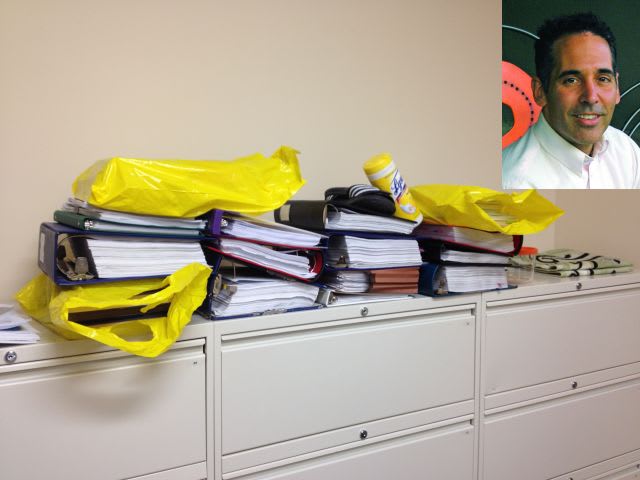
Peter Lawrence (inset) of Fairport (N.Y.) Central School District completed his doctorate last week. In the binders and yellow bags pictured here are the books he used in writing his dissertation.
FAIRPORT, N.Y. — After four years and countless hours of academic work, Peter Lawrence of Fairport Central School District has achieved the title doctor of education.
Lawrence, Fairport’s director of transportation, told SBF that he began working on his doctorate in 2010 at nearby University of Rochester. The degree is in educational leadership, specializing in K-12.
For his dissertation, Lawrence targeted a pertinent pupil transportation topic: ways to achieve cost savings in bus maintenance. He identified four options for his district:
1. Maintain the status quo
2. Move to regionalized maintenance with a board of cooperative educational services (BOCES)
3. Build a new maintenance facility
4. Contract out bus maintenance
Lawrence collected data on the different options through interviews, focus groups and literature reviews. He said he learned quickly that the community was not in support of contracting, and the BOCES option was also not well received.
Lawrence said that removing his own bias was essential (“I would love a new facility,” he noted). In the end, the option that worked out the best was No. 1, to maintain the status quo. However, Lawrence acknowledged that that option doesn’t address some of the problems with Fairport’s current facility, including an inefficient layout, parking concerns and high costs for building repair.
Beyond the findings of the dissertation, Lawrence said that the doctorate program helped him build his skills in decision making, critical thinking and problem solving.
“I’m more apt to ask what problem we are trying to solve,” he said. “Someone might say to you, ‘We need to get this technology on the bus; it’s great.’ But is there really a problem? If you don’t have a problem to solve, you have the potential to throw money away.”
Learning more about different types of educational systems was another key benefit of the doctorate program. One assignment that Lawrence said was particularly insightful was shadowing a principal at a rural school for a day.
The workload was heavy: Lawrence estimated that he put in about 1,000 hours in just the last year as he worked on his dissertation. That was in addition to continuing his full-time job as director of transportation (although he made use of vacation days when major deadlines drew near). At the peak, he was averaging 10 hours a day at the university and operating on about four hours of sleep per night.
“I will say I grossly underestimated how much work goes into writing the dissertation,” Lawrence said.
Having successfully defended his dissertation last week, Lawrence said that he now feels a huge sense of relief as well as a strong sense of accomplishment.
In addition to the array of knowledge he gained and the skills he built in the doctorate program, Lawrence said that he expects the degree to benefit his career path.
“I’m sure that, down the road, it will open doors that might not have been available to me,” he said.
While it is not clear how many pupil transportation directors have earned a doctorate, Mike Martin, executive director of the National Association for Pupil Transportation (NAPT), said that Lawrence is “certainly one of the few, if any.”
“In any event, it is certainly a tremendous accomplishment, especially when you consider that he did it while working full time,” Martin said.
Lawrence, who describes himself as a “lifelong learner,” achieved another educational milestone not long ago: In 2011, he became the first person to finish all of NAPT's Professional Development Series courses.
More Management

EverDriven Launches Route Consolidation Calculator to Estimate Diesel Savings
As diesel prices hit record highs, the largest alternative transportation provider says a 10% route consolidation could save a 120-route district more than $78,000 a year in fuel alone.
Read More →
Zum Secures Continued Financing Support for School Bus Expansion
Generate Private Credit has financed approximately $75 million in school bus deployments across three states, supporting more than 500 buses as Zum expands across the county.
Read More →
Beyond Discipline: A Different Approach to Student Behavior on the Bus
After implementing a dean of students program in Oregon, North Clackamas is seeing positive improvements. Here’s how it worked. The Route is brought to you by IC Bus.
Read More →
A Dean of Transportation's Different Approach to Student Behavior on the School Bus
After implementing a dean of students program in Oregon, North Clackamas is seeing positive improvements on the bus. Here’s how it worked.
Read More →
Inside NAPT ACTS 2026: Highlights from Louisville
From federal updates and student behavior strategies to new school bus technology and industry awards, see highlights from NAPT ACTS 2026 in Louisville.
Read More →
Meet the 2025 School Bus Driver Hero Winner: Annette Brown
We caught up with Wa-Nee Community Schools' Annette Brown on site at SBFX, where she was named the 2026 School Bus Driver Hero Award winner. Hear about her reaction, what she loves most about being a school bus driver, and more!
Read More →
Predictability Is Like Ketchup (According to 6-Year-Olds)
To students, a different school bus can feel like a full-blown crisis. One driver reflects on why familiar routines, showing up on time, and being reliably boring matter more than we think.
Read More →
Samsara Launches Free Driver Rewards Program
The new Driver Perks program gives eligible professional drivers access to discounts and offers without adding a cost for participating fleets.
Read More →
How Tax-Exempt Municipal Leases Can Help Finance School Buses
Let’s explore school bus financing options, including municipal leases, vendor payable accounts, and balloon payments, and how they can help stretch fleet budgets.
Read More →
Nominate Rising School Transportation Pros Under 40!
We’re searching for the next generation of leaders making an impact across the K-12 student transportation industry to recognize as SBF’s 2027 Trailblazers. Nominations are open now!
Read More →