





Did You Miss: CALSTART Report: Funding Lowers EV Barriers, but Hurdles Remain
New York Makes $100M Available for Zero-Emission School Buses
The funding comes from the state’s $4.2 billion Clean Water, Clean Air and Green Jobs Environmental Bond Act of 2022.
September 29, 2023

The program starts accepting applications for zero-emission bus and infrastructure funding in late November.
Image: Canva
3 min to read
The state of New York is making the first $100 million in zero-emission school bus funding available through a bond act passed in 2022.
Governor Kathy Hochul announced that the application period is expected to open Nov. 29. School districts and bus operators in New York are expected to use the money to phase out fossil-fuel buses, curb emissions, and make cleaner school buses – such as electric buses – more affordable. New York has committed to reducing greenhouse gas emissions 85% by 2050 and the governor has established an initiative to require all new school buses sold be zero-emission by 2027 and that all school buses on the road be zero-emission by 2035.
"The commitment of public funds and guidance released today puts New York State schools and bus operators on a trajectory to embrace clean transportation and the benefits that it will bring,” Hochul said. “Zero-emission buses will become a hallmark, not only transporting students through our communities, but also demonstrating the promise and possibility of a healthier, environmentally friendly, low-carbon future for our youngest citizens.”
The New York State Energy Research and Development Authority (NYSERDA) released the program rules, officially launching the pre-application process through which bus manufacturers and dealers can apply to qualify for the New York School Bus Incentive Program (NYSBIP). These rules will guide the bond act allotment of $500 for clean school buses and infrastructure. A webinar is planned for Oct. 11 at 12 p.m. Eastern.
The NYSBIP is statewide point-of-sale incentive program that provides discounts to eligible school bus fleet operators that purchase zero-emission battery electric (BEV) or hydrogen fuel cell electric (FCEV) school buses and associated charging infrastructure. Incentives for school buses will be disbursed directly to dealers and manufacturers to offset some or all of the difference in purchase price between zero-emission school buses and comparable diesel or gas-powered buses. Charging infrastructure incentives will also be issued directly to the fleet owner (the school district or their contractor).
The bond act requires that disadvantaged communities receive no less than 35%, with a goal of 40% of total funds. Buses domiciled in or serving disadvantaged communities or high-need school districts will be considered for higher incentive amounts.
Said Doreen M. Harris, president and CEO of NYSERDA: “The Environmental Bond Act funding creates a pivotal opportunity that brings zero-emission school buses to the forefront of New York State’s clean energy and climate future. Incorporating community feedback received at this summer’s Environmental Bond Act meetings and through the draft criteria open comment period, is now culminating in the next step – working in partnership with school districts, bus operators and manufacturers to make meaningful changes to student transportation by putting more clean buses on our roadways.”
“Zero-emissions buses can have significant benefits for our schools and districts across the state, especially our urban districts, by reducing pollution and providing a cleaner transportation option for students,” said Betty A. Rosa, commissioner of New York’s state education department. “Additional resources—like those announced today—will be critical to ensuring school communities are able to make these investments. Under Gov. Hochul’s leadership and in collaboration with our partner agencies, we can continue to work towards delivering cleaner, healthier communities for New York’s nearly 2.5 million students.”
More Alternative Fuels

CALSTART and Forth Combine to Form Catalyst Mobility
The new name represents a renewed vision for the nonprofit focused on advancing clean, equitable, and affordable transportation solutions that move people and goods.
Read More →
Alt-Fuel Moves: New Buses, Charging Hubs & Real-World EV Testing
Propane and electric school bus deployments continue to grow as districts add new vehicles, expand charging infrastructure, and gather more real-world operating data.
Read More →
Fewer Electric School Bus Models Reshape the U.S. Market
WRI’s latest buyer’s guide points to a consolidating electric school bus market, but fewer options may reflect a maturing industry rather than fewer meaningful choices for school bus operators.
Read More →
The Fuel Budget You Can Actually Predict: How Propane Autogas Keeps Money in the Classroom
Learn how propane autogas helps school districts manage fuel costs with predictable pricing, lower maintenance, and reduced emissions from former transportation director Joel Stutheit.
Read More →
Hendrickson, Driventic Introduce New Electric Powertrain for School Buses
ELECTRAAX, the electrified, lightweight drive axle offers integrated ePowertrain efficiency and modular flexibility for Class 6–7 school bus use.
Read More →
The Mobility House Joins PowerFlex in Fleet Electrification Deal
The acquisition combines intelligent charging software, bidirectional charging expertise, and fleet electrification services to support the growing adoption of electric school buses across North America.
Read More →
Alt-Fuel Moves: Electric School Bus Investments Hit the Road
See which districts across the U.S. are putting electric school buses into service, expanding charging infrastructure, and planning the next phase of fleet electrification.
Read More →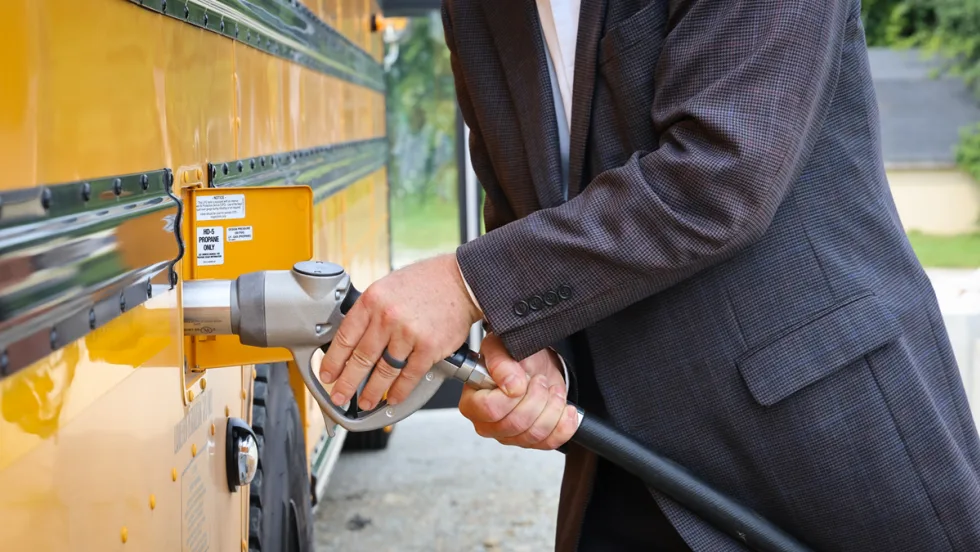
With Fuel Volatility Ahead, School Districts Turn to Propane
While diesel prices peaked above $5 this spring, districts with propane autogas-powered fleets paid under $2 per gallon, according to PERC.
Read More →
EPA Unveils Proposed Changes to 2027 Heavy-Duty Engine Rules
The federal agency has proposed changes to next year’s targets that would eliminate DEF derates, ease warranty requirements, and retain current NOx emissions standards.
Read More →
Alt-Fuel Moves: EV Charging & Infrastructure Projects Gain Momentum
The latest developments include new funding, charging infrastructure, utility investments, and fleet technologies designed to support the transition to electric school buses nationwide.
Read More →