




New York association backs legislation during School Bus Safety Week
The New York School Bus Contractors Association is supporting proposed state bills that call for increased penalties for stop-arm running, tougher penalties for bus drivers who drive under the influence, and other changes.

LATHAM, N.Y. — The New York School Bus Contractors Association joins with the National Association for Pupil Transportation in supporting National School Bus Safety Week by publicly supporting increased school bus safety legislation.
The legislation the association is backing includes increased penalties for motorists who pass a stopped school bus, tougher penalties for bus drivers who drive under the influence of drugs or alcohol and expanded drug and alcohol testing for all bus drivers.
“As champions of school bus safety, the New York School Bus Contractors Association is proud to support this year’s annual National School Bus Safety Week,” association President Robert Pape said. “School buses are, by far, the safest way for a child to get to and from school in New York, and our school districts and contractors are doing a phenomenal job. That said, there is more we can do to make that ride even safer, including passage of additional school bus safety legislation.”
The association supports passage of New York State Sen. John Bonacic’s bill, which calls for increased penalties for drivers who pass a stopped school bus. Currently, drivers ticketed for a first offense face up to 30 days in jail, a $400 fine, and a five-point penalty on their driver’s license. It is estimated that 50,000 motorists illegally pass stopped school buses each school day in New York state, according to the association.
Bonacic’s bill also calls for the additional penalty of a 60-day suspension of a person’s driver’s license when convicted of illegally passing a stopped school bus two or more times within a 10-year period. The bill, S. 1878/A.6610, also sponsored by Assemblyman Michael Cusick, is currently sitting in the New York State Assembly Transportation Committee, association officials said.
In addition, the association supports passage of New York Sen. John Flanagan’s bill that would require all school bus drivers to be subjected to random drug and alcohol testing. Currently, only 10% of school bus drivers employed by a motor carrier are subjected to random drug and alcohol testing, and drivers of buses that carry fewer than 16 passengers are not required to take any type of drug and alcohol testing.
Flanagan’s bill, S.7761, also calls for any failed drug and alcohol test to be reported to the New York State Department of Motor Vehicles and permanently disqualify a bus driver found operating a school bus while intoxicated from future licensure as a school bus driver. The bill also increases the prohibited time for consumption of alcohol prior to operating a school bus from six to eight hours.
“We’re thrilled to throw our support behind this year’s National School Bus Safety Week and its promotion of school bus safety across the country,” Pape said. “Providing a safe ride to school and back home for over a million children every day in New York is the single most important thing we do as school bus contractors. Passage of this important school bus safety legislation will help us to continue to provide the safest pupil transportation services in the country.”
More Management

Logan Bus Company Rolls Out AI Phone System for NYC School Bus Families
A summer pilot found that AI agents could handle most routine calls, freeing up time for customer service staff to focus on emergencies and complex family concerns.
Read More →
From Intent to Impact: What I Learned About Leadership from TAPT
A Texas transportation supervisor shares lessons on self-awareness, accountability, managing stress and building trust — and why investing in leadership development matters at every stage of your career.
Read More →
NAPT Names 2026 Award Recipients
Who earned national recognition for their work in student transportation? This year, NAPT named five recipients of its 2026 awards for service, safety, and leadership.
Read More →


2026 State of Student Transportation Report
Driver shortages. Rising costs. Growing safety expectations. More data, but not enough time to act on it. The 2026 State of Student Transportation Report reveals what transportation leaders say is putting the most pressure on their operations—and where they’re investing next. See how your priorities compare.
Read More →
How to De-Escalate an Angry Person: 5 Steps for Handling Workplace Conflict
What makes emotions run high, and how should you handle an angry colleague or parent? Follow these steps for staying calm, listening, showing empathy, and resolving conflict.
Read More →
What Readiness Looks Like This School Year
Learn about the challenges shaping the 2026–2027 school year, from persistent driver shortages and budget pressure to technology and readiness gaps. See how school districts are responding and adapting in Zonar’s 2026 Back-to-School Readiness Report.
Read More →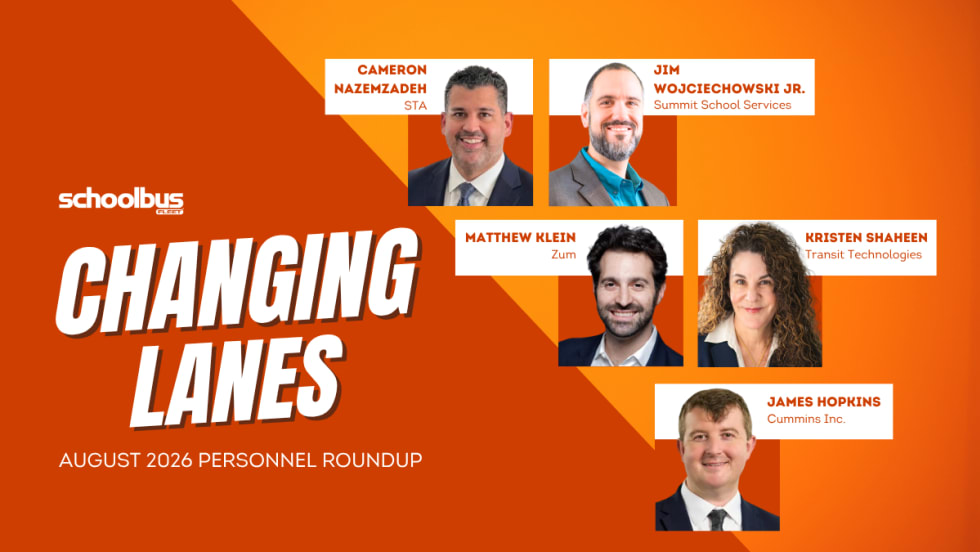
Changing Lanes: Executive Moves at Summit School Services, Zum, STA, Cummins, Transit Technologies, Driventic, & Cadex
See who's been hired, promoted, and appointed to leadership positions at various school transportation industry suppliers and private contractors.
Read More →
Texas Sixth Grader Wins 2026 National School Bus Safety Poster Contest
Sai Darshana Yekolu of Moseley Middle School in Prosper, Texas, was named the newest winner for her artwork, bringing the theme of “Safe Rides, Everyday Heroes” to life.
Read More →
Industry Moves: Companies Expand Fleet Service & EV Infrastructure Footprints
The new facilities and regional hubs could mean faster access to shop equipment, charging support, and transportation technology for fleet operators.
Read More →
Doing More With Less: How Transportation Directors Can Prioritize Safety Amid Budget Uncertainty
With diesel prices soaring and nearly one-third of transportation directors expecting budget cuts, maintaining student safety has never been more challenging. Download this guide to learn how leading districts are prioritizing risk, funding critical safety technology, and building stronger budget cases with data.
Read More →