





Check Out: Federal Court: NYC Denied Equal Access to School Transportation
New York Advocacy Group Seeks Better Data and Centralized Responsibility
A briefing report from New York Appleseed makes a few recommendations for improving transportation equity among public school students in New York City's boroughs.
April 26, 2022
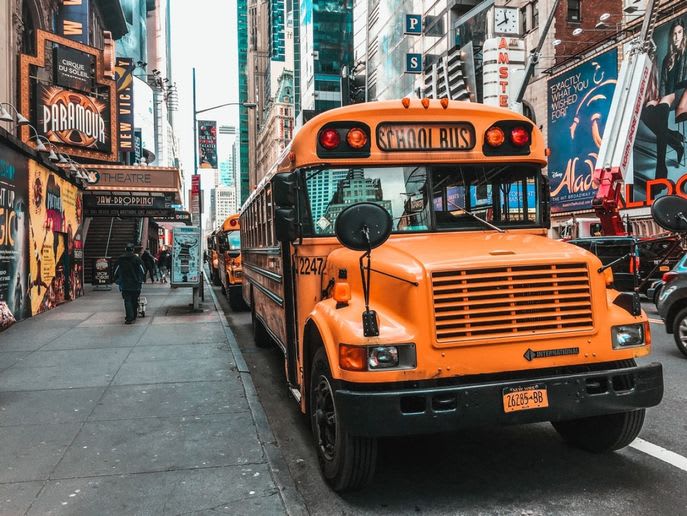
New York Appleseed is part of a network of 16 social justice centers in the United States and Mexico.
Photo: Jannis Lucas via UnSplash.
3 min to read
The public needs more accessible data on yellow school bus ridership from the New York City Department of Education (DOE), city leaders must explore ways to centralize responsibility for equitable service, and marginalized groups should be engaged to better meet the needs of students and families.
Those are among the conclusions and recommendations reached in a research briefing released this month by the New York Appleseed advocacy group. It’s part of a network of 16 social justice centers in the United States and Mexico, working with volunteer lawyers and other professionals to address barriers to opportunity and justice.
An Overview of the Findings
“As New York Appleseed’s advocacy for school integration increasingly grows to encompass integration planning for entire community school districts in New York City, the issue of transportation has become increasingly salient,” the report states. “Not all school districts are alike, and several that wish to implement a diversity plan also must address the question of access for students who reside in transportation deserts or need extra assistance to attend an inclusive school setting.”
The report also indicates that transportation-related issues in the city are complicated by a lack of data and “a long and fraught history between the New York City Department of Education and its reliance on private contractors.”
“Inevitably, the rocky relationship with contractors and their drivers and city officials over the last decade have affected families’ access to putting their children on a bus to get to school each day,” the report states.
The briefing’s executive summary offers an overview of the city’s experiences with school transportation since the 1970s, including:
Two strikes by bus drivers’ unions in 1979 and 2013.
Rising costs and school bus mechanical breakdowns and delays.
Sometimes unenforced regulations, such as background checks for bus drivers.
Halted bus service due to schools shuttered by the COVID-19 pandemic.
“Certain initiatives that were underway prior to the pandemic fell by the wayside as the city grappled with the pandemic generally and looked for a path forward under pandemic conditions,” the briefing states.
Delving into Data
Some recent improvements cited in the report:
The city DOE’s rollout of GPS monitoring for school buses.
Creation of NYC School Bus Umbrella Services, a city-owned non-profit that is responsible for 900 bus routes for children with disabilities previously overseen by a private bus company.
Introduction of electric school buses to the city’s fleet.
Work remains to be done regarding public data about ridership.
“It is egregious that despite over 100,000 students utilizing yellow bus service, we have almost no data to hold leadership accountable,” the report states. “Ridership data should be provided on all aspects pertaining to student transport, including but not limited to ridership data broken down by borough, district, race, students in temporary housing, students with disabilities, students in special programs, and English Language Learners.”
New York Appleseed sought an update to September 2000 data from the Independent Budget Office (IBO) and learned that Black and Hispanic students comprised many riders aboard public school buses in 2019-20. Of the city’s special education students, 44.4% were Hispanic and 33.2% were Black. According to the IBO’s numbers, of the 99,651 students bused in all of New York City’s boroughs, 59,232 were Black or Hispanic.
“Students of color represent the majority of students utilizing the yellow bus service, which is likely a reflection of the demographics of our school system as a whole,” the report states.
More Management

How to Build a Better Driver Training Program
Ready to boost up your school bus instructor training? Here’s how to pick the right talent and improve recruitment, retention, and safety.
Read More →
CALSTART and Forth Combine to Form Catalyst Mobility
The new name represents a renewed vision for the nonprofit focused on advancing clean, equitable, and affordable transportation solutions that move people and goods.
Read More →
What Makes a Great School Bus Driver Trainer?
Choosing the right school bus driver trainer takes more than experience. Learn six keys to selecting and developing trainers and evaluating program effectiveness.
Read More →


School Bus Contractors Expand Through New Deals, Acquisitions & Partnerships
STA's Canadian division acquires Ontario-based G&L Stevenson Transport while Durham School Services adds a new district contract in California, First Student adds a New Jersey contract, and Minnesota Coaches acquires Halo Transportation.
Read More →
Logan Bus Company Rolls Out AI Phone System for NYC School Bus Families
A summer pilot found that AI agents could handle most routine calls, freeing up time for customer service staff to focus on emergencies and complex family concerns.
Read More →
From Intent to Impact: What I Learned About Leadership from TAPT
A Texas transportation supervisor shares lessons on self-awareness, accountability, managing stress and building trust — and why investing in leadership development matters at every stage of your career.
Read More →
NAPT Names 2026 Award Recipients, Hall of Fame Inductee
Who earned national recognition for their work in student transportation? This year, NAPT named five recipients of its 2026 awards for service, safety, and leadership, plus its newest Hall of Famer.
Read More →
Sponsored•September 2, 2026
2026 State of Student Transportation Report
Driver shortages. Rising costs. Growing safety expectations. More data, but not enough time to act on it. The 2026 State of Student Transportation Report reveals what transportation leaders say is putting the most pressure on their operations—and where they’re investing next. See how your priorities compare.
Read More →
How to De-Escalate an Angry Person: 5 Steps for Handling Workplace Conflict
What makes emotions run high, and how should you handle an angry colleague or parent? Follow these steps for staying calm, listening, showing empathy, and resolving conflict.
Read More →
Sponsored•September 1, 2026
What Readiness Looks Like This School Year
Learn about the challenges shaping the 2026–2027 school year, from persistent driver shortages and budget pressure to technology and readiness gaps. See how school districts are responding and adapting in Zonar’s 2026 Back-to-School Readiness Report.
Read More →