





Check Out: Fueling the Future: Green-Powered Technology
Missouri District Using Incentive Funds for Propane Buses
The federal Clean School Bus Program and the state's Propane Education & Research Council are making it possible for Hannibal Public School District No. 60 to steer toward a fully propane-fueled fleet.
January 23, 2023
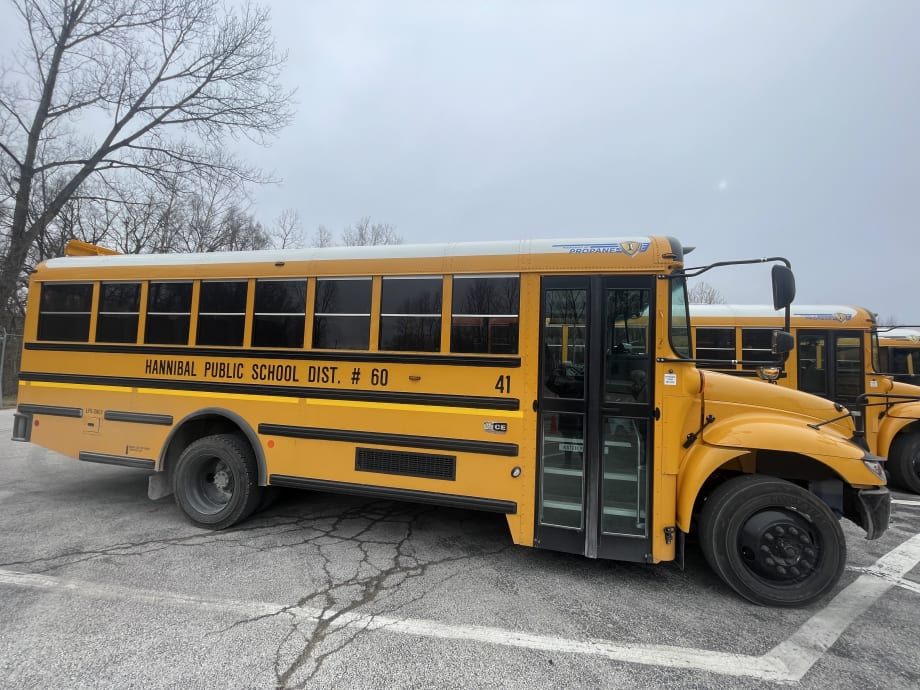
The school district, located in northeastern Missouri, is buying nine propane school buses to replace diesel buses that are about 20 years old. Ultimately, the district aims for a totally propane-fueled school bus fleet.
Photo: Hannibal Public School District No. 60
3 min to read
Missouri’s Hannibal Public School District No. 60 is tapping funds from incentive programs such as the Environmental Protection Agency’s (EPA) Clean School Bus Program and the state’s Propane Education & Research Council to pursue plans for a fully propane-fueled fleet.
“As we researched the various alternative fuels, propane stood out as the best option for our school district,” said Scott Speer, the district’s transportation director.
The district, located in northeastern Missouri, got two propane buses, with four more en route and three on order. With the addition of these new propane buses, 22% of the district’s fleet is expected to soon run on clean, low-emission fuel.
Why Propane?
The nine buses are replacing diesel buses that are about 20 years old and emit known carcinogens. Propane autogas is promoted as a nontoxic, non-carcinogenic, and non-corrosive fuel. It’s classified as a non-contaminant by the EPA.
Four of the new buses are made possible by funding through the first round of the EPA’s Clean School Bus Program. The district is also receiving a $2,000 per bus rebate through the Missouri Propane Education & Research Council (MOPERC), which has pledged $1 million to help school districts transition to propane models.
Affordability proved a deciding factor for the district when it considered which clean alternative to seek out for its school bus fleet.
“Electric buses are very popular right now,” Speer said. “However, an electric bus costs more than three times the amount of a diesel-powered bus.”
The district reviewed the initial purchase price of buses, infrastructure, fuel, and ongoing maintenance costs.
“When comparing infrastructure costs, compressed natural gas would have required an extensive renovation to our facilities, and that has a significant cost,” Speer said. “Conversely, propane is incredibly stable and does not require our facility to undergo extensive renovations. Furthermore, propane itself is a much more affordable fuel than diesel. Simply put: propane was a way that Hannibal transportation could save taxpayer dollars while providing a cleaner alternative to diesel.”
Buses fueled by propane autogas can provide lower total cost of ownership for school districts by saving on fuel, fluids, and filters, according to MOPERC. “Supplies such as diesel particulate filters, manual regeneration and diesel exhaust fluid, and other complex after-treatment devices aren’t needed on a propane bus,” a news release state. “Oil changes on propane buses are also simpler and less expensive.”
Hoping to Realize Meaningful Savings
Propane supplier Big River Oil is partnering with the school district to help with buying and installing infrastructure needed to fuel propane buses on school property.
“Propane school buses are better for our children, better for our community, and better for the environment,” said Steve Ahrens, president of MOPERC. “They eliminate harmful tailpipe emissions while stretching taxpayer dollars. Hannibal School District No. 60 is truly making a wise investment.”
The district, which runs a fleet of 37 buses, currently pays $4.10 per gallon of diesel and $1.69 per gallon of propane. The alternative fuel federal excise tax credit is expected to further accelerate fuel savings for the district by 37 cents per gallon.
“Any savings from propane buses will be used to help support a high-quality education for all of Hannibal’s students,” Speer said.
Today, more than 300 propane buses operate in Missouri, with more than 20,000 in use across the country.
More Alternative Fuels

CALSTART and Forth Combine to Form Catalyst Mobility
The new name represents a renewed vision for the nonprofit focused on advancing clean, equitable, and affordable transportation solutions that move people and goods.
Read More →
Alt-Fuel Moves: New Buses, Charging Hubs & Real-World EV Testing
Propane and electric school bus deployments continue to grow as districts add new vehicles, expand charging infrastructure, and gather more real-world operating data.
Read More →
Fewer Electric School Bus Models Reshape the U.S. Market
WRI’s latest buyer’s guide points to a consolidating electric school bus market, but fewer options may reflect a maturing industry rather than fewer meaningful choices for school bus operators.
Read More →
The Fuel Budget You Can Actually Predict: How Propane Autogas Keeps Money in the Classroom
Learn how propane autogas helps school districts manage fuel costs with predictable pricing, lower maintenance, and reduced emissions from former transportation director Joel Stutheit.
Read More →
Hendrickson, Driventic Introduce New Electric Powertrain for School Buses
ELECTRAAX, the electrified, lightweight drive axle offers integrated ePowertrain efficiency and modular flexibility for Class 6–7 school bus use.
Read More →
The Mobility House Joins PowerFlex in Fleet Electrification Deal
The acquisition combines intelligent charging software, bidirectional charging expertise, and fleet electrification services to support the growing adoption of electric school buses across North America.
Read More →
Alt-Fuel Moves: Electric School Bus Investments Hit the Road
See which districts across the U.S. are putting electric school buses into service, expanding charging infrastructure, and planning the next phase of fleet electrification.
Read More →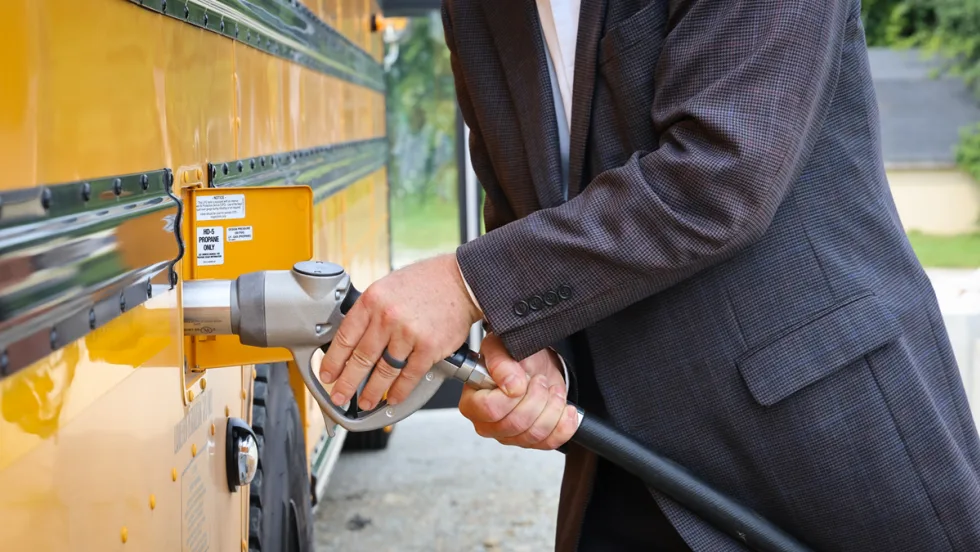
With Fuel Volatility Ahead, School Districts Turn to Propane
While diesel prices peaked above $5 this spring, districts with propane autogas-powered fleets paid under $2 per gallon, according to PERC.
Read More →
EPA Unveils Proposed Changes to 2027 Heavy-Duty Engine Rules
The federal agency has proposed changes to next year’s targets that would eliminate DEF derates, ease warranty requirements, and retain current NOx emissions standards.
Read More →
Alt-Fuel Moves: EV Charging & Infrastructure Projects Gain Momentum
The latest developments include new funding, charging infrastructure, utility investments, and fleet technologies designed to support the transition to electric school buses nationwide.
Read More →