June 2023: Fleet Fuel Price Trends [Updated 06/28]
On average, gasoline prices held steady, although climbed in some specific regions. The average cost of a gallon of diesel fuel fell just over a penny across the United States.
The average price for a gallon of diesel fell slightly during the past week.
Image: Canva/EIA
5 min to read
It cost just a little more than a penny less per gallon to fuel a diesel school bus last week on average across the country, according to the U.S. Energy Information Administration. Gasoline prices also fell on average, despite climbing in some regions such as the Rocky Mountains and Gulf Coast.
Here are the latest gasoline and diesel fuel statistics:
Ad Loading...
U.S. Regional Diesel Fuel Prices as of June 26, 2023
East Coast: $3.85
Midwest: $3.73
Gulf Coast: $3.51
Rocky Mountain: $4.02
West Coast: $4.41
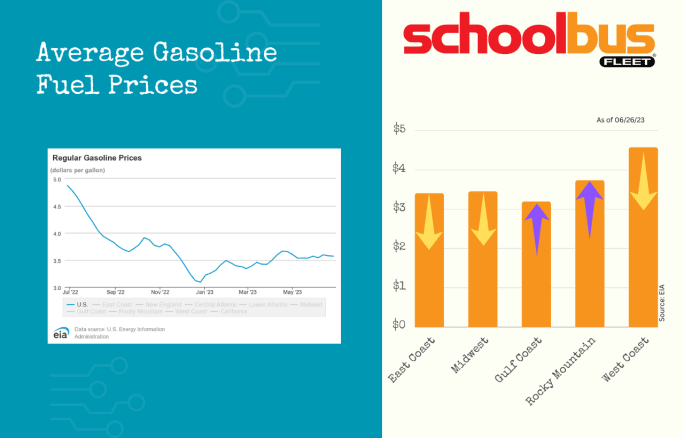
Gasoline prices fell in most areas of the United States, although the cost rose in some places, such as the Rocky Mountains and along the Gulf Coast.
Image: Canva/EIA
U.S. Regional Gasoline Fuel Prices as of June 26, 2023
East Coast: $3.40
Midwest: $3.45
Gulf Coast: $3.19
Rocky Mountain: $3.73
West Coast: $4.56
Uncertainty after the weekend's mercenary mutiny in Russia led oil markets to cautious trading due to concerns about that country's oil production.
“While some states saw big increases from last week, I expect those states to see a calmer week ahead," said Patrick De Haan, head of petroleum analysis at GasBuddy. "Other states saw prices fall, and some like Arizona fell significantly as some of the kinks in supply have improved there over the last few weeks. Ultimately, we could see the national average nudge a bit lower in the week ahead, should oil prices fail to rally. But, with developments including the Wagner group destabilizing and testing Russia, there can always be last-minute shifts that impact prices, which we continue to watch for and hope the market remains calm.”
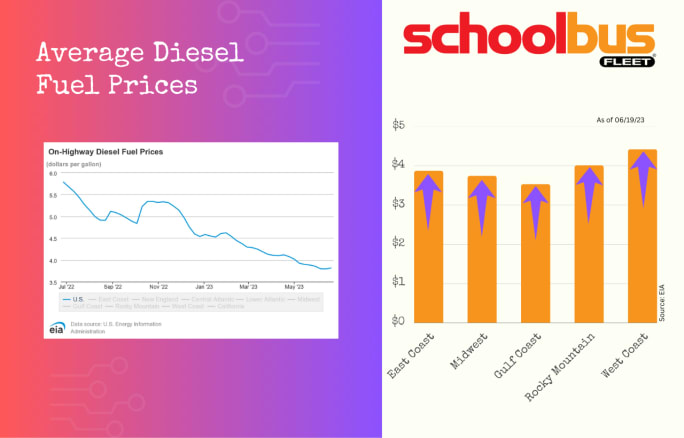
Overall, diesel prices climbed about 2 cents per gallon across the United States during the past week.
Diesel costs rose in all regions monitored by the federal government, while gasoline was cheaper in most places except the Rocky Mountain region, where it was up more than 1 cent.
Here are the latest gasoline and diesel fuel statistics:
U.S. Regional Diesel Fuel Prices as of June 19, 2023
East Coast: $3.87
Midwest: $3.74
Gulf Coast: $3.53
Rocky Mountain: $4.03
West Coast: $4.43
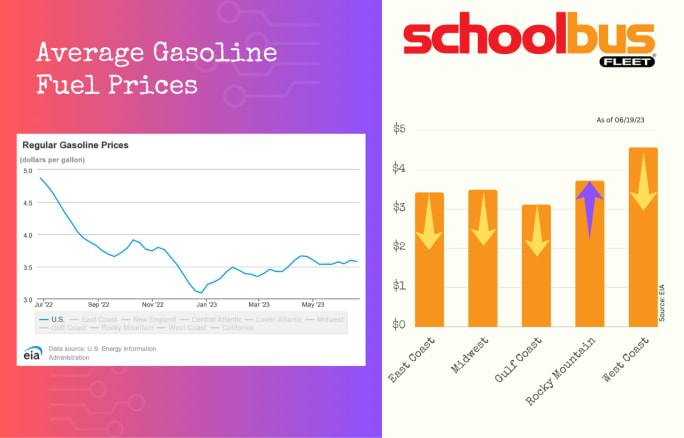
The average price for a gallon of gasoline fell in most areas except for the Rocky Mountain region.
Image: Canva/EIA
U.S. Regional Gasoline Fuel Prices as of June 19, 2023
East Coast: $3.42
Midwest: $3.49
Gulf Coast: $3.11
Rocky Mountain: $3.72
West Coast: $4.57
The price for diesel, although up slightly on average, remains nearly $2 cheaper than the same time in 2022. Gasoline is down nearly $1.39 compared to last year.
Ad Loading...
"While the uncertainty over the direction of the economy is a major player in preventing oil's rise, inventories of oil and gasoline do remain tight, preventing much additional downward movement as well," said Patrick De Haan, head of petroleum analysis at GasBuddy. "We'll have to see which of those factors emerges as a winner to predict when the next large movement in prices could be. We're also seeing more tropical activity in the Atlantic that could pose challenges in the weeks ahead as hurricane season ramps up."
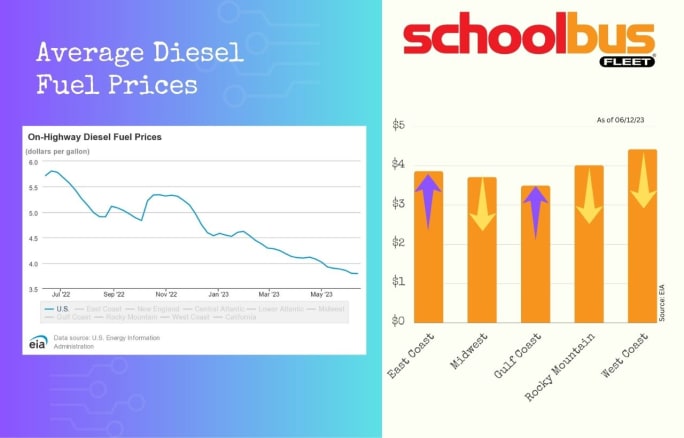
Diesel prices showed signs of leveling off, with costs at the pump rising on the East Coast and Gulf Coast.
Image: Canva/EIA
The average price for a gallon of gasoline went up more than 5 cents in the United States during the past week, according to the Energy Information Administration. Meanwhile, diesel's cost decline showed signs of leveling off due to increases in the East Coast and Gulf Coast regions.
Both gasoline and diesel prices remain below last year's levels at this time - $1.41 and $1.92 respectively.
Here are the latest gasoline and diesel fuel statistics:
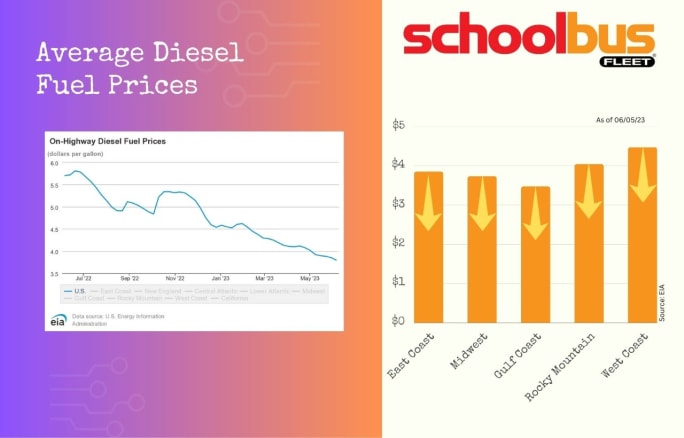
U.S. Regional Diesel Fuel Prices as of June 12, 2023
East Coast: $3.86
Midwest: $3.72
Gulf Coast: $3.49
Rocky Mountain: $4.01
West Coast: $4.42
Ad Loading...
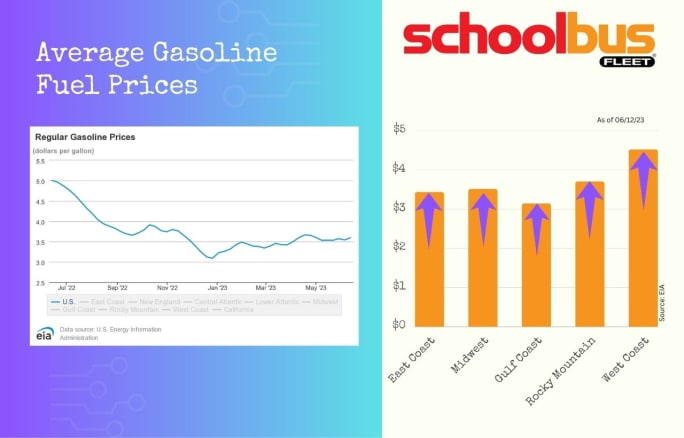
Gasoline prices jumped, likely spurred by consumer demand.
Image: Canva/EIA
U.S. Regional Gasoline Fuel Prices as of June 12, 2023
East Coast: $3.43
Midwest: $3.51
Gulf Coast: $3.14
Rocky Mountain: $3.71
West Coast: $4.58
The higher prices may be driven by demand putting pressure on supply, as consumers for the third straight week went over 9-million barrels per day.
"With the Fed meeting this week to potentially alter interest rates again, we could see some turbulence in oil markets, potentially impacting states where gas prices were quiet this week, while the states that saw a big jump last week could see some moderate relief in the week ahead," said Patrick De Haan, GasBuddy's head of petroleum analysis. "The good news has continued for average diesel prices, which again fell last week to their lowest since early 2022, helping to relieve some pressure on hard-hit consumers of diesel."
Diesel prices declined in all regions of the United States during the past week.
Image: Canva/EIA
Gasoline prices started the month of June down an average of 3 cents for school bus fleets across the United States, while the cost of a gallon of diesel fell nearly 6 cents, according to the Energy Information Administration.
Compared to the same period in 2022, gasoline is down nearly $1.34 and diesel has dropped about $1.91. But recent moves by Saudi Arabia suggest that trend may reverse in time.
Ad Loading...
Here are the latest gasoline and diesel fuel statistics:
U.S. Regional Diesel Fuel Prices as of June 5, 2023
East Coast: $3.85
Midwest: $3.73
Gulf Coast: $3.47
Rocky Mountain: $4.04
West Coast: $4.47
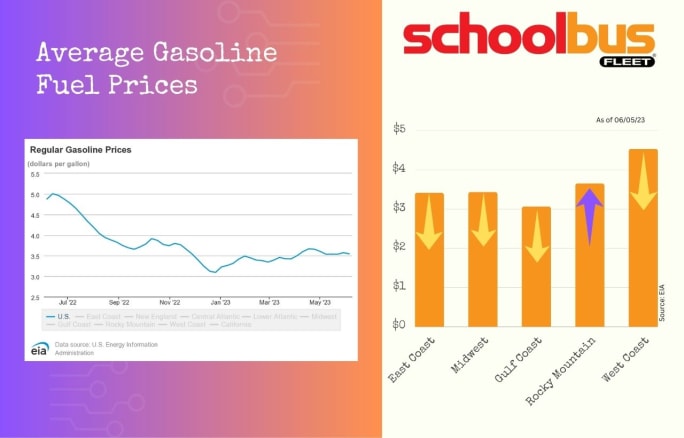
U.S. Regional Gasoline Fuel Prices as of June 5, 2023
Gasoline prices fell by about 3 cents on average in most regions.
Image: Canva/EIA
East Coast: $3.41
Midwest: $3.43
Gulf Coast: $3.06
Rocky Mountain: $3.65
West Coast: $4.52
OPEC+ announced on June 4 that it would extend reduced production of crude oil through 2024, leading the EIA to forecast global oil inventories falling slightly in the next five quarters, and that could mean higher prices, "notably in late 2023 and early 2024."
Said Patrick De Haan, head of petroleum analysis at GasBuddy: "Last time OPEC+ agreed to cut production, it led to a temporary rally in the price of oil, but as global oil demand hasn’t been as strong as expected, the cut failed to hold oil prices up. OPEC+ and Saudi Arabia are likely hoping that the rise in oil prices will stick longer this time, as the Saudi economy relies on oil prices north of $81 per barrel. It’s likely that, as a result of the production cut, oil prices could rally this week, pushing gasoline prices higher as early as mid-week."
Ad Loading...
Keep up with fleet fuel prices throughout the month by checking here for regular updates. We’ll post new information when it’s available!
Your district's buses carry students to school every day. This guide shows how predictive maintenance powered by fleet data helps keep buses reliable, drivers accountable and students safer from the first bell to the last stop.
The acquisition of Downriver Truck and Bus expands Kerry Brothers’ school bus maintenance footprint across southeast Michigan, adding repair capacity, diagnostic resources, and state inspection support.
CAN Mentor and the latest JPRO update aim to simplify vehicle network diagnostics and improve repair efficiency for technicians of all experience levels.
Cummins discusses its first-ever gasoline engine for school buses, EPA 2027, and why bus fleets still want durable, simpler internal combustion options.
Vampire Tools introduced the VAMPLIERS Caiman 7.5-inch multi-purpose pliers, combining screw extraction, cutting, crimping, and gripping functions into a single tool designed for fleet maintenance professionals.
Chat with Noregon’s Kevin Smallhorn at ACT Expo about bus diagnostic tools, telematics integration, CNG maintenance support, and strategies to help reduce downtime and improve uptime.
Don’t let bus downtime wear you down. Here’s how bus operators are shifting from manual processes to AI-powered, data-driven maintenance systems for improved reliability and safety.
Covering 38 routes on a Friday afternoon. Buses idling while routes overlap. Parents calling nonstop about late arrivals. Sound familiar? This whitepaper explores how district transportation leaders solved these exact problems — and what measurable results followed.






![June 2023: Fleet Fuel Price Trends [Updated 06/28]](https://assets.bobitstudios.com/image/upload/f_auto,q_auto,dpr_auto,c_limit,w_920/20230626-sbfdiesel-fuel-prices_1768119432868_xfvb8t.png)