




Industry Responds to NTSB Crash Findings, Recommendations
Operators and associations offer a range of reactions to Tuesday’s school bus meeting of the National Transportation Safety Board.

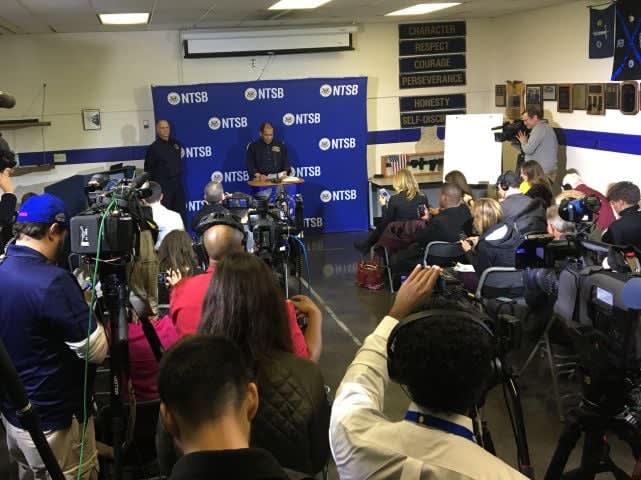
Operators and associations have offered a range of reactions to NTSB’s school bus crash meeting on Tuesday. Seen here is an NTSB press briefing after the 2016 Chattanooga crash. Photo courtesy NTSB
Operators and associations have offered a range of reactions to NTSB’s school bus crash meeting on Tuesday. Seen here is an NTSB press briefing after the 2016 Chattanooga crash. Photo courtesy NTSB
This week’s meeting of the National Transportation Safety Board (NTSB) focused on fatal school bus crashes in two cities, but the agency’s findings and recommendations have broad reach in the pupil transportation industry.
Accordingly, the NTSB developments on Tuesday evoked a range of responses from school bus operators and associations.
As SBF previously reported, NTSB’s three current board members met with agency staff to consider a special investigation report that examines the November 2016 school bus crashes in Baltimore, Maryland, and Chattanooga, Tennessee. While the full report isn’t expected to be available for a few weeks, the agency has released a synopsis that includes its investigation findings and safety recommendations.
In the meeting, NTSB approved 16 new safety recommendations to regulatory agencies, states, and school bus operators and manufacturers, among others. Several of those items cover driver licensing, medical examinations, and other oversight issues. Other recommendations address equipment and technology, including lap-shoulder belts and collision avoidance systems for new school buses.
Following the NTSB meeting, SBF gathered responses from several industry associations and school bus operators.
One of the recommendation recipients is National Express LLC, whose Durham School Services division operated the school bus and employed the driver in the Chattanooga crash. Carina Noble, senior vice president of communications, said that the company is “very sorry that this tragedy happened on one of our buses. Our thoughts remain with the families and friends of those who lost their lives or were injured.”
After the crash, National Express began implementing changes that include the rollout of DriveCam safety camera technology on the company’s buses and a new nationwide system, dubbed BusReport, to record and track complaints.
“This BusReport system was commended as ‘very effective’ in the hearing [on Tuesday], and we believe it will continue to help address the local issues identified,” Noble said. “We will continue to review the NTSB report and will work with school boards and relevant authorities on the technologies identified as an opportunity to enhance industry-wide safety performance.”
The National School Transportation Association (NSTA), which represents contractors across the country, issued a statement in which it highlighted the overall safety record of school buses.
“While the loss of any life on a school bus or in any other vehicle is one too many, less than one percent of all traffic fatalities nationwide occur on a school bus,” NSTA said.
The association also pledged to “carefully review all of the recommendations announced by the NTSB,” as well as existing guidance from the National Highway Traffic Safety Administration (NHTSA) and other sources, to help inform NSTA members.
“The National School Transportation Association is committed to pupil safety on school buses and appreciates all recommendations that can be shown to help provide safe student transportation,” NSTA added.
Meanwhile, the National Association for Pupil Transportation (NAPT) released a response to the NTSB meeting saying that it will “encourage our members to re-double efforts to provide robust, documented training, screening and oversight of all driver and bus operations, and have procedures in place to monitor their effectiveness and take any necessary action quickly.”
NAPT also expressed its support for installing electronic stability control and other crash mitigation technologies on school buses. As for seat belts, the association questioned why NTSB did not press NHTSA on that front — the lap-shoulder belt recommendations were directed at the states.
“If lap/shoulder belts are ‘tried and true’ and provide ‘the highest level of protection’ in school buses, respectfully, why were there no recommendations to NHTSA — the federal agency responsible for regulating them — to provide all of the answers and clarity states and communities need to effectively evaluate belts, among other educational priorities and practices?” NAPT said.
Charlie Hood, executive director of the National Association of State Directors of Pupil Transportation Services (NASDPTS), told SBF that while “school bus transportation affords students unparalleled safety … we know that any serious injuries or fatalities are unacceptable and that more can and should be done to prevent them.”
Last week, NASDPTS published a position paper that details federal requirements and industry best practices in the areas of school bus driver qualifications, training, performance, and oversight.
“Our intent is that the paper should be used as a ‘checklist’ by federal, state, and local jurisdictions, private schools, charter schools, and contractors to review their existing policies and practices,” Hood said. “If any gaps are identified, we encourage that they be closed.”
Hood also reiterated NASDPTS’ endorsement of lap-shoulder belts for school buses, and he said that the association will review all of the investigation findings and recommendations and will “strongly consider lending its support” to NTSB’s call for NHTSA to require collision avoidance systems and onboard data recorders on new school buses.
“While we were deeply saddened by the unfathomable price paid by the victims and families in these crashes, we are encouraged that this report will herald an enhanced emphasis on addressing any safety gaps that exist,” Hood said.
Meanwhile, at least one pupil transportation official in Maryland took issue with one of NTSB’s assertions related to the Baltimore school bus crash. In the meeting on Tuesday, NTSB said it found that driver Glenn Chappell was convicted of second-degree assault in 2011, which the agency said should have prohibited him from driving a school bus, but ambiguity in the term “crime of violence” in Maryland state code left school bus operations to interpret the term for themselves.
Jeffrey Thompson, director of transportation for Leonardtown-based St. Mary's County Public Schools — which was not involved in the crash — told SBF that the term “crime of violence” is defined in Maryland criminal law section 14-101.
“This is the definition school systems have always used, and second degree assault is not a ‘crime of violence,’” Thompson said. “In Maryland, second degree assault covers a wide range of items. A simple tap or shove can be a second degree assault. School systems review second degree assault items if they appear on a candidate’s background check and make a case by case determination.”
NTSB noted in the meeting on Tuesday that the Maryland State Board of Education is slated to vote in June on new language regarding "crime of violence" disqualifications.
“Local school systems, Maryland school bus contractors, and employee groups are all opposed to the Maryland State Department of Education adding second degree assault as an automatic disqualification to state regulations pertaining to school bus drivers,” Thompson said. “No other school staff position in Maryland has second degree assault as an automatic disqualification item. Many of those positions (teachers, para-educators, counselors, nurses, administrators, etc.) have closer contact with students on a daily basis than do bus drivers.”
Thompson added that “thousands of school bus drivers across the state of Maryland do a great job every day transporting our students, and we should do more to support and applaud them, not add additional unfair requirements on them.”
More Safety

Geotab Expands Fleet Safety Tools With Video Coaching, Risk Insights
New safety and video capabilities aim to help fleet managers assess risk, support drivers, and take targeted action through video coaching, red-light violation detection, and more.
Read More →
How to Build a Better School Bus Driver Training Program
Is it time to strengthen your driver training? Here’s how to pick the right talent and improve recruitment, retention, and safety. This video is brought to you by IC Bus.
Read More →
Recent School Bus Accidents Leave 2 Dead, 2 Injured
Four school bus crashes in Florida, Illinois, and Georgia highlight risks in transportation lots, at bus stops, and during student loading and unloading.
Read More →

When Every Second Matters, Clarity Keeps Routes Moving
From routine delays to urgent incidents, strong communication practices help drivers, dispatchers, schools, and families respond with confidence.
Read More →
What Happens When a School Bus Catches Fire — and What Can Help
School bus fires are rare but can be devastating. Learn how advances in fire suppression and asset protection help fleets detect fires earlier, reduce damage, and improve safety.
Read More →
Geotab Launches Tool to Help Fleets Investigate Road Incidents
Geotab Investigations combines telematics data, video, documents, and other evidence to help fleets reconstruct incidents, resolve claims, and determine what happened.
Read More →
Texas Sixth Grader Wins 2026 National School Bus Safety Poster Contest
Sai Darshana Yekolu of Moseley Middle School in Prosper, Texas, was named the newest winner for her artwork, bringing the theme of “Safe Rides, Everyday Heroes” to life.
Read More →
Doing More With Less: How Transportation Directors Can Prioritize Safety Amid Budget Uncertainty
With diesel prices soaring and nearly one-third of transportation directors expecting budget cuts, maintaining student safety has never been more challenging. Download this guide to learn how leading districts are prioritizing risk, funding critical safety technology, and building stronger budget cases with data.
Read More →
Walton County Schools Adds Gatekeeper Stop-Arm Enforcement System
The Florida district will deploy Gatekeeper’s updated Student Protector technology, which now incorporates AI to improve video evidence.
Read More →
How To Build a More Secure School Bus Yard During and After Hours
As thefts and overnight security threats continue, school transportation leaders are combining stronger operational practices with AI-enabled surveillance to better protect buses, facilities, and staff.
Read More →