




Related: Motorist Convicted in Indiana Crash that Killed 3 Students
Illegal Passing Prevention Efforts Shared at NAPT Conference
Several transportation and safety representatives discuss with attendees the issue of illegal school bus passing and the importance of route planning and prevention with new technologies and practices.

Sadiah Thompson・Assistant Editor
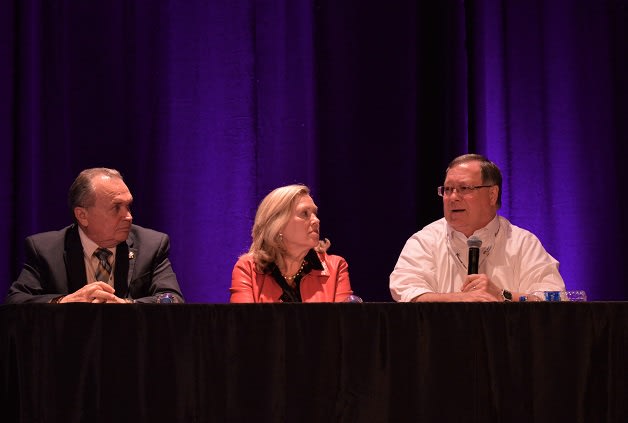
Mike LaRocco (right), president of NASDPTS, Becky Weber (center), a representative from the NSTA, and John Whetsel, a representative from the NSA, discussed several illegal passing prevention efforts during an NAPT conference town hall meeting on Monday.
4 min to read

Mike LaRocco (right), president of NASDPTS, Becky Weber (center), a representative from the NSTA, and John Whetsel, a representative from the NSA, discussed several illegal passing prevention efforts during an NAPT conference town hall meeting on Monday.
COLUMBUS, Ohio — National Association for Pupil Transportation (NAPT) conference attendees discussed the ongoing issue of illegal school bus passing and the importance of route planning and prevention with new technologies and practices during a town hall meeting here on Monday.
The meeting, sponsored by safety solutions supplier Safe Fleet, included a panel of representatives from the National School Transportation Association (NSTA), the National Association of State Directors of Pupil Transportation (NASDPTS), and the National Sheriff’s Association (NSA).
Dr. Meg Sweeney, the moderator for the meeting and representative from the National Transportation Safety Board (NTSB), provided the agency’s latest investigation details into the fatal Rochester, Ind., crash in which a motorist illegally passed a stopped school bus, killing three students and injuring one other last October.
As SBF previously reported, the NTSB released a preliminary report on the crash in February stating that the bus driver had deployed the bus’s warning lights and stop arm at the time of the crash.
During the meeting, Sweeney related the agency’s investigation into the Indiana crash to two other illegal passing incident investigations: the first in Hartfield, Ga., in which a motorist illegally passed a stopped school bus, killing one student and injuring another; and the second in Baldwyn, Miss., in which a pickup truck illegally passed a stopped school bus, killing a 9-year-old student.
Sweeney pointed out that the crash circumstances in all three incidents were similar: they all occurred on dimly lit, high-speed roadways, even while each bus driver had their bus’s stop arm and flashing lights activated.
Despite the school bus’s many safety features, Mike LaRocco, the president of NASDPTS, said that most stop-arm running incidents occur because of distracted driving.
“In most cases, we see that a motorist wasn’t paying attention because they were on the phone or texting,” he said. “We need to instill in motorists the importance of driving and driving safely.”
John Whetsel, a representative from the NSA, added that it ultimately boils down to motorists not adhering to basic traffic laws, partly because states aren’t requiring enough traffic enforcement and are banning the use of automated enforcement, such as stoplight cameras or even school bus stop-arm cameras.
Whetsel added that this is where partnerships between school transportation departments and law enforcement are deemed useful, especially when planning safe and effective bus stops and routes.
“I have never had a school district come out and ask me to assess their [bus] routes,” he said. “So, I encourage you to reach out to your [local] law enforcement officers and get input on routing.”
Several conference attendees echoed Whetsel’s recommendation, and some even cited the successes they’ve had in partnering with their local law enforcement to combat illegal passing.
For example, one conference attendee from Ohio stated that her transportation team created a safety committee to meet with law enforcement to ensure they are issuing tickets to stop-arm violators.
Another attendee from Georgia said that his district is seeing significant reductions in stop-arm violations after installing stop-arm cameras on its entire bus fleet. He added that the district went from experiencing 1,900 reported stop-arm violations per day in 2012 to now under 800 reported daily violations.
Other proposed bus passing solutions mentioned by conference attendees included ongoing mandatory license testing for all motorists, stronger illegal passing penalties, such as license suspension, and creating a mobile phone alert — similar to an amber alert — that can signal to motorists when they are approaching a school bus.
Becky Weber, the Washington, D.C., representative for the NSTA and managing director for the public relations firm Prime Policy Group, also pointed out the federal involvement that has resulted from the nation's stop-arm running epidemic.
As SBF previously reported, U.S. Rep. Walorski (R-Ind.) and Julia Brownley (D-Calif.) introduced the Stop for School Buses Act of 2019 in April. The bill aims to look into ways to prevent school bus passing incidents by directing the U.S. Department of Transportation to conduct a comprehensive review of existing laws and programs in all 50 states, recommend best practices, and create a nationwide public safety campaign.
Weber added that the NSTA is very hopeful the bill will be enacted and help further educate motorists on safety issues that can potentially change their unsafe driving behaviors.
More Safety

How to Build a Better School Bus Driver Training Program
Is it time to strengthen your driver training? Here’s how to pick the right talent and improve recruitment, retention, and safety. This video is brought to you by IC Bus.
Read More →
Recent School Bus Accidents Leave 2 Dead, 2 Injured
Four school bus crashes in Florida, Illinois, and Georgia highlight risks in transportation lots, at bus stops, and during student loading and unloading.
Read More →
Sponsored•September 8, 2026
When Every Second Matters, Clarity Keeps Routes Moving
From routine delays to urgent incidents, strong communication practices help drivers, dispatchers, schools, and families respond with confidence.
Read More →

What Happens When a School Bus Catches Fire — and What Can Help
School bus fires are rare but can be devastating. Learn how advances in fire suppression and asset protection help fleets detect fires earlier, reduce damage, and improve safety.
Read More →
Geotab Launches Tool to Help Fleets Investigate Road Incidents
Geotab Investigations combines telematics data, video, documents, and other evidence to help fleets reconstruct incidents, resolve claims, and determine what happened.
Read More →
Texas Sixth Grader Wins 2026 National School Bus Safety Poster Contest
Sai Darshana Yekolu of Moseley Middle School in Prosper, Texas, was named the newest winner for her artwork, bringing the theme of “Safe Rides, Everyday Heroes” to life.
Read More →
Sponsored•August 27, 2026
Doing More With Less: How Transportation Directors Can Prioritize Safety Amid Budget Uncertainty
With diesel prices soaring and nearly one-third of transportation directors expecting budget cuts, maintaining student safety has never been more challenging. Download this guide to learn how leading districts are prioritizing risk, funding critical safety technology, and building stronger budget cases with data.
Read More →
Walton County Schools Adds Gatekeeper Stop-Arm Enforcement System
The Florida district will deploy Gatekeeper’s updated Student Protector technology, which now incorporates AI to improve video evidence.
Read More →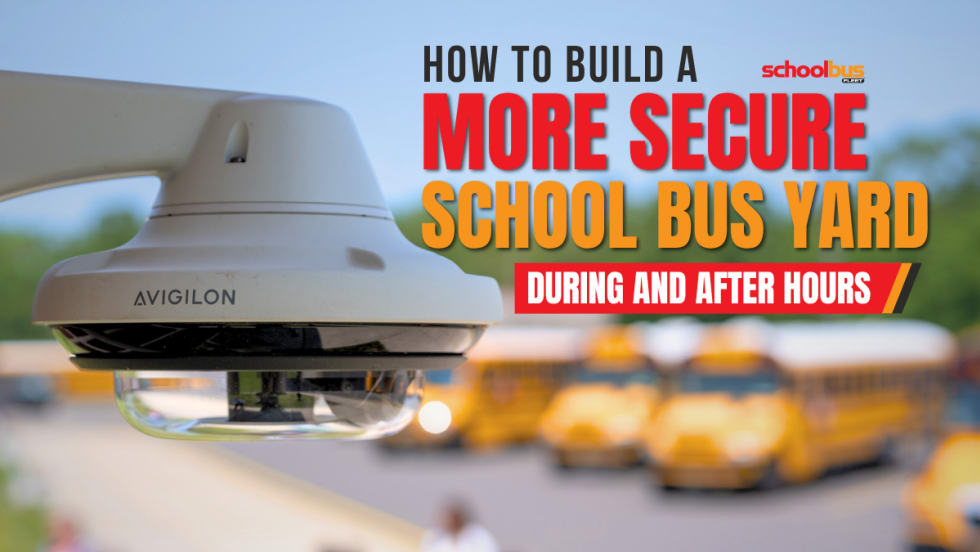
How To Build a More Secure School Bus Yard During and After Hours
As thefts and overnight security threats continue, school transportation leaders are combining stronger operational practices with AI-enabled surveillance to better protect buses, facilities, and staff.
Read More →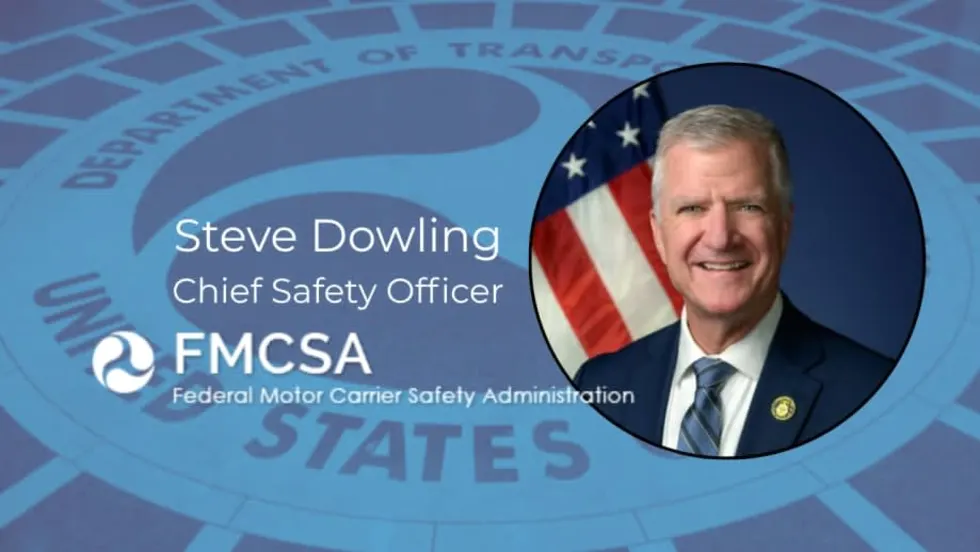
FMCSA Names New Chief Safety Officer: What School Bus Operators Should Know
Steve Dowling is set to lead the federal agency's efforts to advance commercial motor vehicle safety and reduce crashes, fatalities, and injuries on the nation's roadways.
Read More →