




How 2 School Districts Dealt With Fuel Disruption
As motorists across the U.S. rush out to fill up their gas tanks during the Colonial Pipeline disruption, one Virginia school district coordinates with its fuel vendor, while another district in Tennessee hosts virtual learning days to save fuel.

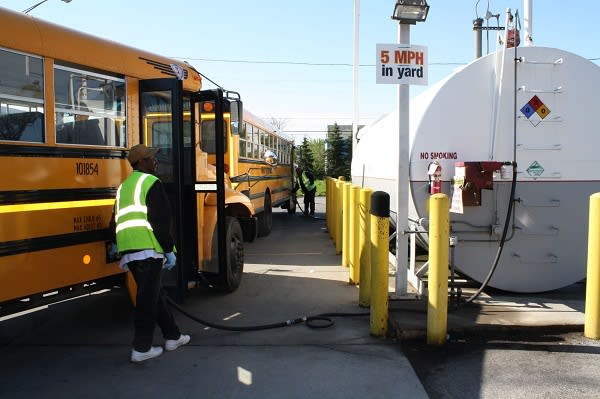
In the Southeast, states like Virginia and Tennessee experienced the far-reaching effects of the pipeline shutdown with gas shortages and increased fuel prices.
File photo courtesy John Fahey
As motorists across the U.S. rushed out to fill up their gas tanks during the six-day Colonial Pipeline disruption earlier this month, two school districts in Virginia and Tennessee took precautions, one coordinating with their fuel vendor and the other hosting virtual learning days in an effort to save fuel.
In the Southeast, states like Virginia and Tennessee experienced the far-reaching effects of the pipeline shutdown with gas shortages and increased fuel prices.
In Virginia, gas prices reached $2.87 — climbing an average of 11 cents within a two-day period between May 10 and 12, according to AAA. Last month, the agency reported the state’s average at $2.70 per gallon. Meanwhile, in Tennessee, gas prices increased from $2.70 per gallon last month to $2.89 per gallon this month, AAA reports.
Despite the higher than usual fuel prices, Jim Foley, the transportation director for Albemarle County (Va.) Public Schools, told School Bus Fleet he was thankful that his district coordinated with its fuel vendor to avoid any major issues in fueling its buses.
“We ran all [160] of our buses [during the pipeline shutdown],” he said. “Our vendor did not have a supply issue with diesel.”
However, Foley said the district did experience some issues in running low on unleaded gasoline to fuel Albemarle County’s department vehicles, including those for emergency services.
To help mitigate any challenges, Foley said he encouraged the drivers of all county vehicles to reduce their driving time when possible. In addition to that, he said Albemarle County Public Schools received an 8,500-gallon truckload of unleaded gasoline on May 12.
“Those two items got us out of the woods," Foley told SBF. “It was helpful that we had a contracted supplier that made us a priority.”
Meanwhile, in Tennessee, Dickson County Schools took a different approach to ensuring it had enough fuel to run its buses during the pipeline shutdown.
In a statement, posted on the district’s website, the district announced that it would be partnering with the Dickson County government to ensure the region had enough fuel to run its emergency and safety services vehicles. To do so, Dickson County Schools said that it would be conducting remote/distance learning for students on May 14 and May 17.
“The school system has sufficient fuel stored for the remainder of the school year,” the statement read. “[The Dickson] County government also has storage capacity to reserve fuel needed for emergency service vehicles. However, out of abundance of caution, we are proud to be able to partner so that our community does not see a disruption of emergency and safety services.”
As of press time, Dickson County Schools has returned to its normal schedule, according to Danny Weeks, the district’s director of schools.
More Management

How to Build a Better Driver Training Program
Ready to boost up your school bus instructor training? Here’s how to pick the right talent and improve recruitment, retention, and safety.
Read More →
CALSTART and Forth Combine to Form Catalyst Mobility
The new name represents a renewed vision for the nonprofit focused on advancing clean, equitable, and affordable transportation solutions that move people and goods.
Read More →
What Makes a Great School Bus Driver Trainer?
Choosing the right school bus driver trainer takes more than experience. Learn six keys to selecting and developing trainers and evaluating program effectiveness.
Read More →


School Bus Contractors Expand Through New Deals, Acquisitions & Partnerships
STA's Canadian division acquires Ontario-based G&L Stevenson Transport while Durham School Services adds a new district contract in California, First Student adds a New Jersey contract, and Minnesota Coaches acquires Halo Transportation.
Read More →
Logan Bus Company Rolls Out AI Phone System for NYC School Bus Families
A summer pilot found that AI agents could handle most routine calls, freeing up time for customer service staff to focus on emergencies and complex family concerns.
Read More →
From Intent to Impact: What I Learned About Leadership from TAPT
A Texas transportation supervisor shares lessons on self-awareness, accountability, managing stress and building trust — and why investing in leadership development matters at every stage of your career.
Read More →
NAPT Names 2026 Award Recipients, Hall of Fame Inductee
Who earned national recognition for their work in student transportation? This year, NAPT named five recipients of its 2026 awards for service, safety, and leadership, plus its newest Hall of Famer.
Read More →
2026 State of Student Transportation Report
Driver shortages. Rising costs. Growing safety expectations. More data, but not enough time to act on it. The 2026 State of Student Transportation Report reveals what transportation leaders say is putting the most pressure on their operations—and where they’re investing next. See how your priorities compare.
Read More →
How to De-Escalate an Angry Person: 5 Steps for Handling Workplace Conflict
What makes emotions run high, and how should you handle an angry colleague or parent? Follow these steps for staying calm, listening, showing empathy, and resolving conflict.
Read More →
What Readiness Looks Like This School Year
Learn about the challenges shaping the 2026–2027 school year, from persistent driver shortages and budget pressure to technology and readiness gaps. See how school districts are responding and adapting in Zonar’s 2026 Back-to-School Readiness Report.
Read More →