




Georgia Issues Back-to-School Bus Safety Message
The Georgia Department of Education urges motorists to use caution when approaching school buses and to brush up on school bus safety rules.

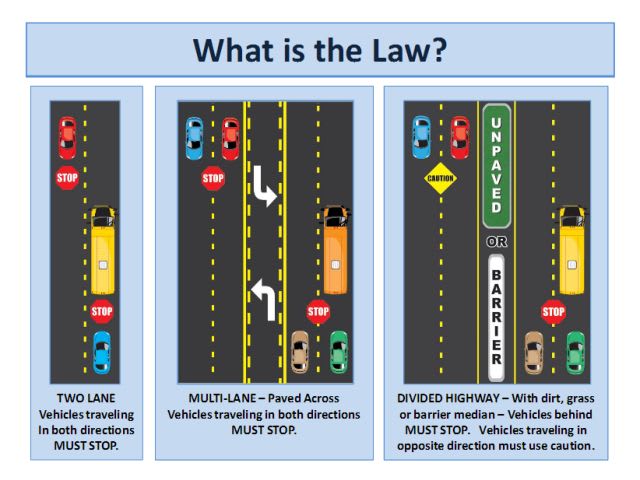
With its back-to-school safety message, the Georgia Department of Education included this diagram to show when motorists need to stop for school buses.
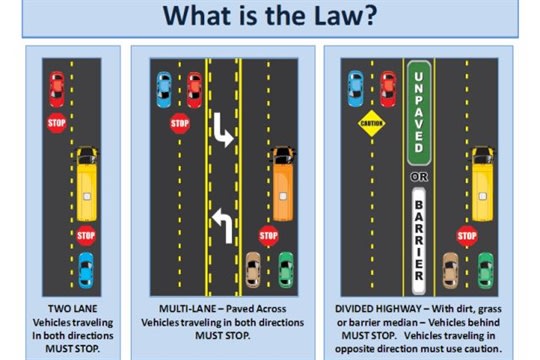
With its back-to-school safety message, the Georgia Department of Education included this diagram to show when motorists need to stop for school buses.
ATLANTA — As students return to school, the Georgia Department of Education is calling for motorists to use caution when approaching school buses and to brush up on school bus safety rules.
According to Georgia law, vehicles traveling in both directions must stop when a school bus activates its stop arm on a two-lane road or a multi-lane road with no median or barrier. Vehicles traveling in the same direction as a school bus must always stop, but motorists traveling in the opposite direction can proceed with caution when there is an unpaved median or concrete barrier separating the opposing lanes.
“I urge the public to pay close attention to school buses and get familiar with the law regarding passing stopped buses,” said Richard Woods, Georgia’s state school superintendent. “Following this law may very well mean saving a child’s life. The safety of our students as they travel to and from school is of primary importance, and I ask for the participation of all Georgians in making sure our students can travel safely.”
The Department of Education’s back-to-school safety message to the public also went into more details about the loading and unloading process for school buses: A warning that a bus stop is about to take place is given with the flashing amber lights on the front and rear of the school bus. Upon seeing these flashing amber lights, vehicles approaching the bus from the front or rear should immediately slow down and prepare to stop.
Once the bus is fully stopped, the flashing red lights will activate and the stop arm will deploy. Vehicles must stop and should remain stopped until all loading students are aboard in the morning or all unloading passengers have cleared 12 feet off the roadway in the afternoon. Motorists should proceed with caution only after passengers have cleared the roadway, the stop arm is canceled, and the flashing red lights are deactivated.
Also, the Department of Education noted, all drivers must pay special attention to children, be focused, and exercise caution when in the vicinity of a school bus stop, because student riders can sometimes be unpredictable.
“As our school buses begin to roll again, I urge drivers to be alert and exercise patience and caution, especially around children waiting at school bus stops or loading and unloading school buses,” Woods added. “Patient, informed, and law-abiding drivers ensure that our children can arrive safely at school each day, ready to learn.”
More Safety
School's Back. Here's What Happened to Traffic, Speeding & Distraction
What happens to traffic when school resumes? New data analysis examines changes in distracted driving, congestion, and speeding around schools.
Read More →
Geotab Expands Fleet Safety Tools With Video Coaching, Risk Insights
New safety and video capabilities aim to help fleet managers assess risk, support drivers, and take targeted action through video coaching, red-light violation detection, and more.
Read More →
How to Build a Better School Bus Driver Training Program
Is it time to strengthen your driver training? Here’s how to pick the right talent and improve recruitment, retention, and safety. This video is brought to you by IC Bus.
Read More →

Recent School Bus Accidents Leave 2 Dead, 2 Injured
Four school bus crashes in Florida, Illinois, and Georgia highlight risks in transportation lots, at bus stops, and during student loading and unloading.
Read More →
When Every Second Matters, Clarity Keeps Routes Moving
From routine delays to urgent incidents, strong communication practices help drivers, dispatchers, schools, and families respond with confidence.
Read More →
What Happens When a School Bus Catches Fire — and What Can Help
School bus fires are rare but can be devastating. Learn how advances in fire suppression and asset protection help fleets detect fires earlier, reduce damage, and improve safety.
Read More →
Geotab Launches Tool to Help Fleets Investigate Road Incidents
Geotab Investigations combines telematics data, video, documents, and other evidence to help fleets reconstruct incidents, resolve claims, and determine what happened.
Read More →
Texas Sixth Grader Wins 2026 National School Bus Safety Poster Contest
Sai Darshana Yekolu of Moseley Middle School in Prosper, Texas, was named the newest winner for her artwork, bringing the theme of “Safe Rides, Everyday Heroes” to life.
Read More →
Doing More With Less: How Transportation Directors Can Prioritize Safety Amid Budget Uncertainty
With diesel prices soaring and nearly one-third of transportation directors expecting budget cuts, maintaining student safety has never been more challenging. Download this guide to learn how leading districts are prioritizing risk, funding critical safety technology, and building stronger budget cases with data.
Read More →
Walton County Schools Adds Gatekeeper Stop-Arm Enforcement System
The Florida district will deploy Gatekeeper’s updated Student Protector technology, which now incorporates AI to improve video evidence.
Read More →