




GAO Issues Report on School Bus Safety
The report analyzes 15 years of crash data and surveys states’ requirements for school bus inspections and driver training.

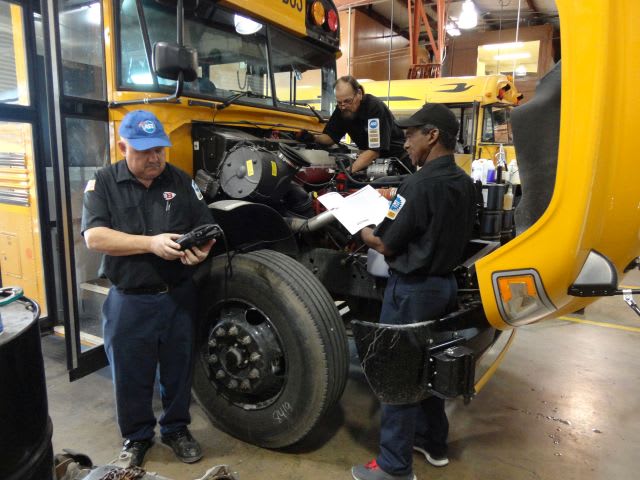
One finding of a new report from the Government Accountability Office is that all 50 states require school bus inspections, although frequency and other details vary. Photo courtesy Biloxi (Miss.) Public School District
One finding of a new report from the Government Accountability Office is that all 50 states require school bus inspections, although frequency and other details vary. Photo courtesy Biloxi (Miss.) Public School District
WASHINGTON, D.C. — A new government report on school bus safety analyzes 15 years of crash data and surveys states’ requirements for school bus inspections and driver training.
The Government Accountability Office (GAO) report, released on Thursday, was required by the Fixing America's Surface Transportation Act, the highway bill passed in December 2015. GAO is the investigative arm of Congress
Over the past year, GAO examined fatal crashes involving school buses from 2000 to 2014 and federal and state school bus regulations. Overall, the GAO report shows a relatively low incidence of fatal school bus crashes and an abundance of regulations, some of which vary from state to state.
“School buses have a strong safety record, but school bus crashes with fatalities and injuries still occur and are often high-profile, since they involve precious cargo — the nation’s schoolchildren,” GAO said in the report. “Thus, government agencies, student transportation groups, and others strive to further improve the safety of school buses.”
For its school bus crash analysis, GAO used two sets of data, from the National Highway Traffic Safety Administration and the University of Michigan Transportation Research Institute. GAO found that from 2000 to 2014, there was an annual average of 115 fatal crashes that involved school buses. Those made up 0.3% of the 34,835 total fatal motor vehicle crashes on average each year.
According to the GAO analysis, the school bus driver was determined to be a contributing factor in 27% of the fatal school bus crashes, while the school bus itself (for example, a vehicle defect) was cited as a contributing factor in less than 1% of the crashes.
"School buses are very safe," Susan Fleming, director of GAO's physical infrastructure team, said in an email to SBF. "Federal laws and regulations set requirements for certain aspects of school bus safety, and state laws and regulations in many cases go beyond the federal requirements."
Another noteworthy crash-related finding from the report: “School bus crashes constituted less than 1 percent of all crashes in 6 of our selected states for which annual crash reports included a section on school bus crashes.”
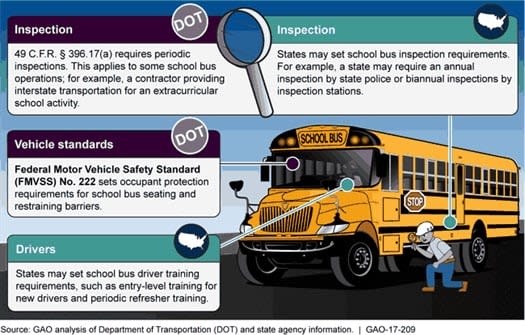
An infographic from the GAO report provides details on some federal and state school bus regulations.
The GAO report also explains federal oversight of pupil transportation, including the CDL requirements for school bus drivers and the federal motor vehicle safety standards that apply to school buses.
GAO also identified differences from state to state for some pupil transportation requirements. For example, the report found that all 50 states require school bus inspections, although there are variations in the frequency of the inspections and the agency conducting them.
In the realm of driver training, GAO found that 44 states require entry-level training and 44 states require refresher training for all school bus drivers. As with inspection rules, the frequency, length, and other details of the training vary across states.
The report notes that the Federal Motor Carrier Safety Administration recently established national minimum training standards that will apply to entry-level commercial vehicle operators, including school bus drivers.
The GAO report also provides details on state requirements for the maximum age and seating capacity of school buses.
To view the GAO report, go here.
The release of the report, which was in the works since February 2016, came a day after three congressmen requested a hearing on school bus safety in response to recent high-profile crashes in their states.
More Safety

How to Build a Better School Bus Driver Training Program
Is it time to strengthen your driver training? Here’s how to pick the right talent and improve recruitment, retention, and safety. This video is brought to you by IC Bus.
Read More →
Recent School Bus Accidents Leave 2 Dead, 2 Injured
Four school bus crashes in Florida, Illinois, and Georgia highlight risks in transportation lots, at bus stops, and during student loading and unloading.
Read More →
When Every Second Matters, Clarity Keeps Routes Moving
From routine delays to urgent incidents, strong communication practices help drivers, dispatchers, schools, and families respond with confidence.
Read More →

What Happens When a School Bus Catches Fire — and What Can Help
School bus fires are rare but can be devastating. Learn how advances in fire suppression and asset protection help fleets detect fires earlier, reduce damage, and improve safety.
Read More →
Geotab Launches Tool to Help Fleets Investigate Road Incidents
Geotab Investigations combines telematics data, video, documents, and other evidence to help fleets reconstruct incidents, resolve claims, and determine what happened.
Read More →
Texas Sixth Grader Wins 2026 National School Bus Safety Poster Contest
Sai Darshana Yekolu of Moseley Middle School in Prosper, Texas, was named the newest winner for her artwork, bringing the theme of “Safe Rides, Everyday Heroes” to life.
Read More →
Doing More With Less: How Transportation Directors Can Prioritize Safety Amid Budget Uncertainty
With diesel prices soaring and nearly one-third of transportation directors expecting budget cuts, maintaining student safety has never been more challenging. Download this guide to learn how leading districts are prioritizing risk, funding critical safety technology, and building stronger budget cases with data.
Read More →
Walton County Schools Adds Gatekeeper Stop-Arm Enforcement System
The Florida district will deploy Gatekeeper’s updated Student Protector technology, which now incorporates AI to improve video evidence.
Read More →
How To Build a More Secure School Bus Yard During and After Hours
As thefts and overnight security threats continue, school transportation leaders are combining stronger operational practices with AI-enabled surveillance to better protect buses, facilities, and staff.
Read More →
FMCSA Names New Chief Safety Officer: What School Bus Operators Should Know
Steve Dowling is set to lead the federal agency's efforts to advance commercial motor vehicle safety and reduce crashes, fatalities, and injuries on the nation's roadways.
Read More →