




Campaign aims to curb stop-arm violations in South Carolina
David Poag of Anderson School District Five tells SBF about the goals of the S.A.V.E. (Stop-Arm Violation Education Enforcement) campaign, which include making school bus stops in the state safer and creating awareness among the public and state legislators about the dangers of stop-arm violations. Sen. Thomas Alexander introduces legislation supporting one of the campaign's goals, telling SBF, “It’s hard for me to imagine how someone would pass the arm of a stopped school bus.”
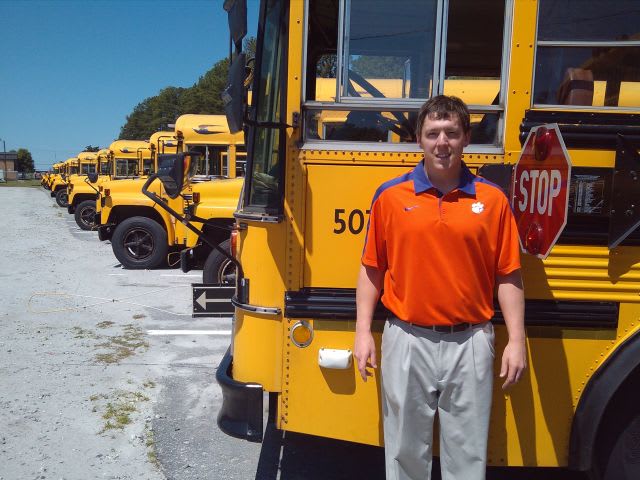
David Poag, operations and routing supervisor for Anderson School District Five, said AngelTrax has supported his S.A.V.E. campaign by providing demos of its stop-arm camera for the district’s buses to track violations.
ANDERSON, S.C. — David Poag, operations and routing supervisor for Anderson School District Five, has created a stop-arm violation awareness campaign, and a bill has been introduced in the state Legislature to support one of its goals.
Poag told SBF that in his position at the district, he witnesses and hears about stop-arm violations all the time, and his desire to see these occurrences reduced is what led him to develop the S.A.V.E. (Stop-Arm Violation Education Enforcement) campaign, particularly after researching how many students in South Carolina have been injured or killed from the violations.
Poag has several goals with the campaign, including making school bus stops in the state safer and encouraging other states in the nation to move forward with campaigns against stop-arm violations, and to use monies collected from violations caught by video surveillance cameras to advertise and educate statewide through billboards, literature for driver’s education classes, etc., about the dangers that stop-arm violations create.
He said he would also like to educate motorists on South Carolina’s law as it pertains to passing a stopped school bus.
Another of Poag’s goals is awareness and support at the legislative level, and in this regard, he has made progress. He reached out to Sen. Thomas Alexander about proposing legislation to use video evidence from stop-arm cameras outfitted on school buses to issue civil fines directly to the registered owners of vehicles who illegally pass stopped school buses.
On May 22, Alexander introduced S.718 in the South Carolina Legislature.
“My goal is to get the bill introduced prior to us adjourning the session in the first week of June so that in the interim, we can do some work on it to hopefully have it move forward when we return in January,” Alexander told SBF prior to introducing the bill. “It’s hard for me to imagine how someone would pass the arm of a stopped school bus. I can’t fathom how someone would put children’s safety at risk from that standpoint.”
S.718 would amend South Carolina law to provide that a motorist would be found liable of a civil penalty for overtaking a stopped school bus if the violation is captured on a video surveillance camera mounted on the bus.
Those found guilty from the video evidence of a stop-arm violation would be subject to a $100 fine for a first offense, $200 for a second offense and $1,000 for each subsequent offense in a five-year period.
“This is really exciting,” Poag said after the legislation was introduced. “I think the biggest question right now is who will pay for the cameras. Hopefully, they will leave that up to the districts and not burden the state with that expense — then hopefully a company would come in as they have done in Georgia and furnish/maintain the cameras for free in agreement that they receive a large portion of the collected fines.”
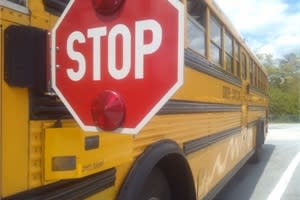
Zen-tinel also supported Poag’s campaign by providing demo stop-arm cameras for Anderson School District Five buses. Poag conservatively estimates that his district has about 738 stop-arm violations per school year.
Poag said that Anderson School District Five Director of Transportation Darryl Webb has provided him with a lot of encouragement and support in getting his campaign off the ground and spreading the word about it.
AngelTrax and Zen-tinel have also supported his campaign by providing the district with demo stop-arm cameras over the past several months, but Poag noted that he has no allegiance to specific vendors.
“My sole purpose is to reduce the amount of innocent children killed and injured at South Carolina bus stops by vehicles illegally passing school buses, and I want our district to be a model in terms of bringing the issue to the state,” Poag said. “For about one month, we had about eight or nine violations that we caught on camera with the four buses that we had demos on, and of those, we had a clear picture for four of those violations, so that’s what I’m basing my numbers on. If we’d had a camera on all 82 of our buses during that one-month period, we would have had 82 violations, and I feel that is a pretty conservative number because I know there are violations that were probably not captured. Multiply that by nine months in the school year, and we’re talking about 738 violations in our school district alone.”
To learn more about the S.A.V.E. campaign, go to www.savecampaign.com, and visit its page on Facebook at www.facebook.com/StopArmViolationEnforcementEducation.
Below is a video that Poag created of stop-arm violations. The first incident shown in the video is the well-publicized violation that occurred in Charleston, W.Va. in 2008. Poag said the rest of the incidents in the video are those that were captured by the stop-arm cameras on Anderson School District Five's buses.
More Safety
Geotab Expands Fleet Safety Tools With Video Coaching, Risk Insights
New safety and video capabilities aim to help fleet managers assess risk, support drivers, and take targeted action through video coaching, red-light violation detection, and more.
Read More →
How to Build a Better School Bus Driver Training Program
Is it time to strengthen your driver training? Here’s how to pick the right talent and improve recruitment, retention, and safety. This video is brought to you by IC Bus.
Read More →
Recent School Bus Accidents Leave 2 Dead, 2 Injured
Four school bus crashes in Florida, Illinois, and Georgia highlight risks in transportation lots, at bus stops, and during student loading and unloading.
Read More →

When Every Second Matters, Clarity Keeps Routes Moving
From routine delays to urgent incidents, strong communication practices help drivers, dispatchers, schools, and families respond with confidence.
Read More →
What Happens When a School Bus Catches Fire — and What Can Help
School bus fires are rare but can be devastating. Learn how advances in fire suppression and asset protection help fleets detect fires earlier, reduce damage, and improve safety.
Read More →
Geotab Launches Tool to Help Fleets Investigate Road Incidents
Geotab Investigations combines telematics data, video, documents, and other evidence to help fleets reconstruct incidents, resolve claims, and determine what happened.
Read More →
Texas Sixth Grader Wins 2026 National School Bus Safety Poster Contest
Sai Darshana Yekolu of Moseley Middle School in Prosper, Texas, was named the newest winner for her artwork, bringing the theme of “Safe Rides, Everyday Heroes” to life.
Read More →
Doing More With Less: How Transportation Directors Can Prioritize Safety Amid Budget Uncertainty
With diesel prices soaring and nearly one-third of transportation directors expecting budget cuts, maintaining student safety has never been more challenging. Download this guide to learn how leading districts are prioritizing risk, funding critical safety technology, and building stronger budget cases with data.
Read More →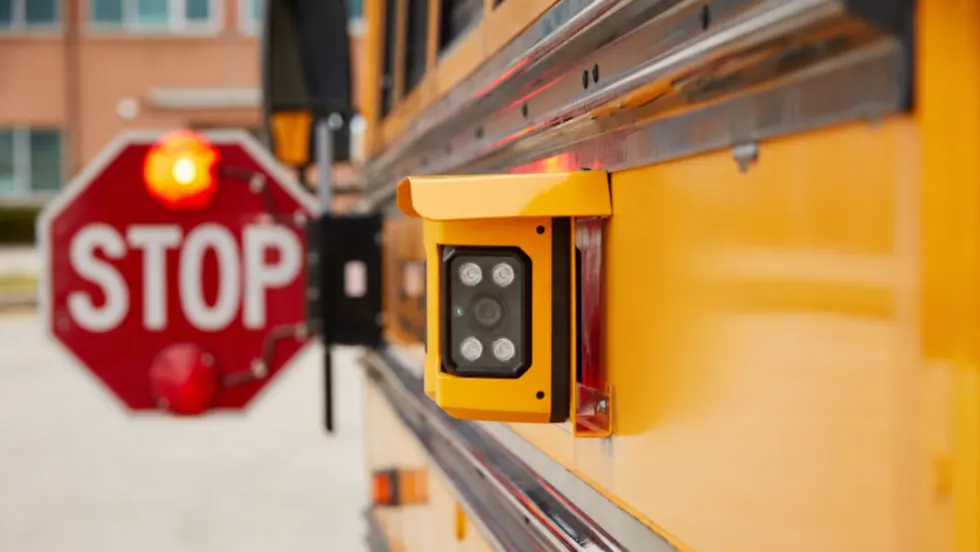
Walton County Schools Adds Gatekeeper Stop-Arm Enforcement System
The Florida district will deploy Gatekeeper’s updated Student Protector technology, which now incorporates AI to improve video evidence.
Read More →
How To Build a More Secure School Bus Yard During and After Hours
As thefts and overnight security threats continue, school transportation leaders are combining stronger operational practices with AI-enabled surveillance to better protect buses, facilities, and staff.
Read More →