




ACT: Half of Class 4-8 Sales to be BEV by 2035
Battery-electric Class 4-8 vehicles already show positive total cost of ownership compared to conventional vehicles in three-quarters of the applications examined by ACT Research in an extensive analysis.

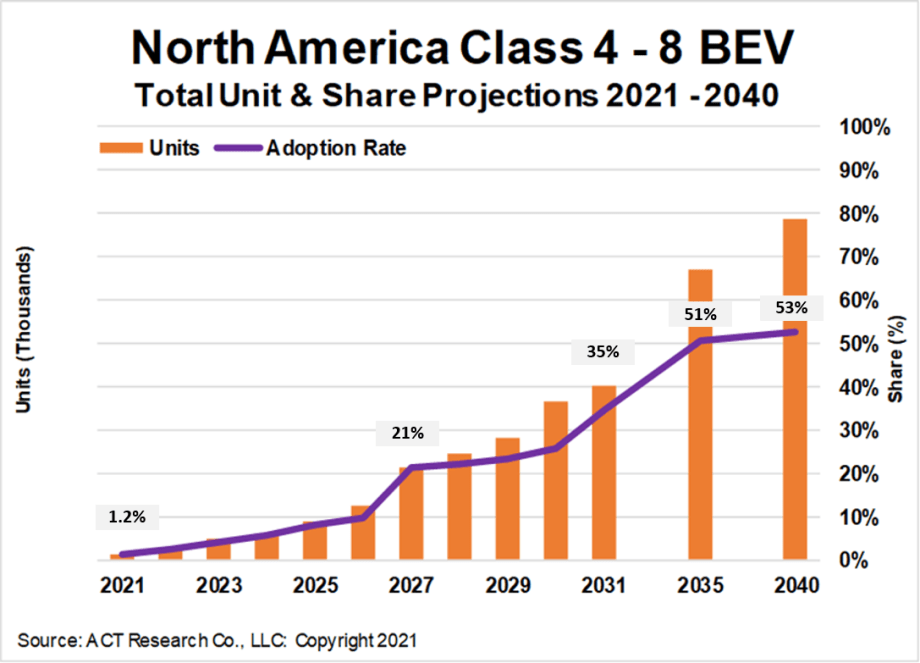
Factors such as battery technology advancements and charging infrastructure will affect BEV adoption rates in some commercial applications.
Credit: ACT Research
Battery-electric Class 4-8 vehicles already show positive total cost of ownership compared to conventional vehicles in three-quarters of the applications examined by ACT Research in an extensive analysis. By 2030, the research firm says, that will rise to 100%. By 2040, 30% of those applications will reach price parity between BEV and conventional powertrains.
In fact, the firm projects that battery-electric vehicles will make up more than half of the Class 4-8 vehicles sold in the U.S. and Canada by 2035.
These gains will be achieved through compelling business cases, as continuing technology improvements and cost reductions make commercial battery-electric vehicles more attractive. Regulations and incentives can help, but ACT says those aren’t the dominant factor in the growth of commercial BEV market share.
These are key findings in ACT’s second edition of its Charging Forward report. ACT Research analyzed and built economic-based, total-cost-of-ownership algorithms to plot baseline, slow-case, and fast-case scenarios for adoption of 23 work applications of Class 4-8 vehicles across North America.
ACT looked at all vehicle-related costs over the full vehicle life, including purchase price, battery/fuel cell replacement, maintenance, fuel, charging infrastructure, acquisition taxes, road use taxes, insurance, and weight penalties.
For total cost of ownership, ACT reports that a battery-electric medium-duty box truck already beats out one with a traditional diesel engine. And once new EPA diesel emissions regulations drive up traditional powertrain costs in 2027 (2024 in California), that comparison will tilt further in favor of BEVs.
“Everybody’s natural expectation is that low-GVW vehicles would see faster BEV adoption,” said Ann Rundle, who joined ACT Research a little more than a year ago as VP of electrification and autonomy, in an interview. “In fact, the higher adoption in our model is Class 6-7." ACT sees Class 4-5 shifting more to gasoline engines than BEV as diesel engine systems start to increase in cost as a result of the 2027 EPA lower NOx regulations.
In comparison, for Class 8 tractors, the TCO will favor diesel over electric until those NOx regulations kick in.
Future trends ACT identifies as key in the growth in EV adoption include:
Falling costs for batteries and fuel cells
Rising costs for diesel powertrains to meet upcoming emissions regulations
Improving powertrain efficiency for both internal combustion and EVs
Rising battery-pack energy density
Zero-emissions sales mandates
Bans on internal combustion and/or diesel engines
Refined TCO Models
This second edition took advantage of ACT’s global commercial electric vehicle analysis, “Power Up,” to refine TCO models and adoption rate forecasts for North America.
For instance, the new analysis provided better understanding of where the costs of battery packs are going and how they will be different for commercial vehicles than passenger cars, Rundle explained in an interview. There is a more in-depth discussion and reporting on regulations and incentives, which help drive adoption rates higher in the earlier years of ACT’s analysis. For instance, between when the first report was published and this second edition, more states have adopted California emissions regulations.
The new report expands on topics such as the propulsion systems and battery recycling, and there’s a new “well-to-wheel” analysis. For those who purchase the report, it comes with spreadsheets allowing users to plug in their own numbers for TCO analysis.
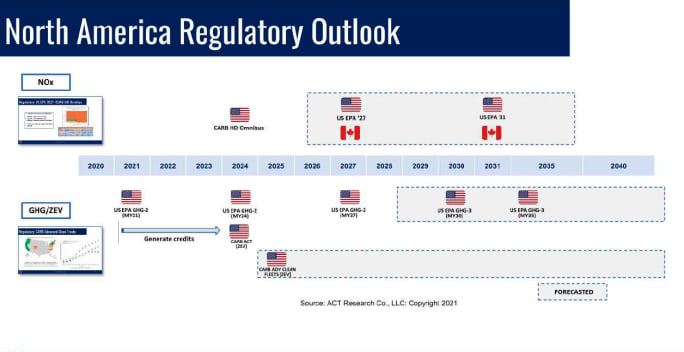
Upcoming emissions regulations are expected to drive up the cost of conventional diesel drivetrains, which will need additional aftertreatment.
Credit: ACT Research
Hydrogen Fuel Cells
ACT is not as bullish on hydrogen fuel cells as it is on battery-electric, saying FCEVs are challenged by durability and costs.
The report notes that for its Class 8 day-cab application model, fuel-cell electric vehicles will eventually offer better TCO than diesel, but not better than battery-electric. In the meantime, an internal-combustion-engine powertrain will have better TCO than either BEV or FCEV for this application until NOx regs tighten.
Some of the challenges the report notes on FCEV commercial vehicles include:
Existing fuel-cell systems cost an average of $350-$450 per kW, many times the Department of Energy’s goal of $80.
The system durability today is about 5,000 hours, but to be on par with diesel it would have to improve to 25,000 hours – a 500% improvement.
To put a fuel-cell system on price parity with a diesel, ACT said, would need to be 30,000 hours and a cost of $60/kW, according to Department of Energy figures.
There are challenges in building out a refueling infrastructure that would use “green” hydrogen. Current hydrogen is mostly produced through methods that are not sustainable.
What About RNG?
Rundle told HDT that although the report did not include natural gas in its comparisons, it deserves consideration.
So for its next edition, ACT will be adding a natural gas analysis — what are the CO2 emissions, what are the costs, how will tighter NOx regulations affect the balance of natural-gas engines vs. diesel or gasoline, etc. And when you factor in renewable natural gas, made from biomass or captured methane from landfills and dairy, there’s an additional greenhouse gas benefit at the source.
Rundle has been in the industry long enough to remember previous attempts at developing alternative propulsion systems, including hydraulic hybrids and diesel-electric hybrids when she was at Eaton. She’s seen EV startups such as Smith Electric come and go. When asked what’s different this time, she answered, “The technology is there. Technology has improved that much.”
Corrections: Updated Feb. 15, 2022, to make the following corrections: By 2040, about 30% of the applications will reach price parity, not "about half" as originally reported. The price for a fuel-cell system to be on parity with diesel would need to be $60/kW (a DOE figure), not $50. ACT sees Class 4-5 shifting to gasoline engines, not natural gas, as diesel engine systems start to increase.
Originally posted on Heavy Duty Trucking
More Alternative Fuels

CALSTART and Forth Combine to Form Catalyst Mobility
The new name represents a renewed vision for the nonprofit focused on advancing clean, equitable, and affordable transportation solutions that move people and goods.
Read More →
Alt-Fuel Moves: New Buses, Charging Hubs & Real-World EV Testing
Propane and electric school bus deployments continue to grow as districts add new vehicles, expand charging infrastructure, and gather more real-world operating data.
Read More →
Fewer Electric School Bus Models Reshape the U.S. Market
WRI’s latest buyer’s guide points to a consolidating electric school bus market, but fewer options may reflect a maturing industry rather than fewer meaningful choices for school bus operators.
Read More →
The Fuel Budget You Can Actually Predict: How Propane Autogas Keeps Money in the Classroom
Learn how propane autogas helps school districts manage fuel costs with predictable pricing, lower maintenance, and reduced emissions from former transportation director Joel Stutheit.
Read More →
Hendrickson, Driventic Introduce New Electric Powertrain for School Buses
ELECTRAAX, the electrified, lightweight drive axle offers integrated ePowertrain efficiency and modular flexibility for Class 6–7 school bus use.
Read More →
The Mobility House Joins PowerFlex in Fleet Electrification Deal
The acquisition combines intelligent charging software, bidirectional charging expertise, and fleet electrification services to support the growing adoption of electric school buses across North America.
Read More →
Alt-Fuel Moves: Electric School Bus Investments Hit the Road
See which districts across the U.S. are putting electric school buses into service, expanding charging infrastructure, and planning the next phase of fleet electrification.
Read More →
With Fuel Volatility Ahead, School Districts Turn to Propane
While diesel prices peaked above $5 this spring, districts with propane autogas-powered fleets paid under $2 per gallon, according to PERC.
Read More →
EPA Unveils Proposed Changes to 2027 Heavy-Duty Engine Rules
The federal agency has proposed changes to next year’s targets that would eliminate DEF derates, ease warranty requirements, and retain current NOx emissions standards.
Read More →
Alt-Fuel Moves: EV Charging & Infrastructure Projects Gain Momentum
The latest developments include new funding, charging infrastructure, utility investments, and fleet technologies designed to support the transition to electric school buses nationwide.
Read More →