




Previously: NSTA Participates in National School Bus Safety Week Event with Pennsylvania Congressman
NSTA Emphasizes School Transportation at the Midwest Commercial Vehicle Safety Summit
From NHTSA safety data to NCST standards and stop-arm passing prevention, NSTA reinforces the role of school buses in protecting students and improving traffic safety.
by Patrick Dean, NSTA President
February 13, 2026
School buses remain the gold standard in transportation safety, and the work to protect kids doesn’t stop at the bus door.
Credit:
School Bus Fleet
3 min to read
At the 2025 Midwest Motor Vehicle Safety Summit in Kansas City, Missouri, last December, the National School Transportation Association (NSTA) took center stage to highlight the critical importance of student transportation safety.
NSTA’s Executive Director Curt Macysyn represented the association during a featured session titled “Protecting Our Most Precious Passengers: Advancing School Bus Safety.” The session brought together student transportation professionals and law enforcement leaders to explore technology innovations, regulations, and best practices in school transportation.
During his presentation, Macysyn emphasized that school buses remain the gold standard in student transportation safety. Drawing on data from the National Highway Traffic Safety Administration (NHTSA), he underscored why school buses continue to be the safest way for students to travel to and from school. On a typical school day, approximately 25 million students ride school buses nationwide, making them the most widely used form of transportation for school-aged children. According to NHTSA, students are about 70 times more likely to get to school safely when riding a school bus instead of a car.
Macysyn highlighted the foundational role of vehicle design and manufacturing in ensuring safety, referencing rigorous testing standards such as the Colorado Racking Test, which simulates rollover conditions to protect passengers, and the Kentucky Pole Test, which evaluates roof strength during impacts. Major school bus manufacturers have voluntarily adopted both standards to further enhance safety.
In addition to vehicle design, Macysyn pointed out the broader community benefits of school bus transportation. A single school bus can remove up to 36 passenger vehicles from local roadways, reducing congestion and lowering overall traffic risk in our communities. These design and manufacturing safeguards are further reinforced by specialized training requirements for school bus drivers, who receive instruction tailored specifically to transporting students safely.
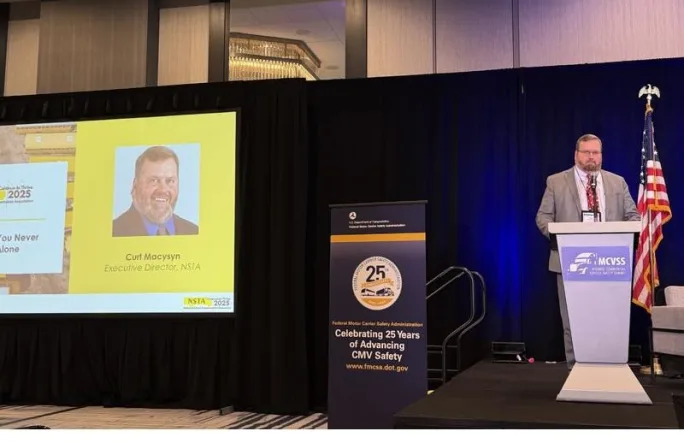
NSTA brought school transportation into the spotlight at the Midwest Commercial Vehicle Safety Summit. Here, NSTA’s Curt Macysyn presents to the crowd.
Credit:
NSTA
Macysyn also addressed the high level of industry self-regulation within school transportation operations, vehicle specifications, and driver training. These standards are developed and reviewed through the National Congress on School Transportation (NCST), which promotes consistency in vehicle construction, driver qualifications, and operational best practices across states. He noted that during the 2025 NCST, state delegates reviewed two school bus specification proposals along with numerous operational, fleet, and safety initiatives. These efforts culminated in the publication of the NCST Specifications and Procedures Manual (NSTSP) in October 2025. Several states have since taken steps to adopt the NCST specifications as part of their regulatory framework.
The presentation also addressed ongoing public policy challenges impacting student safety, particularly with motorist behavior around stopped school buses. Illegal passing of school buses with their red lights on remains a serious nationwide concern, especially when students are boarding or exiting buses. To combat this issue, Macysyn highlighted the Brake for Kids Act (H.R. 2348 / S. 2812), a federal legislative proposal aimed at strengthening enforcement and increasing public awareness regarding illegal school bus passing. The bill remains under consideration in Washington, D.C., and is a primary advocacy initiative for NSTA.
Additionally, Macysyn featured a public awareness video campaign produced by the Michigan Association of Pupil Transportation in partnership with Roush Fenway Keselowski (RFK) Racing. NSTA and other industry organizations launched the campaign during National School Bus Safety Week, and Macysyn encouraged attendees to view the video and accompanying press release.
Macysyn concluded by reinforcing the unique and vital role school buses play in communities nationwide. By providing safe, reliable transportation, school buses are essential to ensuring students’ access to education. The industry’s commitment to rigorous standards, proactive advocacy, and continuous improvement underscores why school buses remain the safest mode of transportation for school-aged children.
Through advocacy, education, leadership, and collaboration, NSTA continues to safeguard the national student transportation landscape. By representing the industry at national forums, advancing legislative and technological solutions, and supporting professional development, NSTA demonstrates that school bus safety is more than a standard; it is a nationwide commitment impacting millions of children every day.
If you want to learn more about NSTA advocacy efforts, please contact me at president@yellowbuses.org. Remember, with NSTA, you never travel alone.
Quick Answers
The NSTA emphasizes school transportation safety because school buses play a crucial role in protecting students and improving overall traffic safety. This is a top priority for NSTA's member businesses.
*Summarized by AI
Subscribe to Our Newsletter
More Blog Posts
NSTA Talks School Bus Safety, Workforce Issues with DOT Secretary & Michigan Congressman
Contractor association leaders met with U.S. Transportation Secretary Sean Duffy and Rep. Tom Barrett to discuss illegal passing, CDL requirements, driver recruitment, and other back-to-school priorities.
Read More →
Student Transportation Leaders Gather at NSTA Annual Meeting & Convention
Patrick Dean recaps key moments from NSTA’s 2026 Annual Meeting & Convention, including advocacy efforts, AI discussions, OEM insights, and federal policy updates.
Read More →
School Bus Contractor Association Brings Key Policy Issues to FMCSA
Federal policy, CDL testing, insurance, and compliance were among the key topics as NSTA leaders met with FMCSA to advance priorities for school bus contractors.
Read More →
NSTA Engages School Boards on Outsourcing Student Transportation Services at COSSBA Conference
What benefits does using contracted providers bring to districts and students? That’s what NSTA shared at a recent conference for education leaders. Here are the highlights.
Read More →
NSTA Advances Legislative Priorities During 2026 Capitol Hill Bus-In
Members of the industry’s contractor’s association traveled to Washington, D.C. to advocate for two key initiatives during congressional meetings.
Read More →
NSTA Participates in National School Bus Safety Week Event with Pennsylvania Congressman
The industry's contractor association and Rep. Brian Fitzpatrick spotlight rising dangers from illegal school bus passings and outline new legislative efforts.
Read More →
Senate Introduction of Brake for Kids Act Marks School Bus Safety Milestone
The legislation seeks to launch a national awareness campaign reminding motorists to stop for school buses. With millions of violations each year, it’s time to make school bus safety a national priority.
Read More →
From Steel to Semiconductors: How Tariff Policy May Impact School Transportation
Tariffs may feel far from the yellow bus, but they affect costs, supply chains, and technology in student transportation. Here’s what you need to know.
Read More →
Building the Future of Student Transportation: Highlights from NSTA’s 2025 Annual Meeting and Convention
From drivers to contractor-member companies, NSTA’s 2025 Annual Meeting in Boston celebrated school bus excellence while spotlighting trends shaping student transportation.
Read More →
Inside the Process: School Bus Safety Subcommittee's Review of FMCSA Proposals
New FMCSA proposals could reshape school bus operations. Here’s how the national contractor’s association is responding to possible changes on railroad crossings and inspection and medical reports.
Read More →