




Also Read: Intense Focus on Curbing Illegal School Bus Passings Urgently Needed in Next Congress
NSTA Alarmed by NHTSA Illegal Passing Study Results
Illegal school bus passing remains a dangerous issue. A national survey reveals the reasons, sparking renewed efforts for a public awareness campaign.
by Dan Kobussen, NTSA President
April 3, 2025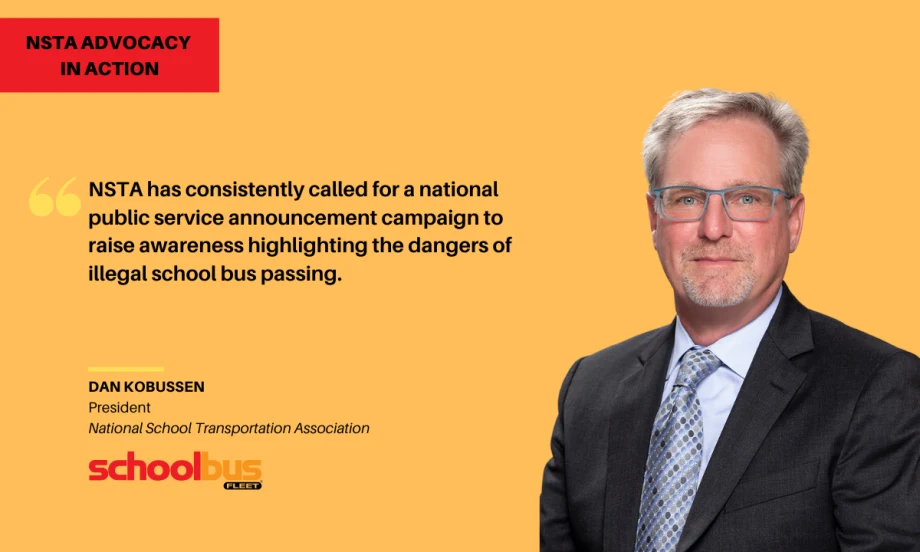
A troubling trend: More than 30% of drivers admit they “don’t care” about school bus passing laws.
Photo: SBF/Canva
4 min to read
On November 11, 2024, the National Highway Traffic Safety Administration (NHTSA) published a report titled “Driver Knowledge of School Bus Passing Laws: A National Survey.”
This survey was a result from a provision of the original NSTA-led “STOP for School Buses Act.” It was included within the Infrastructure Investment and Jobs Act (IIJA), signed by President Joe Biden on November 15, 2021.
According to the report:
Despite the persistence of this (illegal passing) safety problem across decades, to date very little research has focused on determining why drivers illegally pass stopped school buses when the consequences of striking a child can be so severe. One potential explanation is that drivers simply do not understand when they are required to stop based on the traffic laws of the jurisdictions in which they are driving. One survey conducted 26 years ago explored driver knowledge of passing laws (Baltes, 1998) and found that even in the most common roadway condition where a driver will encounter a stopped school bus (a two-lane undivided roadway), 14% of drivers were still unaware they needed to stop when the school bus displayed red lights and extended its stop-arm. More information is needed to better understand to what extent a lack of knowledge regarding when a driver must stop could be playing a role in why drivers continue to pass stopped school buses with such great frequency.”
The goal of this study was to ascertain why drivers across the country continue to illegally pass stopped school buses. As we know, the consequences of these illegal activities can have severe results, and we have seen occurrences continually increase in frequency over the years.
The study surveyed over 3,500 drivers from throughout the United States to gain insight on this vexing problem, and it employed a cross-sectional survey design, targeting a diverse sample of licensed drivers from various regions. Participants were queried on their knowledge of specific school bus passing laws, scenarios requiring a stop, perceived enforcement intensity, and personal attitudes toward these regulations. Demographic data was also collected to analyze trends across different driver populations.
The survey results found several trends. While most drivers acknowledged laws requiring stopping for school buses, their detailed knowledge on how to behave varied significantly. Many participants were uncertain about specific situations, such as divided highways or multi-lane roads, thus leading to inconsistent compliance. A sizable portion of drivers believed that stopping was only necessary when traveling in the same direction as the bus, even on undivided roadways. Others were unaware of the requirement to stop for an oncoming school bus while on two-lane roads without a physical median.
Another key area uncovered in the study revolved around enforcement. A significant number of respondents felt that enforcement of school bus passing laws was lax. This perception potentially contributes to actual non-compliance with laws, as drivers may not fear repercussions for violations. Additionally, younger drivers and drivers from urban areas displayed lower levels of knowledge compared to older and rural counterparts. This disparity suggests the need for targeted educational campaigns.
Several responses of driver perception that NSTA found particularly alarming were that 31.9% of respondents felt that illegal passings occur because drivers “don’t care” and 25.6% of respondents believe it occurs when drivers are “in a rush.”
The study resulted in several recommendations including enhanced enforcement of illegal passing laws, improving driver education, the addition of clear signs in areas where school bus stops are located, and increased community engagement with parents, schools, and other organizations to continue raising awareness. Notably, regarding public awareness campaigns, NSTA has consistently called for a national public service announcement (PSA) campaign to raise awareness highlighting the dangers of illegal school bus passing.
On March 26-27, 2025, NSTA members head to Capitol Hill to advocate for the Brake for Kids Act, which calls for a national public safety messaging campaign involving television and radio advertisements on this issue to educate the public that illegal passing of a stopped school bus is illegal and can have grave consequences. This bipartisan initiative is being spearheaded in the U.S. House of Representatives by Congressmen Pete Stauber (MN-08), Rudy Yakym (IN-02), and Congresswoman Julia Brownley (CA-26). Additionally, we welcome support from anyone who believes this issue is of critical importance to students, schools, and communities.
If you would like to find out more about other NSTA activities and priorities, drop me a line at president@yellowbuses.org. I am always interested in receiving input from those supporting student transportation from around the country. And remember, with NSTA, you never travel alone.
Subscribe to Our Newsletter
More Blog Posts

Student Transportation Leaders Gather at NSTA Annual Meeting & Convention
Patrick Dean recaps key moments from NSTA’s 2026 Annual Meeting & Convention, including advocacy efforts, AI discussions, OEM insights, and federal policy updates.
Read More →
School Bus Contractor Association Brings Key Policy Issues to FMCSA
Federal policy, CDL testing, insurance, and compliance were among the key topics as NSTA leaders met with FMCSA to advance priorities for school bus contractors.
Read More →
NSTA Engages School Boards on Outsourcing Student Transportation Services at COSSBA Conference
What benefits does using contracted providers bring to districts and students? That’s what NSTA shared at a recent conference for education leaders. Here are the highlights.
Read More →
NSTA Advances Legislative Priorities During 2026 Capitol Hill Bus-In
Members of the industry’s contractor’s association traveled to Washington, D.C. to advocate for two key initiatives during congressional meetings.
Read More →
NSTA Emphasizes School Transportation at the Midwest Commercial Vehicle Safety Summit
From NHTSA safety data to NCST standards and stop-arm passing prevention, NSTA reinforces the role of school buses in protecting students and improving traffic safety.
Read More →
NSTA Participates in National School Bus Safety Week Event with Pennsylvania Congressman
The industry's contractor association and Rep. Brian Fitzpatrick spotlight rising dangers from illegal school bus passings and outline new legislative efforts.
Read More →
Senate Introduction of Brake for Kids Act Marks School Bus Safety Milestone
The legislation seeks to launch a national awareness campaign reminding motorists to stop for school buses. With millions of violations each year, it’s time to make school bus safety a national priority.
Read More →
From Steel to Semiconductors: How Tariff Policy May Impact School Transportation
Tariffs may feel far from the yellow bus, but they affect costs, supply chains, and technology in student transportation. Here’s what you need to know.
Read More →
Building the Future of Student Transportation: Highlights from NSTA’s 2025 Annual Meeting and Convention
From drivers to contractor-member companies, NSTA’s 2025 Annual Meeting in Boston celebrated school bus excellence while spotlighting trends shaping student transportation.
Read More →
Inside the Process: School Bus Safety Subcommittee's Review of FMCSA Proposals
New FMCSA proposals could reshape school bus operations. Here’s how the national contractor’s association is responding to possible changes on railroad crossings and inspection and medical reports.
Read More →