




What's New in the Top 100
Buncombe County retrofits engines for cleaner emissions As part of its Voluntary Diesel Retrofit Program, the Environmental Protection Age...
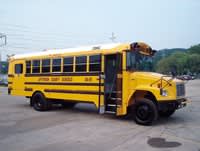
Buncombe County retrofits engines for cleaner emissions
As part of its Voluntary Diesel Retrofit Program, the Environmental Protection Agency (EPA) awarded a $75,000 grant in October 2001 to assist Buncombe County (N.C.) Schools in establishing a program to reduce school bus diesel emissions.
The grant led to the announcement by the Western North Carolina Regional Air Quality Agency, in association with the EPA and Buncombe County Schools’ transportation department, to initiate a pilot project to place state-of-the-art emission controls on the county’s bus fleet. “Approximately 65 buses will be retrofitted with the diesel oxidation catalyst,” says Harold Laflin, transportation director at Buncombe County Schools.
The pilot program will place diesel oxidation catalysts, similar to catalytic converters in cars, on the school buses to reduce the combustion emissions. The equipment will reduce particulate matter by 20 to 50 percent, carbon monoxide by more than 90 percent and unburned hydrocarbons by more than 90 percent.
The catalysts were selected among other options because of their long-term durability, non-specific fuel requirement and low maintenance record.
The regional air quality agency and Buncombe County Schools see the pilot program as an opportunity to introduce to the area technologies for reducing diesel emissions, in hopes of motivating others within the region to take on similar voluntary efforts.
“We are pleased to participate in the retrofit program, as it will provide cleaner air for all the citizens of Buncombe County,” Laflin says.
Cobb County drivers learn new tongues
With nearly 100,000 students and more than 1,000 employees serving them, training and re-training have become big issues for the transportation department at Cobb County (Ga.) School District, which runs 800 school buses.
“With the diversity of the students we service, we are constantly researching ways to help the drivers communicate with the students they transport, as well as parents,” says James Waggoner, associate director of transportation. Therefore, drivers and special education bus monitors are offered in-depth training in such areas as languages and behavior and discipline management.
The ability of drivers to speak Spanish, for example, has proven to be important because the district transports students to an ESL center.
Moreover, the training in behavior and discipline management has helped drivers work proactively, teaching them to recognize potential problems before they arise.
“This behavioral/discipline training has given our drivers the support and confidence they need in providing bus service for students in the TLC (Transitional Learning Center) Program without feeling intimidated or threatened,” says Waggoner.
Also, according to Waggoner, the benefits of the program are worth every penny of the cost. “[The cost] has been minimal, with phenomenal benefits,” he says.
Computer simulation works out routing kinks at Prince George’s County
Faced with having to transport students to nine new schools, and having students’attendance boundaries change at approximately 25 old schools, employees at Prince George’s County (Md.) School District found themselves forced to revise hundreds of routes covered by their 1,477 buses this fall.
The solution, says Dale Krueger, analyst for the school district, came in the form of a computer-simulated routing system, in which new routes were allowed to run alongside the old routes in a virtual reality, months before they were implemented.
“Last winter we built a computer simulation within Trapeze in a parallel data set as though the new boundaries were already in place,” Krueger says. “We routed the buses in the new environment while maintaining our regular production routing system.”
Problems were taken care of before they happened through a proactive solution. “When the student rollover was completed officially in July [of last year], we already had the basic structure of the new routes finished and only minor fine-tuning was needed to be ready for the opening of school,” Krueger says.
In addition, Prince George’s County School District established a phone bank with eight workstations, manned by substitute bus attendants, for better communication during the hectic start of the school year.
Block scheduling reduces overtime at Omaha Public Schools
Omaha (Neb.) Public School District recently switched its drivers and aides to a block scheduling system to stabilize the relationships among drivers, parents and school administrators.
Prior to the new scheduling, the routes in the district, which runs 332 buses, were distributed at the beginning of each school year based on bids and driver seniority. Then, as new routes became available throughout the year, drivers would switch in the middle of a school year if the new routes were considered more lucrative than the ones they were in.
“All new routes and runs were posted throughout the year for bid, which created a domino effect of drivers changing on routes, trying to obtain more working hours,” says David Wolfe, director of transportation for Omaha Public Schools.
Of the district’s approximately 365 drivers and aides, two-thirds are full-time employees and one-third are part timers. With the new system in place, as new routes become available during the year, management assigns them based on the most efficient use of drivers and equipment and not just based on seniority.
Therefore, part-time drivers have an easier time obtaining full-time status because many new full-time routes are offered to the part timers with highest seniority and not necessarily given to full-timers who wish to switch routes.
Furthermore, with the new system, full-time routes earn a driver 7.5 hours, and part-time routes pay 5.5 hours, making the routes almost equal.
According to Wolfe, even though both part- and full-time employees work increased hours, the total cost of salaries was unchanged since overtime pay was reduced due to more efficient scheduling. “The big benefits,” Wolfe says, “came from the efficient use of the fleet and the stabilizing effect it had on drivers working with parents and building [personnel].”
Loudoun County gives parents 24/7 customer service
Loudoun County Public School District in Leesburg, Va., has set up a dispatch center that is open 24 hours a day, 365 days per year, to assist parents and educators with any concerns they might have. The center has become the primary contact for all school emergencies, and delays in school bus service are referred there.
New bid process saves Fairfax County dollars in long run
Fairfax County (Va.) Public School District, which runs 1,317 school buses, recently changed its school bus purchasing process by shifting its focus away from lowest initial cost toward lowest cost of ownership. According to Linda Farbry, director of the Office of Transportation Services, the school district went from an Invitation for Bid (IFB) process to a Request for Proposal (RFP) process.
Before the decision to switch systems was made, the school district wrote specifications for how the new buying process should work and let school bus drivers and maintenance personnel review those conditions.
According to Farbry, during the review process the district asked vendors to prepare proposals that showed base price bids as well as lists of changes recommended to reduce the total cost and enhance the longevity of ownership. The district also requested that vendors include a list outlining the cost of other options being considered by the district, in addition to an estimated cost of ownership based on documented manufacturers’ maintenance recommendations.
Finally, the vendors were asked to provide a sample bus for the mechanics and drivers to judge before all the review results were considered by an advisory committee.
After a “winning vendor” was selected by that committee, “A three-year contract with the potential for two one-year extensions was awarded [that vendor],” Farbry says.
Throughout the contract term, the bid prices from the vendor must remain constant as long as an inflation rate was agreed upon at the time of the initial contract.
Farbry recognizes that the new purchasing process is more complex than the old one, but, she says, “The end product is a bus that will last us two to three years longer than earlier ones, and [it is a bus] that will cost us less in the long run.”
More Management

EverDriven Launches Route Consolidation Calculator to Estimate Diesel Savings
As diesel prices hit record highs, the largest alternative transportation provider says a 10% route consolidation could save a 120-route district more than $78,000 a year in fuel alone.
Read More →
Zum Secures Continued Financing Support for School Bus Expansion
Generate Private Credit has financed approximately $75 million in school bus deployments across three states, supporting more than 500 buses as Zum expands across the county.
Read More →
Beyond Discipline: A Different Approach to Student Behavior on the Bus
After implementing a dean of students program in Oregon, North Clackamas is seeing positive improvements. Here’s how it worked. The Route is brought to you by IC Bus.
Read More →
A Dean of Transportation's Different Approach to Student Behavior on the School Bus
After implementing a dean of students program in Oregon, North Clackamas is seeing positive improvements on the bus. Here’s how it worked.
Read More →
Inside NAPT ACTS 2026: Highlights from Louisville
From federal updates and student behavior strategies to new school bus technology and industry awards, see highlights from NAPT ACTS 2026 in Louisville.
Read More →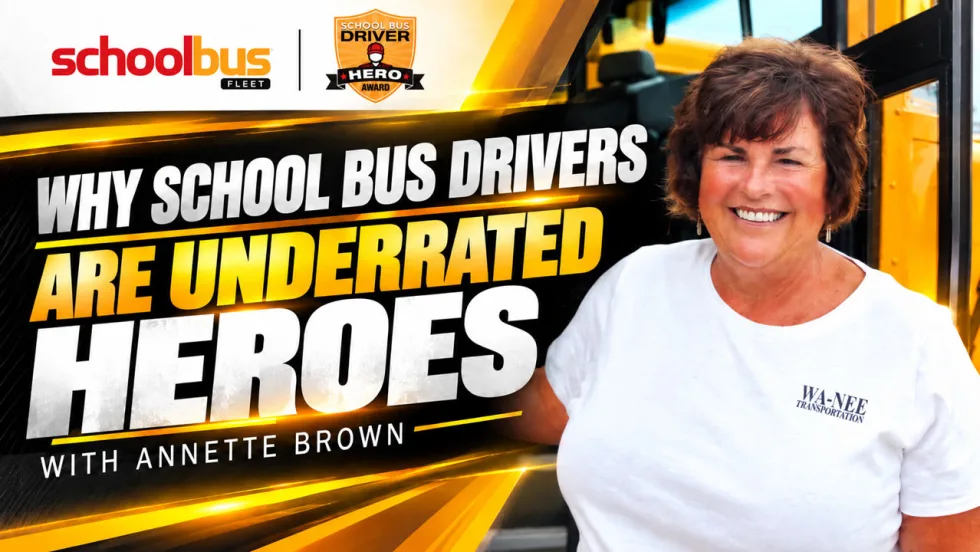
Meet the 2025 School Bus Driver Hero Winner: Annette Brown
We caught up with Wa-Nee Community Schools' Annette Brown on site at SBFX, where she was named the 2026 School Bus Driver Hero Award winner. Hear about her reaction, what she loves most about being a school bus driver, and more!
Read More →
Predictability Is Like Ketchup (According to 6-Year-Olds)
To students, a different school bus can feel like a full-blown crisis. One driver reflects on why familiar routines, showing up on time, and being reliably boring matter more than we think.
Read More →
Samsara Launches Free Driver Rewards Program
The new Driver Perks program gives eligible professional drivers access to discounts and offers without adding a cost for participating fleets.
Read More →
How Tax-Exempt Municipal Leases Can Help Finance School Buses
Let’s explore school bus financing options, including municipal leases, vendor payable accounts, and balloon payments, and how they can help stretch fleet budgets.
Read More →
Nominate Rising School Transportation Pros Under 40!
We’re searching for the next generation of leaders making an impact across the K-12 student transportation industry to recognize as SBF’s 2027 Trailblazers. Nominations are open now!
Read More →