



Useful Techniques to Optimize Mirror Training
Mirror grid systems are designed to assist in the instruction of proper mirror usage. Choosing the right system can enhance the learning experience and increase a driver's visual capacity, especially around the danger zone.
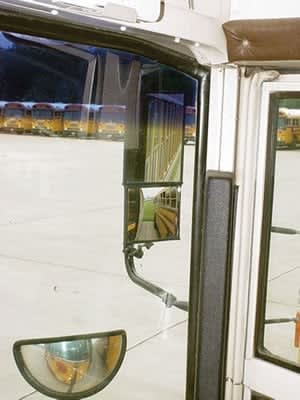
Transportation managers know what’s at stake with inadequate mirror-usage training. Finding the right mirror systems, and providing solid instruction on what to look for in and outside of the danger zone, can mean the difference between life and death or severe property liability.
Mirror grid stations
Most safety trainers agree that teaching the proper use of mirrors to new school bus drivers can be a challenge. Many drivers have a tendency to want to see more than what’s necessary or to look over their shoulders as they would in passenger vehicles instead of using the mirrors. Trainers combat these poor driving habits using mirror grids. Mirror grids incorporate the safety protocol mandated in FMVSS 111 and specified in the National Highway Traffic Safety Administration’s (NHTSA) school bus field-of-view test.
NHTSA’s guidelines specify placement of the test cylinders around a school bus. Drivers adjust their mirrors to attain maximum visibility of these cylinders, which can represent people or objects that may surround a school bus, especially in the danger zone.
Driver training methods
Owego-Appalachin Central School District in New York recently purchased four new Thomas buses — three FS 65s and a C2. Anthony Quaranta, supervisor of transportation, spec’d Rosco mirrors on all four buses. Rosco provided the district with a diagram of what drivers should see through their mirrors. The diagram or grid is painted in multiple colors that correlate with the size of a bus. For instance, if you pull a transit-style bus into the mirror grid, you might use the yellow spots or cylinders.
“We have the grid painted on the ground in the middle of our parking lot,” Quaranta says.
During training, Quranta will usually have one trainer on the bus and one outside the bus, while a mechanic stands outside the bus with a wrench in hand to adjust mirrors according to a driver’s instructions.
At Temple (Texas) Independent School District, where Walter Prothro is director of transportation, drivers go through two sets of training that reinforce proper mirror use. Both training sessions — the roadeo course and the student loading station — take place at the beginning of the school year and incorporate training techniques that emphasize specific locations around the bus that should be seen through the mirrors.
Prothro suggests trainers go a step further and have drivers exit the bus to get an on-the-ground perspective.
“We ask trainees to get behind the bus in the dead spots and have somebody in the driver’s seat yell when they can see the trainee,” says Prothro. “The trainee can then see how far away or close to a bus he or she needs to be in order to be seen by the driver.”
[PAGEBREAK]
Maximizing visibility
Rob Worthington, area director of safety, education and development at Durham School Services in east Los Angeles, tries to create a sound foundation in the original training. He follows that up with evaluations and observations of drivers.
“You have to conduct an overall education so drivers know they can’t keep their heads on the same pivot all the time,” he says. “They have to rock and roll.”
Durham School Services teaches defensive driving and the Smith System, which stresses the need to keep the eyes moving and to constantly scan mirrors.
“Continual training is the key to preventing mirror usage errors,” says Viki Wassink, area supervisor for Granite School District in Salt Lake City. The most common mistake for drivers is improper adjustment of mirrors, she says.
Wassink says spare drivers tend to jump on a new bus every day. They adjust the mirrors on those buses. When a regular route driver jumps back on that bus, there is a tendency to take off without making sure the mirrors are readjusted.
“That’s one of the mistakes our drivers make, that and not checking mirrors frequently enough during turns in traffic,” Wassink says.
Equipment options
Mirror manufacturers offer a variety of mirror systems to choose from, including driver-adjustable mirrors, cross-view styles and interior models.
Driver-adjustable mirrors eliminate the need to have mechanics adjust mirrors. Cross-view mirrors provide a 180-degree view across the front of the bus, its front bumpers and down the sides of the front of the bus. Radius mirrors are shatter resistant and can provide a clearer, wider view of the bus’ interior. Manufacturers also offer mirrors that can be adjusted by remote control.
The latest mirror systems from Rosco Inc. in Jamaica, N.Y., include the Open View mirror, an aerodynamic split-mirror system that hides the mounting arms in a centered channel in the housing.
“The two separate housings satisfy the needs of some customers who want to see in between the mirrors for greater forward visibility,” says Ben Englander, VP of engineering. “The convex mirror is smaller than the flat mirror to also allow greater forward visibility.”
Rosco’s Accustyle rearview mirror incorporates a single-housing dual mirror and is designed to mount on single- or two-point mounting arms or on loop-style mounting arms.
Mirror Lite Co. in Rockwood, Mich., is developing a new cross-view style mirror called the HD, for high definition. This mirror reduces the reflected image of the bus and increases the reflected images in the danger zone.
“Images of kids in the danger zone around the front of the bus appear considerably larger than ever before, even larger than with our Safety Cross cross-view mirror,” says Paul Schuster, communications director at Mirror Lite.
Mirror Lite’s Safety Cross mirror increased mirror image by about 15 percent over its previous model, the Bus Boy. The HD also increases mirror image, but without increasing the mirror head.
The Tiger Mirror Corp. in Toledo, Ohio, is developing a crossover mirror called the Tiger Eye. The Tiger Eye, which is made of tempered glass, has the capability of housing an imbedded camera behind the mirror.
“The mirrors are five years in development,” says Tony Pietrowski, a principal at Tiger Mirror. “They are chromium instead of silvered on the backside second surface, which reduces distortion and cuts down on glare.” Tiger mirrors are guaranteed for the life of the school bus.
More Management
Walton County Schools Adds Gatekeeper Stop-Arm Enforcement System
The Florida district will deploy Gatekeeper’s updated Student Protector technology, which now incorporates AI to improve video evidence.
Read More →
Zum Reaches 19 States With New York Expansion
The addition of the Empire State to the student transportation company's roster marks a growing expansion in the Northeast as it scales its tech and school bus services.
Read More →
First Student Updates Its Parent App
First View connects both yellow bus and alternative transportation, giving families one platform to track student trips for the new school year, with 15 languages supported.
Read More →

The Back-to-School Checklist Every Director Should Complete Before the First Bell
Help your transportation team start the school year strong with these tips for contingency planning, communication, fleet visibility, technology, and trip management.
Read More →
How a New York District Cut Nearly $1M in Transportation Costs While Expanding Bus Access
A data-driven overhaul with BusRight reduced Poughkeepsie City School District's planned routes from 26 to 17 while extending school bus service to about 1,200 additional students.
Read More →
Budgets Down, Enrollment Shifting: What the Data Says Districts Should Watch
School transportation departments face two converging challenges this year: tightening budgets and shifting enrollment. Most districts still address these issues separately, but the assumption that either trend will simplify operations is proving incorrect.
Read More →
These 8 School Transportation Companies Made the 2026 Inc. 5000 List
Find out which school transportation contractors, technology providers, and suppliers ranked among America’s fastest-growing private companies.
Read More →
The Link Between Emotional Intelligence and School Bus Safety
How can emotional intelligence help transportation pros navigate stress, manage change, and build stronger relationships? Listen to find out.
Read More →
What Emotional Intelligence Has to Do With School Bus Safety
In this video, discover how emotional intelligence can help transportation leaders and drivers navigate stress, manage change, and build stronger relationships. The Route is sponsored by IC Bus.
Read More →
Beyond Two-Way Radios: School Bus Communications Evolve With Push-to-Talk Over Cellular
PRYME Radio and PositionPTT join forces to advance hands-free radio use and reduce distracted driving. See how PoC compares with traditional radios on range, cost, safety, and connectivity.
Read More →