




Related: Study Addresses School Bus Behavior Management Challenges
Support Key for Drivers Dealing With Bullying on Buses
A researcher's study finds that the difference between bus drivers who experience bullying often and those who don't is the relationship between drivers and school administrators.
by Sawyer Hogenkamp
May 22, 2020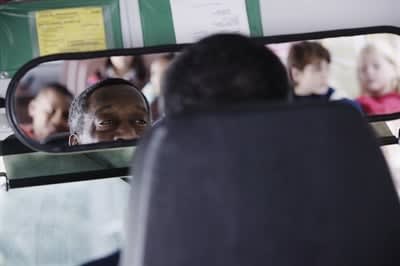
Photo by Andersen Ross Photography via iStock Getty Images
7 min to read
Ask any school bus driver and they will tell you how they or their colleagues have had to deal with peer aggression on their bus. Over the years, some of their experiences, caught on film, have captivated the public. The 2012 viral video of Karen Klein, a school bus monitor, who was filmed crying after being verbally and physically bullied by a group of teenagers, was perhaps the most notorious.
As the news gained traction, there was an outpouring of sympathy and support for Klein, and an online campaign raised over $700,000 from strangers around the world for her. She was able to retire from being a bus monitor and established the Karen Klein Anti-Bullying Foundation with the proceeds. While the four students responsible served a one-year suspension for their actions, two of them later were involved in a much more severe bullying incident against another student. Following this story, bullying on school buses was exposed as an issue that required closer attention.
However, in the years since, it seems that bullying on the school bus continues to be a ubiquitous problem. There have been numerous media reports on school bus drivers who experienced unabated peer aggression and were deeply unsatisfied with how school districts responded.
In August 2019, KGW reported on school bus drivers in Oregon and Washington who brought attention to students committing violence against bus drivers and how it is an under-reported problem that is systemically poorly addressed. Further investigation revealed problems in how school personnel were handling these situations over the years.
With each exposé, schools and the public are increasingly aware that many school bus drivers are struggling. Even as school districts see improvements in how students behave on school grounds and classrooms, school transportation often remains unaddressed. This gap has inspired some academic researchers to investigate the school bus environment as a place that could foster bullying, and school bus drivers as needing to have their voices heard.
Environment Conducive to Bullying
Research has confirmed that the school bus environment may increase the likelihood of bullying. Students aged from toddlers to teens may sit close to each other, potentially exposing younger children to inappropriate behavior. On a bus packed with children, the driver may have difficulty seeing exactly what is going on behind those seats. Children who are victimized often have difficulty escaping bullying in such a tight, enclosed space. Surveillance videos and footage filmed by students illustrate these issues and are easily accessible online and often reported on by news outlets.
As a researcher, I was inspired to investigate bus drivers’ perceptions of bullying on the bus. In a study I conducted from February 2019 to May 2019 of bus drivers in a region in Ontario, Canada, I found that some drivers did report that bullying and peer aggression was a significant and frequent problem.
However, within my small-scale sample of 22 drivers, other bus drivers did not experience many noteworthy bullying experiences, sometimes driving the school bus for years without a major incident. In fact, these bus drivers had remarkable stories to tell.
One bus driver, Steve, who gained a reputation in the school board for effectively dealing with children who have more challenging behavior issues, became known as a “fixer.” He would be assigned (and volunteer for) school bus routes with the most challenging groups of students, who often pushed other school bus drivers to quit the profession.
The first day of school, Steve gave a new group of students on his bus an ultimatum: either quiet down, or everyone on the school bus would get a pink slip (reported to the school principal). Of course, the students didn’t quiet down, so the next day the driver reported approximately 20 students at once to the principal. The principal took swift action and called an impromptu school assembly to reinforce school bus behavior expectations for the students. Through clear communication and proportionate consequences, Steve was capable of quickly earning the respect of the students on his bus, and his colleagues.

Sawyer Hogenkamp is an Ontario Certified Teacher and holds a Masters degree in Education from Queen’s University, Canada. Photo courtesy Sawyer Hogenkamp
Incidents Go Unreported
In other study findings, 68% of drivers said they always intervened when they witnessed bullying. Only 25% formally reported instances of bullying through legally mandated incident forms. Bus drivers cited trust issues with school administration (lack of faith that their complaints would be taken seriously), and confidence that they could deal with bullying situations on their own as reasons why they didn’t fill out incident forms.
Support Key to Success
What was the difference between school bus drivers who experienced bullying often and those who hardly experienced bullying? In my small sample, the main factor was the relationship between school bus drivers and the schools that they drove for. (Twenty of the bus drivers — 91% — had witnessed bullying on their bus, but only occasionally or sometimes, meaning that bullying was infrequent.)
In Steve’s case, school administrators were generally transparent with bus drivers regarding pertinent student information, and quickly following up on school bus drivers’ concerns. Bus drivers who had supportive school leadership behind them did not experience as much peer aggression on the bus.
In contrast, bus drivers who reported experiencing bullying but did not have support from administrators often grew reluctant to report incidents because school administration maintained poor communication and bus drivers felt like their complaints were being ignored. Consequently, peer aggression persisted and was underreported.
In light of what bus drivers and other stakeholders have reported to school boards, the media, and researchers, the following approaches may better mitigate peer aggression on school buses.
Training, Education Needed
First, it is important for school bus drivers, school personnel, parents, and students to be able to recognize if peer aggression is a problem on their bus. Education is key. Certainly, bus drivers should be mandated to receive a high level of training regarding meeting students’ needs and managing behavior on school buses. This training not only empowers bus drivers to be better guardians to children, but it also addresses their own personal safety, as bus drivers need to know how to de-escalate potentially dangerous situations.
Additionally, students need education that not only reinforces proper school bus behavior, but also how to support their peers when they witness peer aggression, so that bystanders become “upstanders.” Students often witness more incidents than a school bus driver could ever detect, so it is crucial for students to feel confident that if they confide in an adult, their concerns will be addressed.
Build Relationships for Support
It is also important to note that school bus drivers cannot meet every student’s needs on their own all the time. It is crucial for schools to foster healthy working relationships between bus drivers, auxiliary staff, educational assistants, teachers, principals, and parents, with the common goal of meeting each student’s needs and to mitigate peer aggression on the bus.
For districts that are working towards improving the school climate, it is crucial to expand that climate sphere to include school transportation, where millions of children spend hours a day under supervised. There are state/provincial and federal laws that address school climate and individual student needs. For instance, many students with individual education plans (IEPs) require additional school personnel to accompany them on school buses, as they would in classrooms and schools. Schools must ensure their sphere of positive school climate embraces school transportation as well.
Highlighting Successes Essential
Addressing peer aggression on the school bus is a complex process that is slowly being unraveled. While researchers and the media often shed light on individual school bus drivers’ transgressions and systemic failures in school boards, it is also important to seek out and acknowledge individual school bus drivers and school boards that are having success.
In particular, school districts that base their interventions on what is already known to work in academic research have been seeing positive results. The media will continue to reinforce that the problem of peer aggression on school bus is a hidden problem that must be revealed, but let’s not keep the solutions to peer aggression in the shadows by ignoring the voices of the school boards and bus drivers that are excelling at nurturing a positive atmosphere on their school buses. We need to continue to evaluate what is and isn’t working in preventing peer aggression to better the school bus ride for drivers and students alike.
Sawyer Hogenkamp is an Ontario Certified Teacher and holds a Master's degree in Education from Queen’s University, Canada. He also holds a Bachelor's degree in Education from Queen’s University and a Bachelor of the Arts degree from the University of Waterloo. His research interests include music education, bullying and peer aggression, school transportation, and school climate.
Subscribe to Our Newsletter
More Management

How to Build a Better Driver Training Program
Ready to boost up your school bus instructor training? Here’s how to pick the right talent and improve recruitment, retention, and safety.
Read More →
CALSTART and Forth Combine to Form Catalyst Mobility
The new name represents a renewed vision for the nonprofit focused on advancing clean, equitable, and affordable transportation solutions that move people and goods.
Read More →
What Makes a Great School Bus Driver Trainer?
Choosing the right school bus driver trainer takes more than experience. Learn six keys to selecting and developing trainers and evaluating program effectiveness.
Read More →


School Bus Contractors Expand Through New Deals, Acquisitions & Partnerships
STA's Canadian division acquires Ontario-based G&L Stevenson Transport while Durham School Services adds a new district contract in California, First Student adds a New Jersey contract, and Minnesota Coaches acquires Halo Transportation.
Read More →
Logan Bus Company Rolls Out AI Phone System for NYC School Bus Families
A summer pilot found that AI agents could handle most routine calls, freeing up time for customer service staff to focus on emergencies and complex family concerns.
Read More →
From Intent to Impact: What I Learned About Leadership from TAPT
A Texas transportation supervisor shares lessons on self-awareness, accountability, managing stress and building trust — and why investing in leadership development matters at every stage of your career.
Read More →
NAPT Names 2026 Award Recipients, Hall of Fame Inductee
Who earned national recognition for their work in student transportation? This year, NAPT named five recipients of its 2026 awards for service, safety, and leadership, plus its newest Hall of Famer.
Read More →
Sponsored•September 2, 2026
2026 State of Student Transportation Report
Driver shortages. Rising costs. Growing safety expectations. More data, but not enough time to act on it. The 2026 State of Student Transportation Report reveals what transportation leaders say is putting the most pressure on their operations—and where they’re investing next. See how your priorities compare.
Read More →
How to De-Escalate an Angry Person: 5 Steps for Handling Workplace Conflict
What makes emotions run high, and how should you handle an angry colleague or parent? Follow these steps for staying calm, listening, showing empathy, and resolving conflict.
Read More →
Sponsored•September 1, 2026
What Readiness Looks Like This School Year
Learn about the challenges shaping the 2026–2027 school year, from persistent driver shortages and budget pressure to technology and readiness gaps. See how school districts are responding and adapting in Zonar’s 2026 Back-to-School Readiness Report.
Read More →