




Drive Dilemma? How to Attract Younger Generations to the Yellow Bus
How to Recruit, Train, and Manage Substitute School Bus Drivers
All employees are essential to keeping a pupil transportation operation running smoothly, with school bus drivers being one of the most critical. Substitute school bus drivers are no less important than regular bus drivers. In fact, officials suggest these drivers can make or break an operation.

Kelly Aguinaldo・Managing Editor
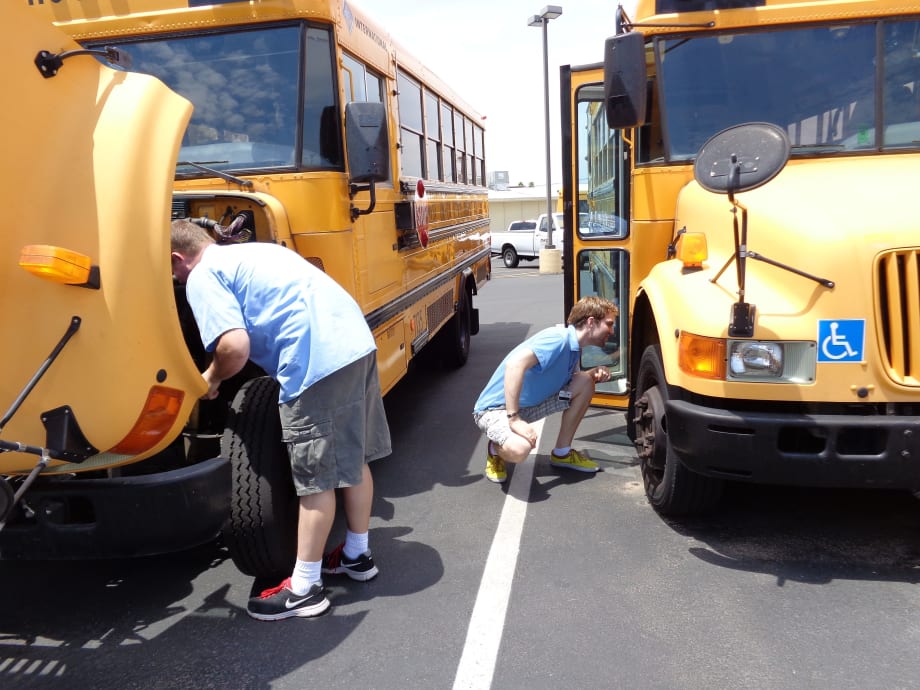
Here, Arizona's Mesa Public Schools substitute drivers pre-trip buses in preparation for a run. Former Director of Transportation and Vehicle Maintenance Ron Latko says subs are “lifesavers” to a transportation operation because they are flexible in what they do.
7 min to read
- School bus drivers play a vital role in ensuring the smooth operation of pupil transportation.
- Substitute bus drivers are as crucial as regular drivers in maintaining operational efficiency.
- Officials highlight the significant impact of substitute drivers on the overall success of transportation services.
*Summarized by AI
All employees are essential to keeping a pupil transportation operation running smoothly, with school bus drivers being one of the most critical. After all, having too few drivers means the responsibility of transporting students may fall on the shoulders of other personnel, creating a domino effect of additional work for many people.
Substitute school bus drivers are no less important than regular bus drivers — in fact, officials suggest these drivers can make or break an operation, especially during periods of driver shortages.
“They are lifesavers to a transportation operation,” said Ron Latko, former director of transportation and vehicle maintenance at Mesa Public Schools (MPS) in Arizona. Latko retired in May 2014. “You can’t run a responsible transportation department without these reliable people. They know the schools, the kids, the various vehicles and are extremely flexible in what they do.”
What To Look For in Substitute School Bus Driver Candidates

LaTania Davis is one of Houston-based Spring Independent School District’s auxiliary (aka substitute) drivers. Under transportation department policy, employees must be a full-time bus driver for at least one year before they can apply for a substitute position.
Many operations select their substitutes from their existing pool of drivers, and because these employees are required to essentially be a “jack of all trades,” there are specific qualities that managers look for when seeking out potential candidates.
Brian Weisinger, former director of transportation at Spring Independent School District (ISD) in Houston, said that drivers in his department have to apply for the position — they’re referred to as auxiliary drivers — and applicants must undergo an interview.
“They have to have a can-do attitude,” he said. “These are also people who are very strong with student management.”
Mike Shedor, former area general manager for First Student’s central region, likened substitute drivers to substitute teachers, in that when that driver steps on a bus, they may not know all of the students.
To that end, “they have to quickly build rapport with students and understand the route,” Shedor said. “You also want to have someone who’s patient because there may be some students who want to test the driver.”
Shedor believes it’s also important for a sub driver to have a strong understanding of and familiarity with the area that the operation serves because they may be called upon to drive a route without having previously driven it.
At First Student’s terminal in Edwardsville, Ill., former District Manager John Mollett said only the top-performing drivers on staff are considered for substitute positions. Specifically, he looks for drivers who understand the operation’s goals and mission, and drivers who are flexible, willing to work any hours, and knowledgeable about the school district’s routes and what is expected of them.
Certain Requirements Must Be Met
Not only is it beneficial for drivers to have certain characteristics to help them handle the responsibilities associated with a substitute position at some districts, but they must also meet certain criteria before they can apply for or be considered for the position.
At both Spring ISD and Cypress-Fairbanks ISD (also in Houston), bus drivers must be employed by the district for at least one year before they are eligible to become a substitute driver. At Cypress-Fairbanks ISD, front-line or full-time subs are classified as charter drivers.
Retired Cypress-Fairbanks ISD Director of Transportation Bill Powell said the candidates must also have acceptable attendance.
Weisinger said Spring ISD’s auxiliary drivers have to be a full-time driver for at least one year so that they can gain knowledge of the district and how it’s run. It also enables Weisinger to get to know the employee.
“[In the past], I’ve had sub drivers who were new employees, and they weren’t full-time,” he said. “I find more comfort in having my sub drivers already trained and seasoned veterans on the road working with these kids. If you have new employees coming into the substitute pool, the chances of them making a mistake is increased because they don’t have the experience.”
Substitute driver positions at MPS are posted as the need arises, and Latko said it is imperative that individuals who apply have the necessary district training, including certifications, to be considered.
The department’s training program exceeds the state’s requirements by approximately triple the amount of time required in the classroom and behind the wheel.
Additionally, all drivers (including substitutes) are required to have “MPS certifications.”
As an example, Latko said that if a “driver of a Type A bus wants to start doing field trips and hasn’t driven a Type C or D in more than six months, they must be recertified to MPS standards. Or, if a regular-education bus driver successfully bids for a special-education route, they must take two days of special-education driver training for their MPS certification in special-education driving.”
At Moorpark Unified School District in California, substitute drivers must be available on an on-call basis.
“We attempt to give them as much notice as possible,” former Director of Transportation Tony Briscoe said of assigning them to routes or trips. “If they regularly turn down assignments, they are removed from the substitute list. As a substitute driver, they’re not eligible to do field trips unless our entire permanent driving staff has declined the trip. They are not assigned to a route unless we have a permanent employee out on long-term leave.”
Components of Bus Driver Management
A lot goes into managing bus drivers — substitutes and non-substitutes alike. Here are several factors and how operations address them with substitutes.
Training for New Substitutes
While Mollett said that he prefers to select his substitute drivers from his existing employees, there have been times when the operation has needed to hire subs. In this case, hired drivers undergo an in-depth training program, and then they are assigned to a mentor. The mentor is a certified trainer, and the driver must report to the mentor for 90 days after undergoing training.
“In addition to that, I don’t expose them to a route unless they have someone else with them,” he said. “We want this new sub to be familiar with the routes, so I’ll assign them to existing routes with drivers and have them drive those routes — as many as possible.”
Pay Rate and Hours
At MPS, substitute drivers are paid the same rate as non-subs, but Latko said they are contracted, which gives them the same benefits as a full-time driver, and they are guaranteed 40 hours of work per week.
“Each of our three locations has a number of sub drivers, and the site supervisors set the schedules for those drivers at the specific locations,” he explained. “The number of field trips we may have on any given day will determine if we have sub drivers on duty, or how many will be on duty.”
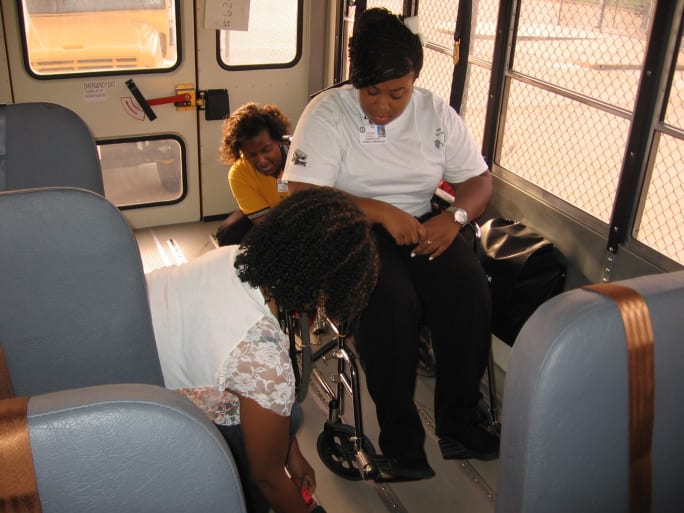
At Houston’s Cypress-Fairbanks Independent School District, full-time substitutes — classified as charter drivers — have to be employed by the district for one year and have acceptable attendance to be considered for the job. Here, charter drivers undergo training on wheelchair securement.
The charter drivers at Cypress-Fairbanks ISD work eight hours per day every school day. Powell said there are also drivers in his department classified as “emergency call-in drivers.” These employees are not guaranteed any hours, and they are called to drive on an as-needed basis.
“They maintain their regular hourly rate, and they provide us with their schedules as to when they are available to us,” he explained. “We do not require any hours on weekends or driving field trips. Emergency call-in drivers must drive at least one route per week to maintain their status.”
Staggering Shifts Keeps Things Moving
Shedor said the First Student terminals in the area he oversees have become more efficient over the past several years by staggering start shifts where possible.
“If there are a number of shifts, we might have our sub drivers start at 5:30, 6, 6:30 and 7 a.m.,” he explained. “The sub drivers are there every day, but by staggering the shifts, we don’t have everyone sitting around waiting for their assignment.”
A Few Challenges To Address
Many supervisors say that managing their substitute drivers can be easier than managing other drivers because subs are typically so well trained and familiar with the operation.
“I find the auxiliary drivers to be easier to manage because they do have previous experience with us and they are full-time employees,” Weisinger said. “It takes less effort on my part to manage these people because they’re all self-starters.”
Most of Moorpark Unified School District’s substitute drivers are people who formerly worked for the district as bus drivers and have since retired, or they work for other departments within the district.
“It tends to work out very well for us, and they have the flexibility to turn down assignments as long as it is not done on a regular basis,” Briscoe said.
Editor's Note: This article was originally published September 19, 2013, and was updated on August 6, 2026, for continued relevancy on substitute bus drivers, management, and driver shortages.
Subscribe to Our Newsletter
More Management

How to Build a Better Driver Training Program
Ready to boost up your school bus instructor training? Here’s how to pick the right talent and improve recruitment, retention, and safety.
Read More →
CALSTART and Forth Combine to Form Catalyst Mobility
The new name represents a renewed vision for the nonprofit focused on advancing clean, equitable, and affordable transportation solutions that move people and goods.
Read More →
What Makes a Great School Bus Driver Trainer?
Choosing the right school bus driver trainer takes more than experience. Learn six keys to selecting and developing trainers and evaluating program effectiveness.
Read More →

School Bus Contractors Expand Through New Deals, Acquisitions & Partnerships
STA's Canadian division acquires Ontario-based G&L Stevenson Transport; Durham School Services adds a new district in California; First Student expands in New Jersey; and Minnesota Coaches rebrands and acquires Halo Transportation.
Read More →
Logan Bus Company Rolls Out AI Phone System for NYC School Bus Families
A summer pilot found that AI agents could handle most routine calls, freeing up time for customer service staff to focus on emergencies and complex family concerns.
Read More →
From Intent to Impact: What I Learned About Leadership from TAPT
A Texas transportation supervisor shares lessons on self-awareness, accountability, managing stress and building trust — and why investing in leadership development matters at every stage of your career.
Read More →
NAPT Names 2026 Award Recipients, Hall of Fame Inductee
Who earned national recognition for their work in student transportation? This year, NAPT named five recipients of its 2026 awards for service, safety, and leadership, plus its newest Hall of Famer.
Read More →
Sponsored•September 2, 2026
2026 State of Student Transportation Report
Driver shortages. Rising costs. Growing safety expectations. More data, but not enough time to act on it. The 2026 State of Student Transportation Report reveals what transportation leaders say is putting the most pressure on their operations—and where they’re investing next. See how your priorities compare.
Read More →
How to De-Escalate an Angry Person: 5 Steps for Handling Workplace Conflict
What makes emotions run high, and how should you handle an angry colleague or parent? Follow these steps for staying calm, listening, showing empathy, and resolving conflict.
Read More →
Sponsored•September 1, 2026
What Readiness Looks Like This School Year
Learn about the challenges shaping the 2026–2027 school year, from persistent driver shortages and budget pressure to technology and readiness gaps. See how school districts are responding and adapting in Zonar’s 2026 Back-to-School Readiness Report.
Read More →