




State Funding, Fuel Savings Drive Propane Bus Adoption in Florida
With reduced operating costs and a rebate program for propane autogas vehicles, Florida school districts are tapping the alternative fuel as an economical and environmental solution. Broward County recently added 98 propane school buses to its fleet.
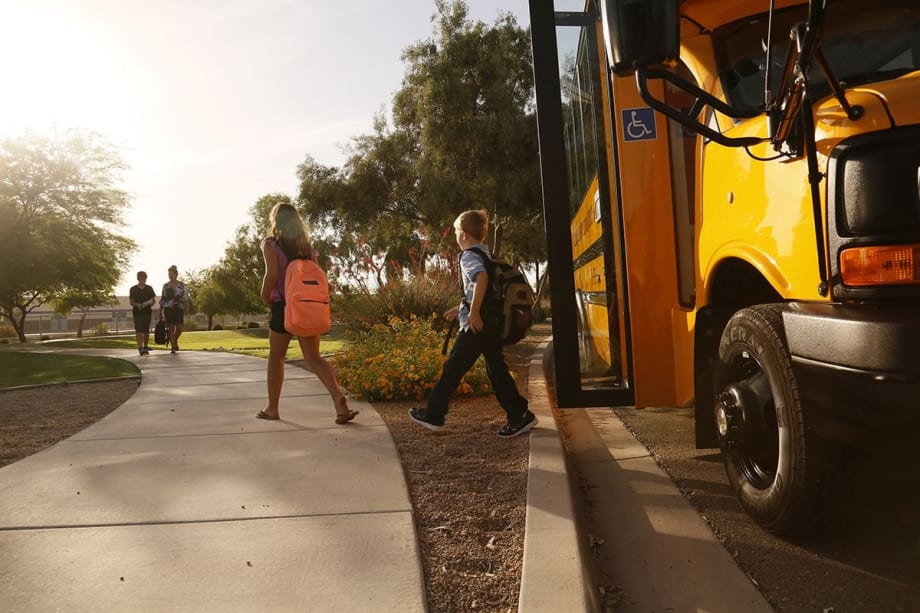
A Micro Bird propane autogas school bus drops off students in Florida. School bus operations have been reporting significant fuel and maintenance savings with propane.
Earlier this summer, a National Climate Assessment report identified Miami as the most vulnerable city on the globe when it comes to climate change impacts. Rising sea levels threaten homes and roads, and recent flooding in the state has put Florida at the center of the climate change debate.
Furthermore, a greenhouse gas emissions report from the Southeast Florida Climate Compact shows that harmful emissions from the transportation sector far and away are the greatest contributor of emissions in the state, more than those from residential, commercial or industrial sectors.
However, despite Florida’s current state of environmental affairs, positive action has been taken to cut the carbon footprint in the region. New alternative-fuel legislation has attracted the interest of public and private sector businesses, spurring them to deploy alternatives to fossil fuels. And local school transportation directors, in particular, have led the charge, investing in propane autogas and new school bus technologies as an economical and environmental solution.
State funding, incentives
Last year, Florida became one of 22 states to adopt a rebate program for the purchase of alternative-fuel vehicles. The Natural Gas and Propane Fuel Fleet Vehicle Program, which is operated by the Florida Department of Agriculture and Consumer Services, covers 50% of the incremental cost of a converted or dedicated propane autogas vehicle, and both private and public entities, such as school districts, are encouraged to apply.
This legislation has had a huge impact on schools looking to reduce short-term costs on new equipment. Putnam County School District was the first in the state to apply for funding assistance through the program for its three propane autogas buses. Additionally, Broward County, one of the largest school districts in the nation, reported utilizing the alternative-fuel program to partially cover costs on its adoption of 98 propane autogas school buses in April, and is also exempt from fuel taxes through the program.
“We’ll be using these buses for our high-mileage routes due to the substantial cost and maintenance savings with clean and safe propane autogas,” says Pat Snell, director of student transportation and fleet services for Broward County Public Schools. “Some of the savings will be funneled directly back into the classroom.”
In total, recent adoptions by Broward County, the School District of Indian River County, Putnam County School District, Alachua County Public Schools and Pasco School District have catapulted Florida to one of the top 10 states in the country leading propane autogas school bus deployments, according to research from the Propane Education & Research Council.
“Contractors and school districts across North America have been reporting terrific fuel and maintenance savings with our propane buses,” says Trey Jenkins, Blue Bird’s vice president of alternative fuels. “Given propane’s proven track record with school districts in Florida, we foresee continued propane growth in this emerging market.”
[PAGEBREAK]Improved technology, performance
Blue Bird’s propane autogas buses have logged more than 50 million miles, and the company has built more than 5,000 of its alternative-fuel models to date. The company reports that propane autogas is its fastest-growing segment in the school transportation industry, and sales reached a peak point in 2013.
“The Blue Bird and Roush CleanTech propane autogas solution offers the best total cost of ownership of any alternative-fuel school bus,” says Todd Mouw, vice president of sales and marketing for Roush CleanTech, Blue Bird Corp.’s fuel system supplier. “Our customers find that with our liquid injection propane autogas system, there is no drop-off in engine performance compared with conventional fuels, and overall our systems are cleaner and more affordable to operate than standard diesel models.”
That performance with new propane autogas fuel systems has contributed to the success of school bus programs in Florida’s diverse topography. For Indian River, the design and engineering of the Blue Bird Vision Type C propane autogas school buses have been a fit for its rural roads. Approximately 45% of the roads on Indian River’s routes are gravel or dirt.
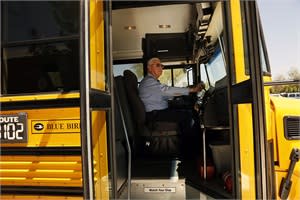
A school bus driver in Florida operates a Blue Bird propane autogas bus. Florida has become one of the top 10 states in the country leading propane school bus deployments.
“With a CNG [compressed natural gas] bus, the engine is in the rear, so it collects a lot more debris,” says George Millar, former director of transportation at Indian River. “The propane buses are built with engines in the front of the bus like a traditional gasoline or diesel bus, which keeps things cleaner.”
Additionally, ease of maintenance and the clean-burning benefits of propane autogas have saved the school money on parts and service of the buses.
“Propane autogas runs so clean that I can swipe my fingers around the edge of a tailpipe on a bus we’ve been running and there will be absolutely no soot residue on my hand — not even after extreme usage and many miles on the road,” Millar adds.
Setting an example
Blue Bird reports that Florida is one of the company’s fastest growing sales regions because of the additional savings schools can realize on top of already low fuel and operating costs with propane autogas.
“Schools like Broward County and Indian River are making serious environmental and cost saving investments in their communities and paving the way for other districts to choose this proven, versatile and American-made fuel,” Mouw says.
Florida Transportation Systems (FTS), the authorized Blue Bird dealer in Florida, has also played a pivotal role in promoting the alternative fuel’s benefits across the state. FTS operates MovingForwardWithPropane.com, a website dedicated to helping school bus fleets in Florida realize the benefits of switching to propane autogas.
According to the site, the state has more than 6,000 buses on the road that are more than 10 years old. FTS estimates that school districts in Florida are facing nearly $600 million in expenses over the next few years to replace their fleets, and propane is emerging as an effective solution.
“This American-made fuel costs less to fuel up and maintain than gasoline or diesel, and propane produces 80% fewer smog-producing emissions compared with diesel-fueled vehicles,” Mouw says. “In a state facing unpredictable budget and environmental conditions, propane autogas is a safe bet for communities and schools.”
Michael Taylor, a 22-year veteran of the school transportation industry, is director of propane autogas business development at the Propane Education & Research Council.
More Alternative Fuels

CALSTART and Forth Combine to Form Catalyst Mobility
The new name represents a renewed vision for the nonprofit focused on advancing clean, equitable, and affordable transportation solutions that move people and goods.
Read More →
Alt-Fuel Moves: New Buses, Charging Hubs & Real-World EV Testing
Propane and electric school bus deployments continue to grow as districts add new vehicles, expand charging infrastructure, and gather more real-world operating data.
Read More →
Fewer Electric School Bus Models Reshape the U.S. Market
WRI’s latest buyer’s guide points to a consolidating electric school bus market, but fewer options may reflect a maturing industry rather than fewer meaningful choices for school bus operators.
Read More →
The Fuel Budget You Can Actually Predict: How Propane Autogas Keeps Money in the Classroom
Learn how propane autogas helps school districts manage fuel costs with predictable pricing, lower maintenance, and reduced emissions from former transportation director Joel Stutheit.
Read More →
Hendrickson, Driventic Introduce New Electric Powertrain for School Buses
ELECTRAAX, the electrified, lightweight drive axle offers integrated ePowertrain efficiency and modular flexibility for Class 6–7 school bus use.
Read More →
The Mobility House Joins PowerFlex in Fleet Electrification Deal
The acquisition combines intelligent charging software, bidirectional charging expertise, and fleet electrification services to support the growing adoption of electric school buses across North America.
Read More →
Alt-Fuel Moves: Electric School Bus Investments Hit the Road
See which districts across the U.S. are putting electric school buses into service, expanding charging infrastructure, and planning the next phase of fleet electrification.
Read More →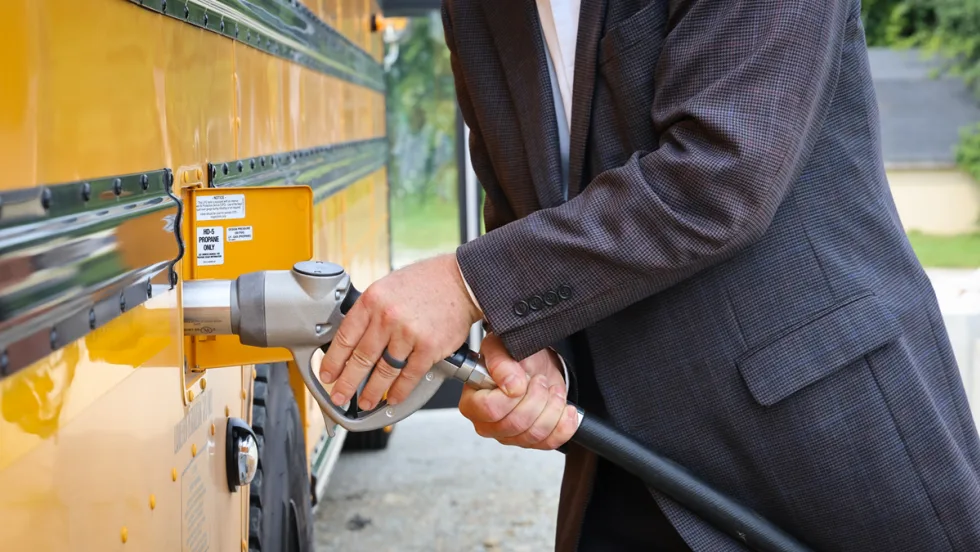
With Fuel Volatility Ahead, School Districts Turn to Propane
While diesel prices peaked above $5 this spring, districts with propane autogas-powered fleets paid under $2 per gallon, according to PERC.
Read More →
EPA Unveils Proposed Changes to 2027 Heavy-Duty Engine Rules
The federal agency has proposed changes to next year’s targets that would eliminate DEF derates, ease warranty requirements, and retain current NOx emissions standards.
Read More →
Alt-Fuel Moves: EV Charging & Infrastructure Projects Gain Momentum
The latest developments include new funding, charging infrastructure, utility investments, and fleet technologies designed to support the transition to electric school buses nationwide.
Read More →