School Bus Safety Ramps Up Amid Increased Stop-Arm Running Incidents
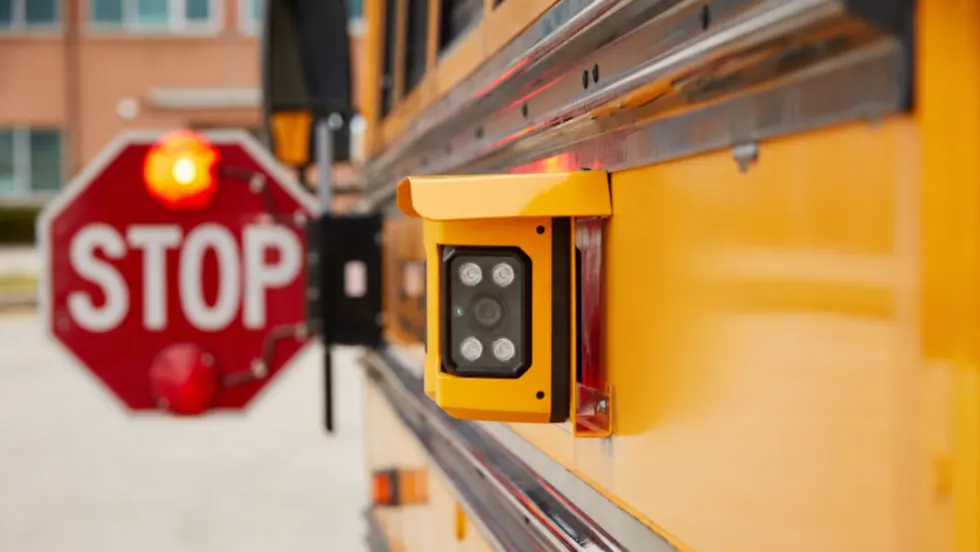
Stop-arm cameras, partnerships with law enforcement for increased traffic patrol, and public safety campaigns are just some of the measures school districts are taking to ensure the yellow bus is the safest mode of transportation for students. Lawmakers are also introducing several federal and state safety bills.
Sadiah Thompson・Assistant Editor
October 10, 2019
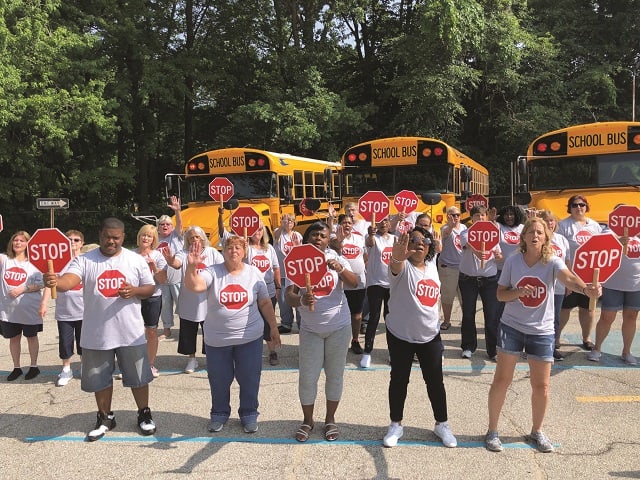
Michigan City (Ind). Area Schools’ transportation department recently recreated The Supremes’ famous “Stop in the Name of Love” — urging motorists to think twice before illegally passing a stopped school bus. Photo courtesy Michigan City Area Schools
7 min to read
Michigan City (Ind). Area Schools’ transportation department recently recreated The Supremes’ famous “Stop in the Name of Love” — urging motorists to think twice before illegally passing a stopped school bus. Photo courtesy Michigan City Area Schools
It’s been a little over a year since the fatal Rochester, Ind., crash that claimed the lives of three students and injured one other. The incident and subsequent school bus crashes issued a shock wave throughout the industry — just as many pupil transporters were attending the annual National Association for Pupil Transportation (NAPT) conference in Kansas City, Mo., last October.
The incident not only served as a reminder to pupil transporters of the importance of school bus safety, but also of the constant need to ensure their training efforts, safety equipment, and loading and unloading procedures are up to par.
Ad Loading...
“Whenever there’s a tragedy like this, we have to ask ourselves, ‘Is there anything that we can do going forward to not have this happen again?’” says Todd Watkins, the director of transportation for Montgomery County (Md.) Public Schools. “We, as pupil transporters, need to look for any proactive things we can do and talk about them in in-service meetings. We need to use these tragedies to try and get some good out of them to prevent this from happening to another student.”
A Closer Look: National Efforts for Improving Bus Safety
Oct. 30, 2018 Motorist hits, kills three students and injures one other after passing a stopped school bus in Rochester, Ind.
Oct. 31, 2018 A petition sent to the White House seeks to toughen penalties on stop-arm running.
Jan. 30 NAPT launches its “Zip. Zero. Nada. None.” campaign to eliminate school transportation-related fatalities by 2025.
April 10 Federal lawmakers introduce the Stop for School Buses Act that aims to address illegal passing.
July NASDPTS national stop-arm survey counts over 95,000 illegal school bus passing incidents.
July 10 The presidents of NSTA, NAPT, and NASDPTS send a joint letter to Congress to support the Stop for School Buses Act.
July 26 Federal lawmakers re-introduce the School Bus Safety Act of 2019 that would require lap-shoulder belts and safety technology on every school bus and provide funding for them.
That was the approach Watkins says he took several years ago when a student in his district was struck by a vehicle that illegally passed a stopped school bus. Thankfully, the student was not seriously injured, but Watkin says the bus surveillance video of the incident still serves as a “safety wake-up call.” He also says it was one of the key reasons Montgomery County approved the purchase of stop-arm cameras for all of the district’s buses for the 2019-20 school year.
“The challenge [for school districts] comes with influencing the behavior of the motorists on the road with school buses,” says Adam Baker, the press secretary for Indiana’s State Department of Education. “Nearly all school bus accidents can be avoided by motorists paying attention and slowing down. However, the conversations around making safer those things within a district’s control need to come from legislators and school leaders.”
From installing stop-arm cameras to partnering with law enforcement for increased traffic patrol and implementing public safety campaigns, school districts are ramping up their safety efforts to further prevent incidents like the fatal Rochester, Ind., crash and many others from happening now and in the future.
Illegal Passing Crackdown
Within the past year, a record number of bills have either been passed or introduced in multiple states to address school bus safety. Most of the legislation has been geared toward toughening penalties on stop-arm running and allowing or even requiring stop-arm and exterior cameras on school buses.
Ad Loading...
On a single day last year, nearly 131,000 school bus drivers in 39 states reported that 95,319 vehicles passed their buses illegally, according to an annual survey conducted by the National Association of State Directors of Pupil Transportation Services (NASDPTS). This number was significantly higher than the 83,944 passing incidents reported last year.
While the number of passing incidents may have increased, Watkins says his district and many others have made strides to implement the use of school bus cameras.
“We’ve added stop-arm, interior, and exterior surveillance cameras for the first time ever on all 1,378 of our fleet’s buses,” he says. “This is something we’re extremely proud and happy about, and we believe we’re making changes in [motorists’] behavior.”
Since piloting the cameras in Oct. 2016, Watkins says his district has seen a significant decrease in its per bus/per day passing events. He also says the district’s repeat offender rate has dropped to about 6%.
Increased Traffic Enforcement
In addition to the growing use of school bus cameras, districts’ combined safety efforts with law enforcement have sparked more awareness among the motoring public about how to drive safely around buses.
Ad Loading...
In August, Indiana’s Gov. Eric Holcomb announced the distribution of $380,000 in grant funding from the Indiana Criminal Justice Institute for increased traffic enforcement near school bus stops across the state. The funding — distributed among 230 Indiana police agencies — allows the agencies to equip officers with resources to enforce increased fines and penalties for stop-arm running.
Sue Harrison, the transportation director for Michigan City (Ind.) Area Schools, says that partnering with local police officers has helped significantly in reducing the district’s number of reported stop-arm violations.
“Motorists are becoming more aware, and we’re not getting as many complaints from our bus drivers,” she adds.
Harrison, who was a police officer for 24 years, says she understands firsthand the impact law enforcement has on school bus safety, especially when she would go out patrolling the neighborhood.
“It’s like having an extra pair of eyes, except this time there’s more consequences involved with motorists getting increased fines for passing school buses,” she explains.
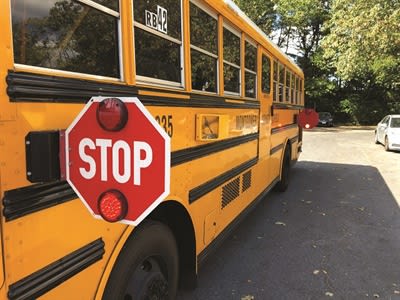
Montgomery County (Md.) Public Schools installed — for the first time — stop-arm cameras on all of its school buses for the 2019-20 school year. Photo courtesy Montgomery County Public Schools
Route, Stop Changes
Several states have adopted special guidelines for enhancing the safety of the loading and unloading process for students at bus stops.
In California, the State Department of Education already has in place a longstanding procedure that includes the driver escorting students across the street.
Since the new law was passed this summer, Zach McKinney, the transportation director for Hamilton Southeastern Schools in Fishers, Ind., says that now his district requires bus drivers to run their routes prior to the start of each school year to report any safety issues.
“This ensures that if there are areas of concern, then those stops are marked to keep them as door side pick up only,” he explains.
Ad Loading...
In Maryland, Montgomery County Public Schools has similar requirements.
“We have a rural part of our county where sometimes we have students cross on neighborhood streets where we think it’s safe,” Watkins says. “But, we’ve had a longstanding practice on controlling where kids are able to cross. For example, we don’t cross on roadways that are higher speed even if they are one direction. Even in areas where we’re allowed to have kids cross by state regulations or law, we often don’t have them do so if we believe it’s a riskier than average stop to exit the bus.”
To further boost safety on routes, Harrison says Michigan City Area Schools has increased its number of bus monitors.
“We have a total of 50 monitors for our elementary and special-needs routes, so they’re able to assist with children walking across the street,” she adds.
The monitors — as well as the rest of the district’s transportation staff — are required to wear reflective safety vests to make them more visible when they’re getting off the bus.
Earlier this year, South Bend (Ind.) Community School Corp. became part of the larger conversation around bus safety when its transportation staff presented several bus safety initiatives to U.S. Rep Jackie Walorski’s chief of staff, says Juan Martinez-Legus, the district’s former transportation director.
In April, Rep. Walorski (R-Ind.) and Julia Brownley (D-Calif.) had introduced the Stop for School Buses Act of 2019, which aims to look into ways to prevent school bus passing incidents by directing the U.S. Department of Transportation to conduct a comprehensive review of existing laws and programs in all 50 states, recommend best practices, and create a nationwide public safety campaign.
Some of the ideas presented to Walorski’s staff — before the bill’s introduction — included uniform bus stop procedures nationwide, special school bus stop requirements, and requiring two stop arms and LED lighting on all full-size school buses (a current requirement for all South Bend Community School Corp. buses), Martinez-Legus says.
“We use the brightest lighting all around our buses which helps with visibility during our early morning routes,” he says. “We also order our buses with rear stop arms and front crossing arms to make sure motorists know when our students are crossing the roadway.”
Aside from legislative involvement, Michigan City Area Schools’ transportation department has taken an alternative approach to raising public awareness about illegal passing.
Ad Loading...
The district recently recreated The Supremes’ “Stop in the Name of Love” in a viral video urging motorists to “Stop when the arm is out.”
“One of my drivers came up to me about the idea for the video after seeing how the Rochester, Ind., crash affected our community,” Harrison explains. (The bus involved in the crash was not Michigan City’s.) “After that, I had my staff send out a memo to see who would be interested in participating. We just got the ball rolling, and it turned into this big viral sensation.”
As of press time, the video has been viewed more than 20,000 times on the district’s YouTube channel.
“With our campaigns, we want our drivers to be responsible for reinforcing the education around school bus stop safety in our community and everywhere else,” Harrison says. “Sometimes our drivers will even wear T-shirts with the ‘Stop when the arm is out’ phrase while they’re out on routes, in addition to the signage we’ve put up near our school bus stops with the phrase. All of those little things really make a difference.”
Key Safety Bills Adopted Across the U.S.
Jan. 31 New Jersey Gov. Phil Murphy approves three safety bills, requiring a school bus safety study, a certification program for some school transportation supervisors, and temporary suspension of a school bus endorsement for drivers with three or more moving violations.
Feb. 15 Georgia Gov. Brian Kemp signs SB 25 into law, reversing a provision in a law that let motorists pass a stopped school bus if they are on the opposite side of a highway divided only by a turn lane.
April 25 Oklahoma Gov. Kevin Stitt signs HB 1926 into law, allowing school districts to install stop-arm cameras and issue fines to offending motorists.
May 1 Indiana Gov. Eric Holcomb passes a school bus safety bill into law, ushering in harsher penalties for motorists who run a stop arm, establishing bus safety practice requirements, and allowing reimbursement for stop-arm camera equipment.
May 13 Maryland Gov. Larry Hogan increases the fine for passing a stopped school bus with its lights flashing from $250 to $500.
June 17 Maine Gov. Janet Mills signs LD 166 into law, permitting the use of stop-arm and exterior cameras to catch illegal passers.
Aug. 6 New York Gov. Andrew M. Cuomo approves law that allows school districts to install stop-arm cameras and work with law enforcement to issue tickets to stop-arm violators.
Maine District Adds Extended Stop Arms to Some School Buses
A school district in Maine recently added extended stop arms to some of its buses.
Regional School Unit 57 (RSU 57) installed the extra-long stop arms, which extend out an additional 6 feet longer than the regular stop arm, on nine of its buses, Matt Kearns, the director of transportation for the district, told School Bus Fleet.
The district piloted one extended stop arm from May to June in 2018 on a bus route where several stop-arm violations were reported. After adding it, Kearns said, the number of illegal passing incidents on that route were reduced to almost none.
A couple months later, RSU 57 installed four more of the extended stop arms, which are made and sold by Bus Safety Solutions, for the 2018-19 school year. The district recently added three more to its school bus fleet in time for the start of the school year on Sept. 4.
Overall, the bus drivers have seen a significant decrease in illegal passing incidents since their buses were equipped with the longer stop arms, Kearns said. Similar to the pilot results, most drivers have gone from experiencing several incidents per week to none, he added.
In addition to the stop arms, RSU 57 has installed about 20 stop-arm cameras and dashboard cameras in buses to help catch motorists illegally passing stopped buses.
New safety and video capabilities aim to help fleet managers assess risk, support drivers, and take targeted action through video coaching, red-light violation detection, and more.
Is it time to strengthen your driver training? Here’s how to pick the right talent and improve recruitment, retention, and safety. This video is brought to you by IC Bus.
Four school bus crashes in Florida, Illinois, and Georgia highlight risks in transportation lots, at bus stops, and during student loading and unloading.
School bus fires are rare but can be devastating. Learn how advances in fire suppression and asset protection help fleets detect fires earlier, reduce damage, and improve safety.
Geotab Investigations combines telematics data, video, documents, and other evidence to help fleets reconstruct incidents, resolve claims, and determine what happened.
Sai Darshana Yekolu of Moseley Middle School in Prosper, Texas, was named the newest winner for her artwork, bringing the theme of “Safe Rides, Everyday Heroes” to life.
With diesel prices soaring and nearly one-third of transportation directors expecting budget cuts, maintaining student safety has never been more challenging. Download this guide to learn how leading districts are prioritizing risk, funding critical safety technology, and building stronger budget cases with data.
As thefts and overnight security threats continue, school transportation leaders are combining stronger operational practices with AI-enabled surveillance to better protect buses, facilities, and staff.