




School Bus Operators Save Big on Maintenance With Propane
Pupil transporters in Colorado, Georgia, and Illinois share the financial benefits of adding propane buses to their fleets — including reduced costs on oil and filter changes and minimal cold-weather starts.


Bibb County (Ga.) School District’s 97 propane buses have yielded a more than 28% reduction in fuel costs compared to its 103 diesel buses. Photo courtesy Bibb County School District
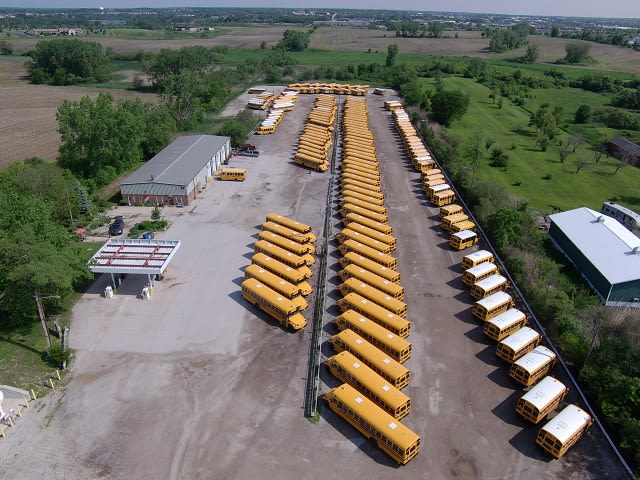
Of the 166 buses in American School Bus Co.’s fleet, 81 are propane. The company also has an onsite fueling station with three pumps and a 6,500-gallon propane tank. Photo courtesy American School Bus Co.
Across the U.S., school districts and transportation companies are adopting alternative-fuel vehicles as part of district and statewide initiatives to go green. While these alternative fuels can benefit the environment by reducing harmful emissions, they have also helped some operations save hundreds, if not thousands of dollars in fuel and maintenance costs each year — particularly with propane buses.
According to the Propane Education and Research Council (PERC), there are nearly 20,000 propane school buses on the road nationwide, and over 1.2 million students in 48 states are transported to and from school on a propane bus.
Last year, 15% of respondents in School Bus Fleet’s Annual District Fleet Survey who bought new buses chose propane-powered vehicles, and about 6% of respondents’ current buses were propane.
As the number of propane buses in the U.S. continues to increase, more school districts are realizing the benefits these buses can have on their transportation budgets. SBF spoke with operators and maintenance technicians in Colorado, Illinois, and Georgia to find out how propane buses have led to significant advantages for their operations — including reduced fuel costs, frequency of oil changes, and minimal cold-weather starts.
More Funding, More Propane
Over the past three years, Boulder Valley (Colo.) School District has added more than two dozen propane buses to its fleet, and nearly all of them were purchased in part with grant funding.
The district’s latest propane-powered vehicles — six Blue Bird Vision model year 2021 buses — were purchased with a little less than $400,000 of the state’s $68.7 million total share of Volkswagen (VW) settlement funds. Each bus cost approximately $110,000, and the funding covered about $30,000 per bus, according to Leslie Hornbaker, the district’s shop foreman. (The remaining VW funds were used to purchase one electric school bus for the district.)
“The two main reasons we started incorporating propane buses were fuel costs and pollution,” Hornbaker explains.
The buses are reportedly able to cut current tailpipe emissions by 66% and produce “near-zero” nitrogen oxide (NOx) emissions at 0.02 NOx, according to Ryan Zic, vice president of school bus sales for Roush CleanTech, the propane fuel systems supplier for Blue Bird.
On average, Hornbaker says, each of Boulder Valley’s propane buses travels up to 80 miles per day, totaling to about 6,000 miles each school year. The average cost to operate one of the district’s 37 propane buses is about $0.48 per mile compared to $0.72 per mile for a diesel bus, he adds. That means the district, on average, spends about $38.40 a day to run a propane bus versus $57.60 for a diesel bus. This rounds out to a total cost savings of $19.20 per day and more than $3,000 for a 160-day school year.
Hornbaker says that much of this cost savings is due to decreased fuel expenses, fewer oil changes, and propane buses not requiring diesel particulate filter (DPF) cleaning, which can be costly.
“As our diesel buses get older, they get more costly to repair and clean,” he adds. “We do the DPF cleaning at approximately every 50,000 miles on a diesel bus, which can cost up to $1,000 per bus, so that’s a huge savings for us.”
Easier Cold-Weather Starts
In Orland Park, Ill., American School Bus Co. (ASBC) — a subsidiary of school bus contractor Cook-Illinois Corp. — has experienced similar savings, even in cold weather, according to Clint Meadows, the company’s shop foreman.
Every month, ASBC monitors the miles per gallon (mpg) of its 81 propane buses, with each bus reportedly traveling up to 300 miles on a full tank and averaging about 4 mpg, he says.
Even though ASBC performs similar maintenance procedures for all 166 buses in its fleet, which also includes 48 diesel and 37 gasoline buses, Meadows says the cost of operating a propane model is about three-quarters less than a diesel model.
“It’s less oil changes and less fuel filters, so you don’t have to change them as often,” he says. “When changing oil on [a] propane [bus], we’re looking at seven quarts of oil versus 18 to 20 quarts [of oil] for a diesel.”
Using an oil monitoring system, ASBC’s maintenance staff performs oil changes every 8,000 miles or roughly once a year on all of its buses.
“When you change the oil from a propane bus, it’s clean,” Meadows says. “I’m sure in the long run this will pay off for the internal maintenance of the engine.”
Another cost-saving benefit, he points out, is the reduced time and fuel used for cold-weather starts.
“We used to start diesels early in the morning because you had to get them up and running in the cold weather,” he explains. “We don’t have to do that with propane.”
By running the buses for shorter amounts of time, Meadows says, the company can see returns on fuel costs and also reduce its emissions levels.
Greater Tech Efficiency
Historically, propane fuel has been about 50% less expensive than diesel, says Roush CleanTech’s Zic.
In Bibb County, Ga., the cost per gallon for propane is $0.95 versus $1.33 for diesel, according to Anthony Jackson, the transportation director for Bibb County (Ga.) School District. These figures have reportedly remained the same since the district added 31 propane buses to its fleet in 2016.
Today, the district runs nearly half of its fleet on the alternative fuel: a total of 97 buses out of 206. Since making the shift to propane in 2014, Jackson says the district has experienced a more than 28% reduction in fuel costs.
Each bus in Bibb County’s fleet runs up to 25,000 miles per year. For every two oil changes performed at 5,000-mile intervals, he says the district’s propane buses average almost 40% less in oil change costs than those required for diesel models, which are changed every 10,000 miles.
“The newest propane engine technologies are more efficient than older technologies still in use,” Jackson points out. “Each Blue Bird Vision propane runs on a Ford 6.8 liter V10 engine with a Ford 6R140 automatic transmission.”
He also says that installing a propane fueling station is less costly than other fueling stations, such as gasoline and CNG, because the EPA classifies propane as a non-contaminant and that the infrastructure for the alternative fuel has fewer compliance requirements.
Jackson encourages districts that are interested in adopting propane to reach out to operations that have firsthand experience with the alternative fuel.
“There are plenty of districts out there that have already made the transition [to propane] and they all seem to be willing to answer questions and share information with districts considering the change,” he adds.
“Your overall retention with customers, contracts, and employees are all important, and [using propane] is definitely more beneficial for the environment,” ASBC’s Meadows says. “At first it was new to [ASBC], but the cost savings has been the most helpful.”
More Maintenance
The Essential Guide to School Bus Maintenance and Student Safety
Your district's buses carry students to school every day. This guide shows how predictive maintenance powered by fleet data helps keep buses reliable, drivers accountable and students safer from the first bell to the last stop.
Read More →
Kerry Brothers Grows Michigan School Bus Repair Network
The acquisition of Downriver Truck and Bus expands Kerry Brothers’ school bus maintenance footprint across southeast Michigan, adding repair capacity, diagnostic resources, and state inspection support.
Read More →
Noregon Introduces CAN Bus Diagnostic Tool, Expands JPRO Features
CAN Mentor and the latest JPRO update aim to simplify vehicle network diagnostics and improve repair efficiency for technicians of all experience levels.
Read More →
Cummins on Smarter, Simpler Engine Innovation
Cummins discusses its first-ever gasoline engine for school buses, EPA 2027, and why bus fleets still want durable, simpler internal combustion options.
Read More →
Report: 72% of Diesel School Buses Now Use Advanced Low-Emission Engines
New data shows advanced low-emission diesel technology continues expanding across school bus fleets, even as electric bus adoption gains momentum.
Read More →
Vampire Tools' CAIMAN 7.5-Inch Multi-Purpose Screw Extractor Long-Nose Pliers with Crimper
Vampire Tools introduced the VAMPLIERS Caiman 7.5-inch multi-purpose pliers, combining screw extraction, cutting, crimping, and gripping functions into a single tool designed for fleet maintenance professionals.
Read More →
How Advanced Diagnostics Helps Bus Fleets Stay Ahead of Repairs
Chat with Noregon’s Kevin Smallhorn at ACT Expo about bus diagnostic tools, telematics integration, CNG maintenance support, and strategies to help reduce downtime and improve uptime.
Read More →
How School Bus Fleets are Getting Ahead of Breakdowns
Don’t let bus downtime wear you down. Here’s how bus operators are shifting from manual processes to AI-powered, data-driven maintenance systems for improved reliability and safety.
Read More →
Pennsylvania School Bus Maintenance Team Praised for Dedication to Safety
Matthews Bus Company’s West Jefferson received a letter of commendation from the Pennsylvania State Police for their fleet inspections.
Read More →
From Chaos to Clarity: How School Districts Are Running Leaner Transportation Operations
Covering 38 routes on a Friday afternoon. Buses idling while routes overlap. Parents calling nonstop about late arrivals. Sound familiar? This whitepaper explores how district transportation leaders solved these exact problems — and what measurable results followed.
Read More →