




Q&A: ‘Pre-Buy’ Activity Boosts School Bus Sales in 2006
Thomas Built Buses President and CEO John O’Leary says the manufacturing sector is seeing increased sales due to customers increasing their bus purchasing before the EPA’s stricter emissions standards take effect in 2007.


How is the school bus manufacturing sector doing these days in a period of tight school district budgets, looming changes in EPA emissions standards and increasing construction costs for vehicles?
One manufacturer, Thomas Built Buses in High Point, N.C., seems to be handling the pressure well. Just how well? SBF Editor Steve Hirano recently asked John O’Leary, president and CEO of Thomas Built Buses, about his company’s performance and its responses to the many challenges facing the school transportation industry.
How is the school bus market looking for the 2006 sales year (Nov. 1, 2005, to Oct. 31, 2006) compared to the previous year?
We tabulated the industry at roughly 44,000 orders in 2006 versus roughly 40,000 in 2005, with the increase being largely driven by 2007 engine pre-buy activity offset by lower Type A volumes.
Do school districts and contractors seem to have more capital for bus procurements?
There seems to be a little more capital available in general, and with fuel costs dropping lately, there will be less pressure to convert capital to operating funds. However, the big unknown at this point is what impact we’ll see on volumes as more customers confront the EPA ‘07 price increase.
What have you seen with regard to pre-buying to avoid purchasing buses with 2007 engines?
There was an EPA ‘07 pull-forward effect of approximately 6,000 units in 2006, primarily from the contractors and several state accounts. Most districts did not have the flexibility in their funding models to purchase many, if any, extra buses in 2006. However, many private contractors and states such as North Carolina, South Carolina, Florida and Kentucky were able to do so.
How competitive is the school bus market right now? That is, are margins being eroded by competition for market share?
The school bus market is always competitive! That is a natural result of OEMs having more capacity than demand in a market with relatively flat annual volumes.
Thomas has the highest market share in the industry, which is rewarding because it is a positive reflection on how well received our Type A, C and D products are by thousands of customers. It is also a tremendous reflection on our dealers, who are the best in the industry.
However, we do not spend much time talking or thinking about market share. Our primary focus is on financial performance. It would be extremely irresponsible for me to pursue a “market share at any cost” strategy. I spent the longest two years of my life at Freightliner helping to repair the damage from that flawed strategy. It isn’t sustainable over time.
My duty to the shareholders of DaimlerChrysler is to provide a competitive return on their investment, and by doing so we ensure Thomas will be in business for another 90 years.
How is the C2 doing against your competitors’ conventionals?
Tremendously well. Our backlog on them is currently out to May 2007. We hear a lot of stories about kids wanting the “cool bus” put on their routes. Some of the early units had their problems, which we had obviously hoped to avoid. But the reality is this is the first school bus completely designed from a clean sheet of paper in many years, and on top of that we introduced an enormous amount of new technology.
An example of how good the C2 now is came from our newest dealer, who recently jumped to Thomas from a competitor. It was taking him eight to nine hours to get the competitor’s conventional ready for delivery. He was shocked to find it only took him an hour to get his new C2s ready for delivery.
How many C2s are you building each day in High Point?
We are currently building 30 C2s per day, which will rise to 36 per day by Thanksgiving and ultimately to 44 a day late in the first quarter of 2007. The plant is performing spectacularly, and it is always fun to watch a customer’s jaw drop the first time he or she walks into the plant.
Now we have a new challenge. Due to the popularity of the C2, we need to figure out a way to increase the maximum build rate above 44 while retaining today’s excellent quality. But these are good problems to have.
[PAGEBREAK]
Are you having any problems getting components on time?
We had a very difficult time getting wiring harnesses throughout the summer for our FS-65 and transit products, although that is now behind us. Despite record truck demand recently, the supply base seems to be doing a much better job of meeting OEM demand than it did during previous market booms.
A lot of discussion in the industry has focused on the incredible number of options available to school bus buyers. Where does Thomas stand in this controversy?
There is a simple axiom in manufacturing, which is that complexity adds cost and inhibits quality. Sure, we can do anything the customer wants, but there is a cost associated with that. I know customers hate to see price increases every year, yet I’m not sure people realize how much complexity across the industry has increased. If you walk down one of our production lines, you can see how little commonality there is among buses from different states.
The specs vary considerably from state to state, and they rarely get simpler over time. A transportation system dedicated to the delivery of schoolchildren is very expensive, so much so that the U.S. and Canada are the only nations that choose to take this approach on a widespread basis. The more expensive it gets, the more tempting it is for districts and politicians to throw this responsibility back at parents. North American student transportation as a whole needs to remain affordable or its very existence will be at risk.
I am not advocating all buses be exactly the same, but in some areas such as lights, traffic control and emergency equipment, there is a lot of potential for trimming the number of options down to a few “best” solutions.
In what ways can OEMs help their customers write better specifications for their bus procurements?
The OEMs all have the luxury of seeing what specifications are currently used around North America, and of those which ones are more prevalent and why. So if a customer has an end result he or she is trying to achieve, such as better warning light visibility, more maneuverability or greater fuel economy, we and our dealers can typically help them achieve that using an existing option, as opposed to the customer coming up with their own solution, which requires us to create a new option.
How is the Type A market? Are you seeing a surge in sales of Minotours to Head Starts?
Despite the Type A market slowing in 2006, we still believe in its growth potential, so from that perspective it is very attractive to us. We ran our Minotour plant at maximum capacity for most of this year, and we totally dominate the yellow bus piece of that market. However, we have not done as well selling into the non-traditional white bus piece of that market. That will change shortly.
Is Thomas planning any major redesigns of its products?
The feedback we get from industry people is that we currently have best-of-class products with the C2, HDX and Minotour, so we have no major redesigns scheduled for them at this time. Our forward-control Type D, the EF, is the sales leader in its market niche but will get a major facelift prior to the next EPA engine change in 2010.
Later this fall we will be making a major investment of roughly $12 million in our production facilities. Once the FS-65 is retired in October, we will renovate Plant 1 substantially. The Type D body will get a new, much more efficient layout, and we will move Minotour production into that building as well. We will transform all of our production facilities to the same world-class level as the C2 plant.
What’s the biggest challenge facing bus manufacturers these days?
Trying to differentiate yourself from your competitors. When a district makes a purchasing decision based purely on low bid, it takes out of the equation things that we as OEMs assume the customer values, such as driver comfort, visibility, turning radius, technology, innovation, fuel economy and broader issues such as dealer service and support, resale value, whether the company will stand behind the product, or even if the company will still be around in 10 years to support the product.
As most of your readers well know, not all school buses are the same, and yet many purchasing departments acquire them the same way they do pencils or light bulbs.
Personally, what’s your biggest challenge?
My biggest challenge is harnessing and sustaining the tremendous momentum we have at Thomas right now. People here who once resisted change are now leading it. We just concluded our annual dealer meeting, where we shared with them our plans for 2007, and they are more excited than I have ever seen them. My role is to ensure we keep our eye on the ball and deliver on our potential.
More Management
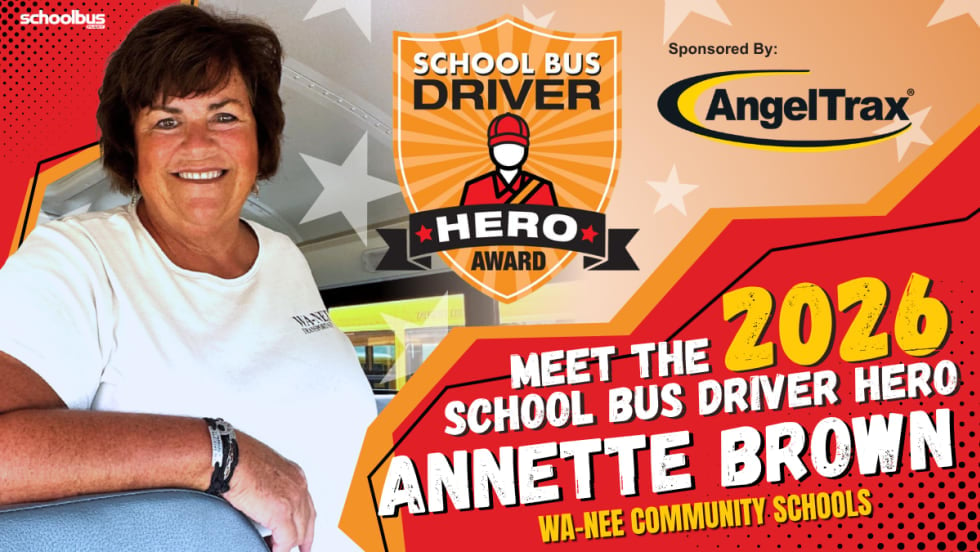
Annette Brown Always Takes the Extra Time: Meet Our 2026 School Bus Driver Hero
For more than 30 years, the Wa-Nee Community Schools driver has treated students like family, combining safety, compassion, and servant leadership to make a lasting difference on and beyond the school bus.
Read More →
How to Build a Better Driver Training Program
Ready to boost up your school bus instructor training? Here’s how to pick the right talent and improve recruitment, retention, and safety.
Read More →
CALSTART and Forth Combine to Form Catalyst Mobility
The new name represents a renewed vision for the nonprofit focused on advancing clean, equitable, and affordable transportation solutions that move people and goods.
Read More →

What Makes a Great School Bus Driver Trainer?
Choosing the right school bus driver trainer takes more than experience. Learn six keys to selecting and developing trainers and evaluating program effectiveness.
Read More →
School Bus Contractors Expand Through New Deals, Acquisitions & Partnerships
STA's Canadian division acquires Ontario-based G&L Stevenson Transport; Durham School Services adds a new district in California; First Student expands in New Jersey; and Minnesota Coaches rebrands and acquires Halo Transportation.
Read More →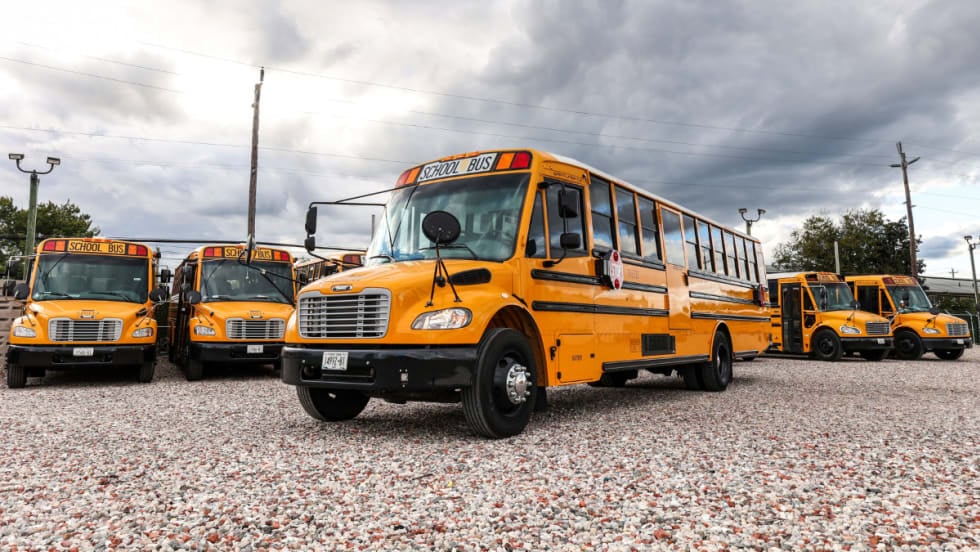
Logan Bus Company Rolls Out AI Phone System for NYC School Bus Families
A summer pilot found that AI agents could handle most routine calls, freeing up time for customer service staff to focus on emergencies and complex family concerns.
Read More →
From Intent to Impact: What I Learned About Leadership from TAPT
A Texas transportation supervisor shares lessons on self-awareness, accountability, managing stress and building trust — and why investing in leadership development matters at every stage of your career.
Read More →
NAPT Names 2026 Award Recipients, Hall of Fame Inductee
Who earned national recognition for their work in student transportation? This year, NAPT named five recipients of its 2026 awards for service, safety, and leadership, plus its newest Hall of Famer.
Read More →
2026 State of Student Transportation Report
Driver shortages. Rising costs. Growing safety expectations. More data, but not enough time to act on it. The 2026 State of Student Transportation Report reveals what transportation leaders say is putting the most pressure on their operations—and where they’re investing next. See how your priorities compare.
Read More →
How to De-Escalate an Angry Person: 5 Steps for Handling Workplace Conflict
What makes emotions run high, and how should you handle an angry colleague or parent? Follow these steps for staying calm, listening, showing empathy, and resolving conflict.
Read More →