




Q&A: New President at Thomas Faces Key Challenges
In late August, Thomas Built Buses announced that longtime president John Thomas III was stepping down and being replaced by John O’Leary, a driving f...

In late August, Thomas Built Buses announced that longtime president John Thomas III was stepping down and being replaced by John O’Leary, a driving force in the turnaround strategy of Freightliner, the Portland, Ore.-based parent company of Thomas.
O’Leary, a relative newcomer to the school bus industry, is undaunted by the challenge of taking over the reins from Thomas, who will remain a company consultant. Chief among his new initiatives will be overseeing the construction of Thomas’ new $40 million manufacturing facility [scheduled for completion in late 2003] in High Point, N.C., launching a new conventional bus product and building Thomas’ market share in the highly competitive school bus industry.
In an interview in late October, O’Leary, 41, discussed these challenges with Editor Steve Hirano.
SBF: What is your impression of Thomas Built Buses so far?
JOHN O’LEARY: I’ve been very impressed in many ways. First, Thomas is highly regarded in the local community. It’s one of the largest employers in High Point and the surrounding areas. So it has very high visibility here.
Within the school bus industry, I know that we’re up there with Blue Bird and International [Truck and Engine Corp.] as far as this neck-and-neck battle for supremacy, and that’s an ongoing battle. It’s a very competitive business right now, and it’s nice to be in the middle of that. Obviously, we’d like to extend a lead out further and further as time goes on, but that’s one of the challenges we have.
Tell me a little bit about what you did at Freightliner before coming to Thomas.
When I first started with Freightliner, I had responsibility for about half of the accounting organization. About three months later, I was promoted to the position of audit director. I was in that job, literally, for about a month, and then the need arose for the turnaround effort. We were starting to see some good-sized losses, and we could look out on the horizon and see more coming our way. So the decision was made to engage in a very structured turnaround program. They put me in charge of that, and that’s what I did for about the last 18 months prior to my Thomas position — just head that up and really manage all the day-to-day aspects of that program.
Sounds like a difficult assignment.
Yes, it was. The company was losing a lot of money, and I don’t think it’s any secret that Freightliner lost over $1 billion in 2001. So it was very serious. Obviously, Chrysler was losing a lot of money at the same time, so from the overall DaimlerChrysler perspective, we were the two divisions with the big problems. We had a lot of long days, long hours, long weekends. It was a very difficult time.
Where is the plan at now?
We’re roughly a year into it, and it’s going extremely well. Freightliner’s back in the black and actually ahead of schedule. We figured we’d get about $850 million of savings by 2004, and we had earmarked $450 million of that to come home in 2002. We’ve actually achieved about $500 million, so we’re about $50 million ahead of schedule in 2002, so it’s going very well.
The closing of Thomas’ Canadian plant was part of the turnaround initiative. Is Thomas on line with what was expected of it in terms of its cost cuts?
Yes, we are. As part of the turnaround program, each division, including Thomas, had its own subprogram. One of the largest measures Thomas had was closure of the plant in Woodstock, Ontario.
Thomas is doing very well in its turnaround initiatives. Savings at this point are all coming home on schedule. It’s been a big win for the Thomas team because they had a pretty aggressive target. And we are tracking it very well. One of the interesting things about this whole program is we continue to monitor; we haven’t just said, “OK, we’re out of the woods now, and let’s go back to business as usual.” All these initiatives — and there were more than 4,000 of them for all of Freightliner — continue to be tracked. We follow up on each and every one of them both here at Thomas and corporate-wide. So we’re continuing to drive all the savings home.
Was part of your responsibility in the turnaround plan dealing with Thomas?
Yes, it was. We had 17 teams corporate-wide, and Thomas was one of those teams. So I dealt with all of those teams; they basically all came under my management of tracking how they were doing and making sure that they were delivering the savings on time. Thomas was one that I was familiar with. Every two weeks or so, we had video conferences with Thomas’ senior management staff. So I got to learn a fair amount about the company.
You previously worked at Paccar, a heavy-truck manufacturer. How does the school bus business compare with the truck business?
It’s a lot different, actually. In the North American truck business you have Freightliner with the biggest market share at about 31 percent. Then you have International at 18 or 20 percent. Then you drop down to Kenworth and Peterbilt at about 12 percent each, and I think Volvo and Mack are not too far behind. So Freightliner’s going to be the 800-pound gorilla, and then you have some smaller players.
In school buses, it’s much more tightly bunched. You have the three big ones neck and neck. So that makes it much more competitive. The other thing that is interesting, and somewhat frustrating, is that it’s hard to really differentiate yourself other than in cost because it’s mainly a low-bid business. That’s fine, except that when you have the access to technology and automotive-type features that we do, it would be nice to take better advantage of those opportunities.
You’re talking about DaimlerChrysler and your access to some of its technology?
Exactly.
Will you bring in more of that synergy, or is it already in place?
Some of it’s in place, but there are more opportunities to explore. If you were to look at the dashboard of some of our products, you would see a more automotive finish than in the past. Driver ergonomics and visibility can only get better with some of the technology we have.
The Mercedes engine has been a huge win for us. About 40 percent of our backlog is for Mercedes engines. So we’ve had a great opportunity to leverage that, because it’s such a great product. It’s nice when you go to your customers and say, “Here’s something with the appeal or the quality image of a Mercedes engine, and, oh, by the way, it doesn’t cost you any more, and it’s very quiet, and it runs smooth and has great mileage.”
Are there synergies with DaimlerChrysler’s commercial bus network?
The synergies with the commercial bus side are on the manufacturing end, and you’ll see a lot of them when we get our new plant built in 12 months. Recently I was in Germany reviewing the technology that they use in their bus plants over there. And what we’ve done is engaged a group within DaimlerChrysler that specializes in plant construction and manufacturing procedure. They’re working with us on the design of the new plant, so we went over there to see the cutting-edge technology, logistics and manufacturing processes that they’re using that we intend to use here.
Sounds pretty expensive.
Well, it can be as expensive as you want it to be. We’ve told them very clearly that in our market — given the price competitiveness and given the relatively low volumes, certainly by automotive and even by truck standards — we need to use technologies and processes that we can afford. We’re not going to gold-plate this to the point that we can’t be competitive. The intent of the plant is to drive cost out of our product and allow us to be even more competitive price-wise than we are today.
One of the things that one of your competitors has done is move toward a CNG bus option for their small bus. Is that something that Thomas is looking at?
We’re looking at that. I think CNG has limited applications, and we certainly have a CNG product in our transit-style bus today. If you look at the 2007 emissions regulations, where they basically turn diesel engines into air cleaners, I’m not really sure about the long-term viability of CNG. Certainly, you have other things out there like hybrid power and fuel-cell technology and things like that down the road. We — again, being part of DaimlerChrysler — are going to have access to that type of technology probably much sooner than our competition. But it’s sure to say that we are constantly reviewing all the different power technologies out there.
You’re well aware that the school bus market has been in a slump for a couple of years. When do you think the market is going to break loose from that?
Our sense is that, historically, the market has gone down in three-year steps, and we anticipate that 2003 will be the trough of the market. So we expect another down year next year and then a rebound out of it in 2004. That’s our prognosis at this point.
Are there things that you do in terms of your capacity in preparing for that? Obviously, you’re building a new plant that is expected to open in 2004.
We definitely have hunkered down, and we would like to be building more buses than we are. But as far as being structured for the capacity, we still have a lot of upward potential we’d like to be using right now, but we can’t. But like you said, the timing of the rebound and the bringing online of the new plant should work very well for us. We should really be looking at a great year in 2004 if all these things come together. Obviously, you can’t predict what’s going to happen in the world, and the whole post-9/11 meltdown of the economy has not been something anyone anticipated. But barring any of those types of situations, we look for a pretty strong year in 2004.
Has the tie between Freightliner and Thomas become stronger since your appointment?,br> I think the tie is stronger, only because I directly reported to Rainer Schmueckle, the president and CEO of Freightliner, and worked very closely with the senior vice presidents on the restructuring program. So they all know me extremely well. As far as the autonomy they give me, I think it’s very similar. I don’t think they have any shorter leash on me than they did on John. They pretty much let us do what we think the right thing is for the business.
What plans does Thomas have for its product line?
At the current time, we’re pretty happy with our product. We have a new conventional on the drawing board that I really can’t talk a lot about at this point, but it’s going to be quite a pleasant surprise for people. It’ll be on the new M2 chassis, which is the new medium-duty truck that Freightliner introduced earlier this year.
In fact, the entire reason for having the new plant is the new product. So that’s going to be a big hit for us. And again, we’ve done a lot of things right with the product. We’ve done a lot of things as far as utilizing engineering and technology from DaimlerChrysler.
What would you say is Thomas’ biggest challenge over the next few years?
I think the biggest challenge is the competitive landscape out there. We know that we have some tough competitors arrayed against us. It doesn’t matter if you’re talking about Blue Bird or International in the big-bus markets or some of the smaller players in the Type A markets. It’s just very competitive, and I think that the real challenge is to get away from this pure price-based dealing that we’ve lapsed into, where school buses have become to some extent just commodity items. I would really like to see us be able to differentiate ourselves more from the competition, and that’s really what we’re pushing to do — to be able to go to somebody and say, “There are reasons other than price to buy a Thomas bus.” I think that we’re heading in that direction, and we’ll just continue to push that.
More Management

Zum Secures Continued Financing Support for School Bus Expansion
Generate Private Credit has financed approximately $75 million in school bus deployments across three states, supporting more than 500 buses as Zum expands across the county.
Read More →
Beyond Discipline: A Different Approach to Student Behavior on the Bus
After implementing a dean of students program in Oregon, North Clackamas is seeing positive improvements. Here’s how it worked. The Route is brought to you by IC Bus.
Read More →
A Dean of Transportation's Different Approach to Student Behavior on the School Bus
After implementing a dean of students program in Oregon, North Clackamas is seeing positive improvements on the bus. Here’s how it worked.
Read More →
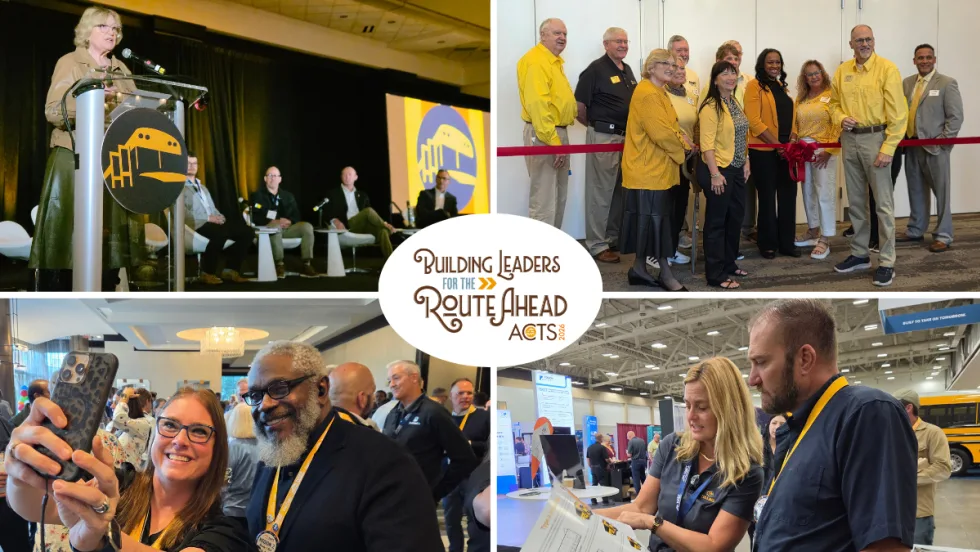
Inside NAPT ACTS 2026: Highlights from Louisville
From federal updates and student behavior strategies to new school bus technology and industry awards, see highlights from NAPT ACTS 2026 in Louisville.
Read More →
Meet the 2025 School Bus Driver Hero Winner: Annette Brown
We caught up with Wa-Nee Community Schools' Annette Brown on site at SBFX, where she was named the 2026 School Bus Driver Hero Award winner. Hear about her reaction, what she loves most about being a school bus driver, and more!
Read More →
Predictability Is Like Ketchup (According to 6-Year-Olds)
To students, a different school bus can feel like a full-blown crisis. One driver reflects on why familiar routines, showing up on time, and being reliably boring matter more than we think.
Read More →
Samsara Launches Free Driver Rewards Program
The new Driver Perks program gives eligible professional drivers access to discounts and offers without adding a cost for participating fleets.
Read More →
How Tax-Exempt Municipal Leases Can Help Finance School Buses
Let’s explore school bus financing options, including municipal leases, vendor payable accounts, and balloon payments, and how they can help stretch fleet budgets.
Read More →
Nominate Rising School Transportation Pros Under 40!
We’re searching for the next generation of leaders making an impact across the K-12 student transportation industry to recognize as SBF’s 2027 Trailblazers. Nominations are open now!
Read More →
Changing Lanes: BusWhere, EverDriven, InterMotive, Summit School Services, Switzer-Carty & Thomas Built Buses
Check out who's been hired, promoted, and appointed to leadership positions at various school transportation suppliers, contractors, and manufacturers.
Read More →