




Protecting Precious Cargo: Safety Comes Standard
School bus manufacturers keep their focus on making every child’s ride as safe as possible with a variety of safety features.

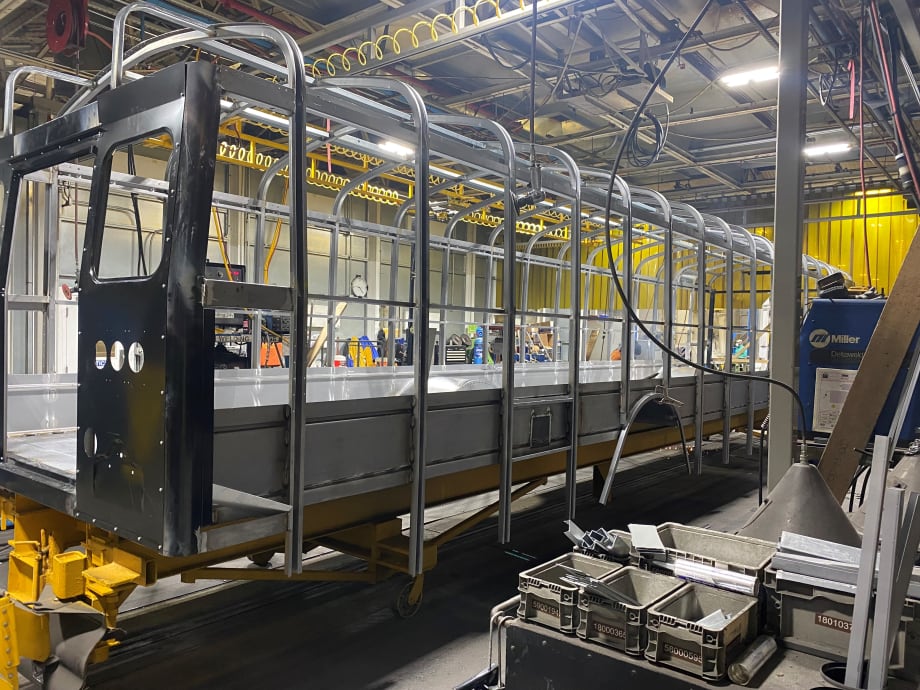
Thomas Built Buses use Saf-T-Net construction to create a cage-like design for increased passenger protection.
Photo: Wes Platt
Inside or outside the school bus, the safety of the children each vehicle carries remains a primary consideration for companies that build them.
From fundamental roof bow construction to high-tech sensor equipment, the modern school bus has evolved as one of the most intensely regulated vehicles on the road each and every day.
Ken Whisnant, engineering manager for Thomas Built Buses, said safety remains a major focus for the company: “For a long time, it was seat belts and different seat types. The focus recently has been around-the-bus safety features. We recognize it’s important not only getting kids safely to and from school, but also safe from oncoming traffic.”
That focus is also found at IC Bus. Said Katherine Stok, the company’s segment marketing director: “Safety is included in all of our investments for R&D and is at the heart of all we do at IC Bus.” She noted that any and all technologies that protect children in the danger zone around the bus are prioritized.
Michael Perez, GreenPower Motor Company’s vice president for school buses, contracts, and grants, said that the company spends an equal amount of resources improving safety inside and outside the bus.
“For instance, GreenPower has made several features standard in its school bus builds that are usually options,” he said.
Bryce Pfister, vice president and general manager for Collins Bus, said his company’s also “dedicated to designing and manufacturing the safest bus on the market to protect the lives of its precious cargo.”
In this article, School Bus Fleet explores some of the standard and premium features available to keep children safe, including:
Sturdy frames and roofs.
Reliable flooring.
Impact-absorbing rub rails.
Safety alarms.
And more!
Blue Bird
Blue Bird’s All American boasts the largest bumpers in the school bus industry at 15 inches tall.
Rain visor built into roof to enhance visibility in all conditions.
Rub rails mounted above floor level, providing additional structural rigidity and passenger protection.
The Vision bus offers forward visibility and mirror systems that improve driver awareness and increase child safety around the bus.
Heavy 14-gauge floor panels cover full width of bus and are reinforced with “U” channel crossmembers every nine inches.
Electronic stability control (ESC) to help prevent loss of steering control in inclement road conditions.
Back-up/rear view camera that provides the driver with a display to assist with backing the bus.
Collins Bus
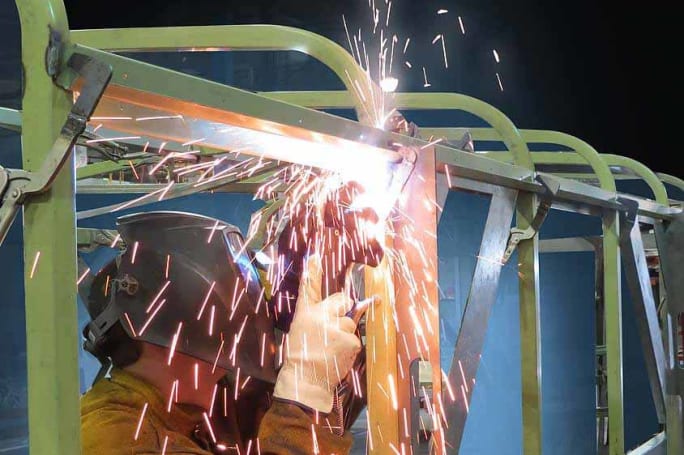
The Collins Bus Type A vehicle has full-length interlocking cross members and floor beams that provide roll-over and side-impact protection.
Photo: Collins Bus
One-piece tubular roof bow construction made of HSLA (high-strength low-alloy) steel.
Full length interlocking longitudinal cross members and floor beams creating a roll cage structure that offers roll-over and side impact protection.
Interlocking floor beams that hook to one another to create a cage that delivers extra strength and protection.
View-out window that reduces blind spots and enhances visibility.
One-piece marine grade plywood (not separate panels) reduces splintering under duress.
Egress window zones throughout the bus maximizes available emergency exit locations.
Collins Clean and Shield (by Permasafe) application to each bus which eliminates most germs, bacteria, viruses an other harmful microorganisms on surfaces and fabric.
Back-up camera system standard on all buses under 10,000 GVWR.
GreenPower Motor Company
BEAST Type D
Seat belts for passengers.
Interior reminder safety alarms.
Non-slip flooring.
Monocoque Constellium all-aluminum chassis on the BEAST Type D school bus.
Higher floors than typical school buses, elevating student passengers above the usual accident impact zone.
IC Bus
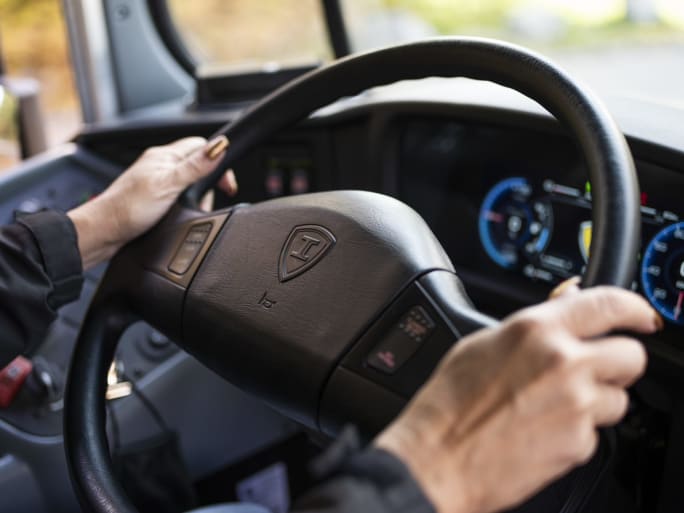
The IC Bus CE Series features steering wheel controls that allow the driver to keep better control during passenger loading and unloading.
Photo: IC Bus
CE Series
Bendix ESP Full Stability System (electronic stability control).
Active emergency braking – Bendix Wingman Advanced Collision Mitigation System (air brake buses, internal-combustion engine buses only).
Entrance steps remain their full width with no taper from the bottom to top.
Steering wheel controls – allows the driver to keep better control during both loading and unloading of passengers.
Child detection/post-trip monitor system.
Threaded-bow body construction with continuous runners connecting all roof bows.
Upgradable SafeGuard BTI Seating – protects for combination of belted and unbelted occupants; includes SmartFrame technology to enhance compartmentalization.
CE Series Electric
High-voltage disconnect switch.
Batteries fully enclosed between frame rails.
Noise emitter.
Air disc brakes.
Thomas Built Buses
Minotour
Safety cage body construction.
Two internal roof crash rails for rollover protection.
Daytime running lights.
Four-wheel anti-lock brakes.
Saf-T-Liner C2
Saf-T-Net construction with extended roof bows and a rafter system that create a cage-like design. Roof bows go three inches below the floor line for enhanced durability in a crash.
Side skirt reinforcement.
Bonded windshield and stationary glass.
PV360 360-degree camera.
Mobileye N.V. warning system to prevent forward collision, pedestrian collision, and lane departure.
Saf-T-Liner HDX
LED lighting.
Up to 50-degree wheel cut.
Loading zone visibility.
Exterior mirror cluster with flat and convex rear view mirrors and front crossover mirrors.
Optional backup camera.
Looking ahead, Whisnant at Thomas Built expects safety technology aboard school buses to keep evolving based on advancements in autonomous vehicles and advanced cameras and sensor detection.
“There’s a ripple down from a lot of sensors in technology in the passenger car that can benefit the school bus industry,” he says. “We’ll keep seeing how our features perform, get feedback, and improve and refine our designs.”
More Safety
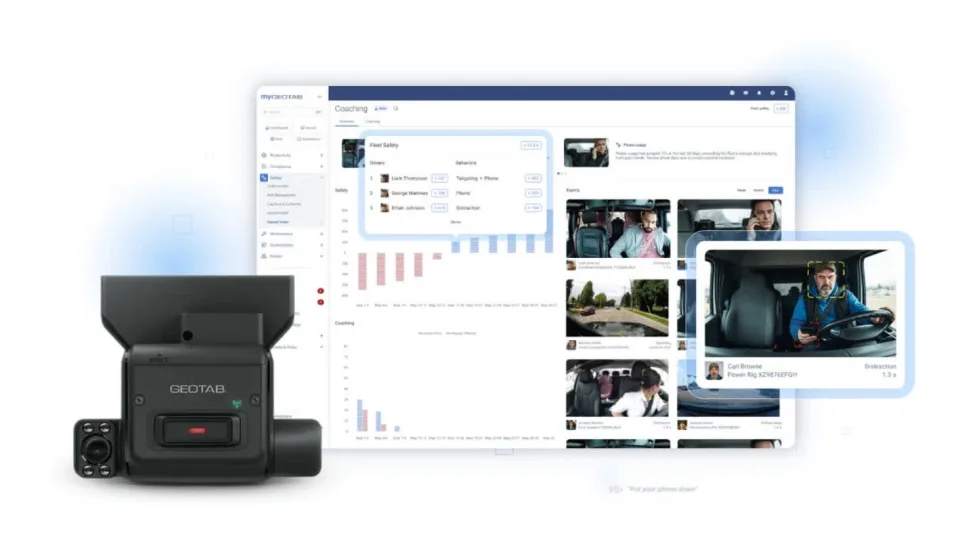
Geotab Expands Fleet Safety Tools With Video Coaching, Risk Insights
New safety and video capabilities aim to help fleet managers assess risk, support drivers, and take targeted action through video coaching, red-light violation detection, and more.
Read More →
How to Build a Better School Bus Driver Training Program
Is it time to strengthen your driver training? Here’s how to pick the right talent and improve recruitment, retention, and safety. This video is brought to you by IC Bus.
Read More →
Recent School Bus Accidents Leave 2 Dead, 2 Injured
Four school bus crashes in Florida, Illinois, and Georgia highlight risks in transportation lots, at bus stops, and during student loading and unloading.
Read More →

When Every Second Matters, Clarity Keeps Routes Moving
From routine delays to urgent incidents, strong communication practices help drivers, dispatchers, schools, and families respond with confidence.
Read More →
What Happens When a School Bus Catches Fire — and What Can Help
School bus fires are rare but can be devastating. Learn how advances in fire suppression and asset protection help fleets detect fires earlier, reduce damage, and improve safety.
Read More →
Geotab Launches Tool to Help Fleets Investigate Road Incidents
Geotab Investigations combines telematics data, video, documents, and other evidence to help fleets reconstruct incidents, resolve claims, and determine what happened.
Read More →
Texas Sixth Grader Wins 2026 National School Bus Safety Poster Contest
Sai Darshana Yekolu of Moseley Middle School in Prosper, Texas, was named the newest winner for her artwork, bringing the theme of “Safe Rides, Everyday Heroes” to life.
Read More →
Doing More With Less: How Transportation Directors Can Prioritize Safety Amid Budget Uncertainty
With diesel prices soaring and nearly one-third of transportation directors expecting budget cuts, maintaining student safety has never been more challenging. Download this guide to learn how leading districts are prioritizing risk, funding critical safety technology, and building stronger budget cases with data.
Read More →
Walton County Schools Adds Gatekeeper Stop-Arm Enforcement System
The Florida district will deploy Gatekeeper’s updated Student Protector technology, which now incorporates AI to improve video evidence.
Read More →
How To Build a More Secure School Bus Yard During and After Hours
As thefts and overnight security threats continue, school transportation leaders are combining stronger operational practices with AI-enabled surveillance to better protect buses, facilities, and staff.
Read More →