




Pinpointing a Successful Stop-arm Camera Program
Districts that have deployed stop-arm cameras on school buses have seen success in citing violators, but they also focus on educating the public to help reduce the illegal-passing problem. Stop-arm camera system suppliers weigh in on ways to succeed in violation enforcement and prevention.
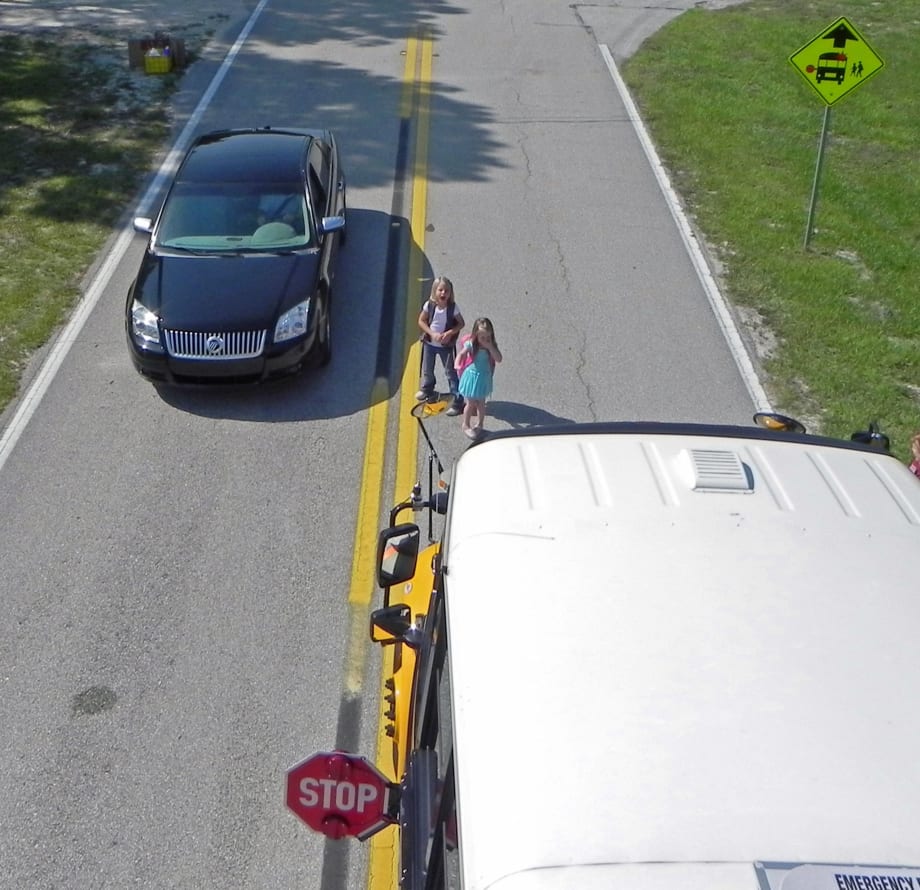
Staged photo by Brevard Public Schools (Fla.)
The issue of drivers illegally passing school buses as children load and unload continues to present itself as school bus operators work to ensure child safety.
Despite the fact that motorists are required to stop when a bus’s stop arm is deployed, many drivers still pass, resulting in children continuing to be endangered. A viable solution to help with this problem came with the addition of stop-arm cameras to monitor and capture driver violations.
Following the captured footage of stop-arm violators, depending on the state or county’s laws, law enforcement would ticket the violators in the same way red light violators are ticketed after a camera records them. Since the introduction of stop-arm cameras, companies industrywide have monitored results, checking to find what kinds of stop-arm camera programs have worked for customers, and why.
Targeting violations
Since there are still so many stop-arm violations, there is a clear need for enforceable consequences for drivers. Though citations are the agreed upon method of enforcing these violations, officials examine how exactly to catch drivers and prosecute them to prevent additional violations in the future.
Charles Territo, the senior vice president of communications, marketing and public affairs for American Traffic Solutions, which has partnered with AngelTrax in the distribution of these stop-arm systems, points out that it isn’t realistic to assume that school districts can afford to install outside cameras on all of their school buses. However, this doesn’t prevent districts from running successful programs.
“What you need to do is make sure you have cameras on the buses on the most dangerous routes, and to implement an aggressive public relations program that informs drivers in the community that the buses and the cameras are operating. Just like you don’t have red light cameras at every intersection; there is a halo effect that occurs,” Territo says.
With its system, American Traffic Solutions issued 14,000 school bus stop-arm violations across more than 20 districts in the 2013-14 school year. Territo goes on to explain that the most violations occur equally in the morning and the afternoon at 7 to 8 a.m. and 3 to 4 p.m., and that Wednesday is the day of the week with the most reported stop-arm violations.
Jody Ryan, the director of communications for Redflex Traffic Systems, shares the number of captured violations across two school districts that Redflex has worked with: Lancaster, Ohio, and Bartow County, Georgia.
Since Lancaster launched Redflex’s Student Guardian program at the beginning of the 2013-14 school year as a way to increase child safety, it has equipped six school buses with the stop-arm camera technology and more than 70 drivers have been cited at $250 per violation. In Bartow County, the Student Guardian program has led to 547 tickets being issued, with drivers facing fines of up to $1,000.
Frank Bowden, sales manager for Fortress Mobile, explains that since North Carolina has seen a high number of stop-arm violations, it is implementing a very strong system. Not only is there a fine involved with illegally passing a bus, but a citation also brings added points against a license. With this, of course, comes stringent review of video footage to ensure that it is, in fact, a violation.
Bowden says, “Aside from a DUI or a DWI, a violation of a school bus brings the highest points on a driver’s license. Just like they say when you get your license, it’s a privilege, not a right.”
[PAGEBREAK]
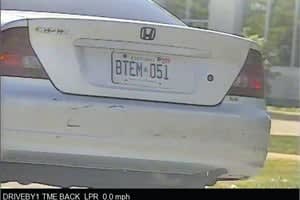
Stop-arm cameras can help catch bus-passing violations and serve as a deterrent to prevent them. Image courtesy 247Security
Educating the public
According to a 2014 study by the National Association of State Directors of Pupil Transportation Services, 29 states found that nearly 76,000 vehicles illegally passed 97,000 school buses in one day.
Despite the presence of flashing lights, stop arms and now stop-arm cameras, vehicles continue to pass school buses and break the law. Perhaps it is because they feel they won’t be caught, or perhaps it is just because they are not aware of the potential violation. Regardless, stop-arm camera suppliers are developing systems to help address the problem.
According to Rob Scott, the vice president of sales and marketing at 247Security, the most logical and straightforward solution is a system that reduces the frequency of violations, and this comes directly from educating the public. Since school districts have installed and begun using stop-arm cameras, the manufacturers and districts have worked together to notify the public about the increased enforcement surrounding stop-arm violations. Almost all the programs would not be successful without the assistance of local law enforcement.
Lori Jetha, the marketing and communications manager for Seon, explains how Tom Oestreich, transportation director at Bloomington (Minn.) Public Schools, partnered with local law enforcement to raise awareness for his stop-arm program by setting up a sting operation to catch stop-arm violators in action. The sting involved police officers stationed at key bus stops prepared to pull over drivers as soon as they passed a deployed bus stop arm. Local media coverage helped spread the word about his newly installed Seon stop-arm cameras. Because this was an initial step in notifying the public, no tickets were issued, but rather this served as an education platform.
American Traffic Solutions, which offers full service public relations for community awareness of stop-arm cameras, helped launch the “Watch You Like a Hawk,” program in Cobb County, Georgia. The program not only educates students about school bus safety with the help of a hawk mascot, but it was named after the police officer who spearheaded the project: Lt. Hawk.
Is it working?
Stop-arm violation programs aren’t just about reacting to a problem, but more about preventing it. Territo says that another indicator of a successful program is reducing the percentage of drivers who receive a second violation after their initial one, and having fewer violations from the beginning of the year to the end. He says that 99% of the drivers whom American Traffic Solutions has ticketed have not received a second, and there was a 15% decrease in captured violations from the start to the end of the 2013-14 school year.
Though it could be a viable source of income, revenue is not the ultimate goal of these programs, but rather, the safety of students.
Scott explains, “When you think about it, these programs, if successful, should ultimately fail financially. That does not mean these programs are not good for the industry — simply that they may be short term business plans. But with an average of one violation per day per bus across the country, there is a lot of work to do. It is a problem worthy of our attention and investment.”
And while there is still work to be done to eliminate stop-arm violations, these programs serve as an efficient way to gain reductions.
Thomas O’Connor, president of Redflex Student Guardian, says, “Communities across the country are utilizing stop-arm technology as a cost-effective and efficient way to increase safety for their students. Not only are children safer, but the camera systems enable local law enforcement to refocus their energies on other high-priority tasks while still ensuring school bus routes are monitored.”
For more information on stop-arm camera systems, see these companies' websites:
• 247Security
• American Traffic Solutions
• AngelTrax
• Fortress Mobile
• Redflex Traffic Systems
• Radio Engineering Industries
• Safety Vision
• Seon
More Safety

How to Build a Better School Bus Driver Training Program
Is it time to strengthen your driver training? Here’s how to pick the right talent and improve recruitment, retention, and safety. This video is brought to you by IC Bus.
Read More →
Recent School Bus Accidents Leave 2 Dead, 2 Injured
Four school bus crashes in Florida, Illinois, and Georgia highlight risks in transportation lots, at bus stops, and during student loading and unloading.
Read More →
When Every Second Matters, Clarity Keeps Routes Moving
From routine delays to urgent incidents, strong communication practices help drivers, dispatchers, schools, and families respond with confidence.
Read More →

What Happens When a School Bus Catches Fire — and What Can Help
School bus fires are rare but can be devastating. Learn how advances in fire suppression and asset protection help fleets detect fires earlier, reduce damage, and improve safety.
Read More →
Geotab Launches Tool to Help Fleets Investigate Road Incidents
Geotab Investigations combines telematics data, video, documents, and other evidence to help fleets reconstruct incidents, resolve claims, and determine what happened.
Read More →
Texas Sixth Grader Wins 2026 National School Bus Safety Poster Contest
Sai Darshana Yekolu of Moseley Middle School in Prosper, Texas, was named the newest winner for her artwork, bringing the theme of “Safe Rides, Everyday Heroes” to life.
Read More →
Doing More With Less: How Transportation Directors Can Prioritize Safety Amid Budget Uncertainty
With diesel prices soaring and nearly one-third of transportation directors expecting budget cuts, maintaining student safety has never been more challenging. Download this guide to learn how leading districts are prioritizing risk, funding critical safety technology, and building stronger budget cases with data.
Read More →
Walton County Schools Adds Gatekeeper Stop-Arm Enforcement System
The Florida district will deploy Gatekeeper’s updated Student Protector technology, which now incorporates AI to improve video evidence.
Read More →
How To Build a More Secure School Bus Yard During and After Hours
As thefts and overnight security threats continue, school transportation leaders are combining stronger operational practices with AI-enabled surveillance to better protect buses, facilities, and staff.
Read More →
FMCSA Names New Chief Safety Officer: What School Bus Operators Should Know
Steve Dowling is set to lead the federal agency's efforts to advance commercial motor vehicle safety and reduce crashes, fatalities, and injuries on the nation's roadways.
Read More →