




Performance Management: A Tool for Measuring Operational Growth
Performance management describes a framework for analyzing, measuring and correcting work processes that provide products or services. The key to perf...

Performance management describes a framework for analyzing, measuring and correcting work processes that provide products or services. The key to performance management is performance metrics.
One of the greatest management scholars in modern times, Peter F. Drucker, said, “If you can’t measure it, you can’t manage it.” Aside from Drucker’s sage advice, there are other compelling reasons to measure performance. Here are a few. . .
Set internal benchmarks
To go down the pathway of improving operations, you must have a known starting point. What was the level of performance on the date that your service commenced? Periodically, you will want to ask yourself, “Have we improved since I started?” Thus, you set an initial benchmark and you periodically measure that same metric as a check on how you are doing. A very simple example is personal weight loss. If you decide that you need to lose weight, the first thing to do is get on the scale and weigh yourself. Your starting benchmark is established. You establish your desirable weight and periodically measure progress toward that goal. After the goal is reached, you measure to maintain the standard.
After you establish internal benchmarks, it is natural to look around and ask, “How are other people doing in comparison to us?” This can be useful to help determine if improvements are possible and what the magnitude might be. Of course, it is important to pick organizations of similar composition, mission and staffing.
Justify investments
Metrics can help make the case for investing in capital equipment, infrastructure or adjustments in personnel staffing. Measurement of operating costs for a depreciable asset over time will show increase as the asset ages. A sudden upswing in costs can indicate impending component failure and provide data to determine replacement criteria. Productivity measurements of the number of students transported per bus per day help size the fleet and give a gross indicator of efficiency.
Incentivize the workforce
Performance metrics can also be used to establish goals for the workforce as a whole and for individuals. Studies have shown repeatedly that employees will continually work harder to achieve a realistic goal. They may compete with themselves, among teams or against a best-practicing organization. This also helps the organization to focus on the results and not the process — a condition endemic in many public-sector entities. You also avoid the self-delusion of “I said it. They agreed to it. It must be happening.”
Measure for effectiveness
Now that you’ve decided that performance metrics can help you in your day-to-day work of transporting students to and from schools, what should you measure? Although there is a multitude of metrics, you should concentrate on five areas:
Customer satisfaction
Reliability
Ontime performance
Maintainability
Financial performance
Beside each area, write indicators that would measure their effectiveness. Ensure that all members of a team are involved in measuring performance to keep everyone focused on raising standards across the board. For ontime performance, consider cycle time by measuring in-transit times and in-transit time variability. Measuring ontime arrival percentage and on-time departure percentage also give a measure of quality and reliability. Total transportation cost and transportation cost ratios will help you determine financial performance against critical cost-drivers — fuel costs, for example.{+PAGEBREAK+} Accept mistakes and improve
To properly begin a program of performance management in your organization, self-examine your organizational philosophy. Does it include the philosophy of continuous improvement? Is it fixated on maintaining status quo? To be successful and flourish, performance metrics in the overall framework of performance management must be introduced in an organizational climate where honest mistakes are tolerated in an effort to improve, and the prevailing attitude is, “If it ain’t broke, let’s see how we can make it better.” For truly optimum synergy, performance metrics must flow from organizational goals and objectives. These in turn are derived from the organization’s mission, which is the manifestation of the vision for the organization.The sequential steps of this process are easy to state and somewhat harder to actually do. Begin by creating or renewing your organization’s vision. This should be a short statement of your core purpose and aspirations for the future. Next, craft a mission statement that supports the vision. The mission statement can cover who, what, where and when but not how. A generic statement of mission could be, “The transportation department brings students to and from school and other authorized destinations in accordance with policies established by the board of education.” Annually or at some other periodic basis, establish organizational goals and objectives that reflect the what and when of the mission. Now establish processes and procedures to specify how to accomplish the goals and objectives and measure those processes and procedures with performance metrics.
Publicize results
If you are new to performance management, then a “crawl, walk, run” and KISS (keep it simple, stupid!) approach is highly recommended. Evaluate your organizational climate and determine if the necessary conditions are in place to begin performance management. Lay the necessary groundwork by meeting with key stakeholders and asking for their input.Don’t try to establish a fully integrated and comprehensive performance management system out of the box. Instead, start with simple, easy-to-understand metrics that relate in a very direct manner to commonly held objectives in the organization. For example, getting children to school on time is a metric that virtually all employees could agree is important.
Once you have a performance management program up and running, publicize your results. Let the team know how they are doing and, most importantly, let all the stakeholders know how you are doing. Use bulletin boards, newsletters, community forums and Websites to graphically display your progress. If appropriate, recognize high achievers or a sustained level of excellence. Above all, celebrate your successes and honestly evaluate shortcomings.
Finally, don’t let measurement of metrics become an end unto itself. Remember, achieving results and measuring progress to those results is your objective.
Common Pitfalls in Developing Metrics
Developing metrics for which you cannot collect accurate or complete data.
Developing metrics that measure the right thing but cause people to act in a way contrary to the best interest of the business to simply “make their numbers.”
Developing so many metrics that you create excessive overhead and red tape.
Developing metrics that are complex and difficult to explain to others.
Peter Iverson is chief business officer at San Diego Unified School District's Eugene Brucker Education Center.
More Management

School Transportation Data Is Only as Powerful as the Story It Tells
Leaders say turning operational metrics into student-centered narratives can help districts justify investments and improve service.
Read More →
Photos: NYAPT Celebrates 50 Years at 2026 Conference & Trade Show
See highlights from NYAPT's 50th anniversary conference in Saratoga Springs, featuring educational sessions, awards, a trade show, networking, and more.
Read More →
Ohio Transportation Workgroup Calls for End to 'Impractical to Transport' Payments
A final report from Ohio's Pupil Transportation Workgroup proposes ending "impractical to transport" payments and expanding transportation options through regional partnerships, but not all industry pros agree on the approach.
Read More →


Transfinder Expands California Footprint with Multiple School District Wins
Six California school districts selected the company's routing platform and related transportation technology as Transfinder continues expanding its presence across the state.
Read More →
NSTA's Curt Macysyn on Student Transportation History and What's Next
Hear from NSTA's executive director as we discuss student transportation's role in American history, federal regulation, driver recruitment, illegal passing, AI, and what might be next, in this Route interview.
Read More →
NSTA on 250 Years of America and the Road Ahead for Student Transportation
Curt Macysyn joins The Route to discuss student transportation's role in American history, federal regulation, driver recruitment, illegal passing, AI, and the industry’s future. Sponsored by IC Bus.
Read More →
Photo Highlights: Inside the 2026 Michigan Association for Pupil Transportation Conference
Snapshots from the 2026 MAPT conference, where Michigan's school transportation professionals gathered for training, technology updates, awards, networking, and more.
Read More →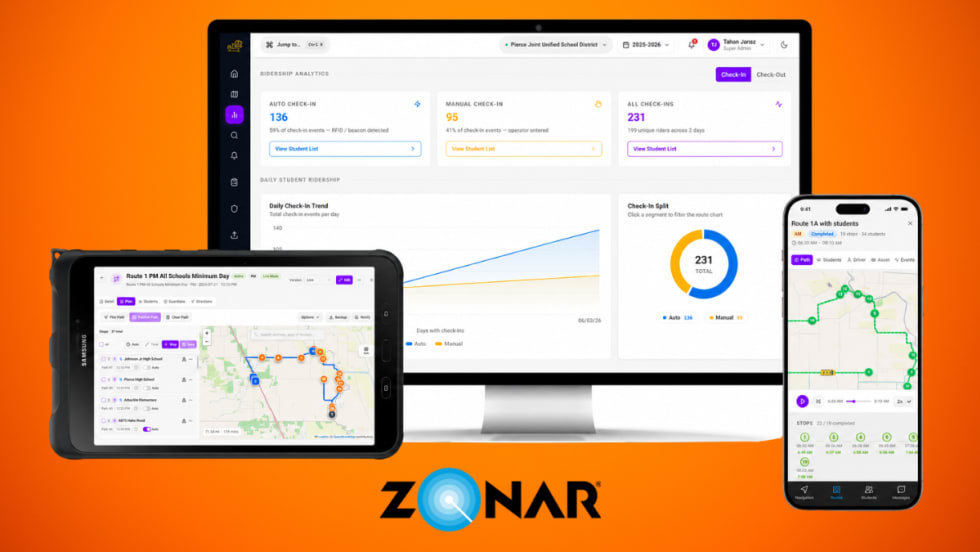
Zonar Launches Reimagined Bus Suite Web Portal
Can one platform replace your transportation software stack? Zonar says its new Bus Suite unifies routing, dispatch, field trips, GPS, and parent communication.
Read More →
Indiana Association Announces 2026 Award Winners
See who earned top honors at the 2026 School Transportation Association of Indiana conference, recognizing excellence in school transportation statewide.
Read More →
Student Transportation of America Acquires Massachusetts Contractor
Tremblay’s Bus Company and its 400-bus fleet joins the STA family of brands as the company grows its presence across the Northeast U.S.
Read More →