




PA systems help drivers communicate safely
Whether directing students to cross the street safely in front of the bus or providing instructions during an emergency, these systems are vital to helping drivers communicate effectively. Suppliers meet these needs with systems as simple as speakers and a microphone or as elaborate as speakers integrated with emergency switches and ambient noise systems.


External public address systems enable drivers to direct students to cross safely in front of the bus, help guide maintenance workers and share information with teachers, aides, parents and first responders during emergency situations. Pictured: Robert Reese from the Capital School District in
Dover, Del.
Public address (PA) systems can be a crucial part of the safe operation of school buses. A vital communication tool, they provide a way for bus drivers to safely share with students important information such as arrival and departure times, restore order to a bus with unruly children and communicate during emergency situations.
To enable safe and easy communication in a variety of situations, PA systems can be equipped to work both on the inside and outside of buses. While the internal system feature is used to address the students on board, the external feature, a speaker on the outside of the bus referred to as a PA horn, enables drivers to direct students to cross safely in front of the bus, and share information with teachers, aides, parents and first responders during emergency situations.
The systems are also used to guide other driver duties, such as directing maintenance staff outside the bus as they are checking lights or adjusting mirrors.
Delaware, other states, require external use
The external PA feature is required in a handful of states, including Delaware, North Carolina, Idaho and Oregon.
Particularly, the Delaware Department of Education’s administrative code, Regulation 1104, SB Standards, has required the use of external as well as internal PA systems for many years, according to Ron Love, state supervisor of school transportation at the Delaware Department of Education.
“We use it to cross students with an audible clearance signal from the driver or the aide,” he explains. Students are instructed to wait to cross the street during unloading and loading until they hear the clearance signal from the PA system.
The location of the speakers is also very important, Love adds. In Delaware, the two interior speakers must be placed above the window line, and not within four feet of the driver’s seat back in its rearmost upright position. Additionally, according to the state’s administrative code, the outside speaker must be located, depending on whether the bus is Type A or B, on the left front side of the bus forward of the front wheels; Type C, in the engine compartment forward of the radiator or on the inside of the front bumper on the left side; or Type D, under the floor on the left side of the bus between the front bumper and the left front wheel.
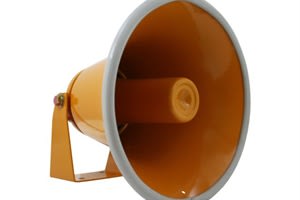
States such as Delaware have requirements for the location of external PA speakers. For Type A and B buses, that’s on the left front side of the bus, forward of the front wheels. Pictured: REI’s external PA horn.
After the National Congress on School Transportation specified the location of internal PA systems in its 2010 National School Transportation Specifications and Procedures, Love explains, the Delaware Department of Education discussed with three vehicle manufacturers — Blue Bird, IC Bus and Thomas Built Buses — the best place to locate the speaker for optimal sound before it revised its latest standards to include its requirement details.
“The external speaker location wasn’t clear in the previous requirements,” Love says.
A noise suppression feature that is controlled by a switch is another state requirement. Drivers need to turn off all radios and noisy equipment or use a noise suppression switch at railroad crossings. It must be labeled and alternately colored, have an on/off function and deactivate body equipment that produces noise, including heaters, air conditioners, fans and defrosters.
[PAGEBREAK]
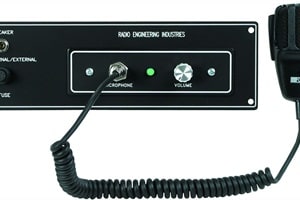
REI offers a wide
variety of PA systems,
ranging from its basic Panel Mount models to its 760928 model (pictured), with features such as an external PA, as well as the ability to immediately switch from radio mode to PA mode.
REI provides customizable systems
With many states requiring them, a PA system on the inside of a school bus is almost standard operating procedure, Chris Shigley, national sales manager for REI, says. REI meets this need with a wide range of custom PA systems from its basic Panel Mount PA system to its 760928, with features such as wireless microphones and external PAs, as well as the ability to immediately switch from radio mode to PA mode.
Some of REI’s PA systems include a squelch mechanism that sends a loud, high-pitched, screeching noise through the speaker and ambient noise systems that dynamically adjust the sound in specific areas of the vehicle.
“That’s the uniqueness of REI: our scalability,” Shigley says. “Whether you want just one simple independent PA that’s not even a radio, or one that’s integrated with a radio and wireless headsets, we have a solution for you. We can custom-configure a system [with] the simple internal PA or an AM/FM/CD/SD/USB port wireless headset internal/external PA system.”
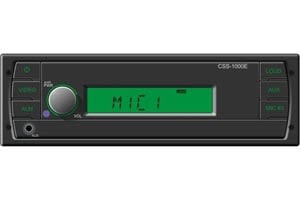
Custom Radio Corp.’s new PA system product, the CSS-1000E Din Mount, comes equipped with a PA-on-demand feature, a controller mechanism that overrides other functions, such as the radio, in case of an emergency.
Custom Radio offers PA-on-demand
A wide variety can also be found among Custom Radio Corp.’s PA systems. In addition to basic radios with PAs built in, Custom Radio’s products also come equipped with emergency switches. As with REI’s systems, some include a squelching mechanism to get the attention of students, for example, if there is disorder on the bus, and a PA-on-demand feature, a controller mechanism that overrides other functions, such as the radio, in case of an emergency.
For example, Custom Radio Corp.’s new PA system product, the CSS-1000E Din Mount, provides all these capabilities, as well as three microphone inputs.
While some of Custom Radio’s systems come with all the bells and whistles, such as SB and USB ports and capabilities for controlling audio, and external microphones for tour buses, Custom Radio can also simplify its radios for easy plug-and-play use. Each radio comes with a PA built into it. The CSS 1008 Din-Mount PA system is the most popular because it is strictly the PA, Eric Storey, bus sales, Custom Radio Corp., says.
“It eliminates all kinds of driver distractions. You don’t have to worry about messing with the radio.”
Increasingly, school bus applications of internal PA systems include drivers using microphones to give school tours and coaches to provide game strategies on the way to athletic events, Storey adds. Some of Custom Radio’s PAs can be used to narrate while watching game film by placing a microphone near the front seats, preventing the coach from having to cross into the restricted area near the driver.
More Safety

HopSkipDrive Reports Progress on Safety Advisory Council
More than a year after forming the council, independent safety experts have helped shape new rider-safety features and policy progress, with a new goal to address rider behavior.
Read More →
What the 2026 National School Bus Safety Month Resolution Means for Student Transportation
The bipartisan resolution highlights illegal school bus passing, student safety during loading and unloading, and the need for driver training and public education.
Read More →
School Bus Stop-Arm Violations Decline 53% Across Verra Mobility Programs
Verra Mobility shares how school bus stop-arm cameras and school zone safety programs are changing driver behavior, reducing violations, and protecting students.
Read More →
Most Bus Crashes Aren’t Your Fault. Here’s How to Prove It.
A guide for what to do in between a school bus crash and a claim: what to preserve, who to notify, and how to keep the facts available when they matter.
Read More →
National School Bus Safety Week 2026: Tips, Toolkits & Resources to Keep Students Safe
School bus safety takes more than awareness. Explore expert tips, enforcement strategies, and free resources to help protect students on every ride.
Read More →
2 Killed, Dozens Injured in Florida School Bus Crash
A multi-vehicle collision caused a Polk County school bus carrying 37 students to overturn on its way to Winter Haven High School.
Read More →
Illegal School Bus Passing Drops 24% in New York Districts
With fewer than 5% of citations involving repeat offenders, Westchester County officials said enforcement, education, and community partnerships are helping change driver behavior.
Read More →
School's Back. Here's What Happened to Traffic, Speeding & Distraction
What happens to traffic when school resumes? New data analysis examines changes in distracted driving, congestion, and speeding around schools.
Read More →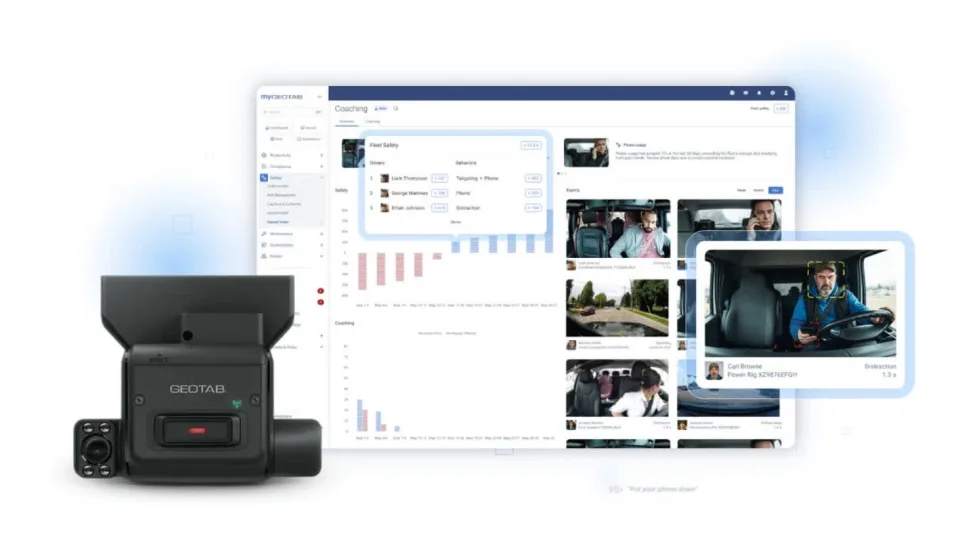
Geotab Expands Fleet Safety Tools With Video Coaching, Risk Insights
New safety and video capabilities aim to help fleet managers assess risk, support drivers, and take targeted action through video coaching, red-light violation detection, and more.
Read More →
How to Build a Better School Bus Driver Training Program
Is it time to strengthen your driver training? Here’s how to pick the right talent and improve recruitment, retention, and safety. This video is brought to you by IC Bus.
Read More →