




NSTA Advocacy in Action — Should FMCSA increase the federal insurance minimums?
The FCMSA is considering an increase in the federal minimum insurance requirements for passenger motor carriers. This is a very important issue for school bus contractors, as these requirements could dramatically affect insurance costs.

Ronna Weber is executive director of the National School Transportation Association.
The Federal Motor Carrier Safety Administration (FCMSA) issued an Advance Notice of Proposed Rulemaking (ANPRM) on Nov. 28, 2014, exploring an increase in the federal minimum insurance requirements for passenger motor carriers.
This is a very important issue for school bus contractors, as these requirements could dramatically increase, which would affect insurance costs. Even if you currently carry more than the required minimums, don’t dismiss this issue. FMCSA has suggested that the minimum requirements should increase to as much as $20 million to $25 million for large vehicles — a staggering increase.
As you likely know, school transportation contractors across the country must follow federal regulations when providing transportation services for any trips other than home-to-school. Home-to-school operations are narrowly and literally defined as home-to-school and school-to-home. Thus, a school bus contractor is required under federal law to carry a minimum of $1.5 million in insurance on every vehicle with 15 passengers or fewer and $5 million on every vehicle with 16 passengers or more that they are using for work outside of home-to-school operations (activity trips, field trips, charter work).
A survey of NSTA members found that most companies prefer flexibility, so their entire fleets comply with federal requirements. In addition, while some large NSTA member companies carry higher levels of insurance than required, many smaller companies do not. Given that larger companies obviously have more flexibility, any increase will disproportionately impact smaller carriers.
So how big is the nation’s school transportation industry? School bus carriers, public and private, operate the largest mass transportation fleet in the country. Each day, 480,000 yellow school buses travel the nation’s roads, carrying 26 million children to and from school.
There are currently 90,000 transit vehicles; 40,000 motorcoaches; 7,400 commercial airliners; and 1,200 railroad passenger cars on the nation’s roads, railways and in our airspace today. In fact, the nation’s school bus fleet is 2.5 times the size of all other forms of mass transportation combined.
In addition, school transportation is the safest form of transportation in the country. According to the August 2014 National Highway Traffic Safety Administration Safety in Numbers newsletter, of the more than 30,000 annual deaths from traffic accidents, on average just four per year were students inside school buses. In addition, travel by school bus is 23 times safer than travel with a parent driver and 58 times safer than travel with a teen driver.
FMCSA utilized several bodies of work to research this issue, but none of the studies considered school bus transportation accident or claims data, compared school bus transportation to other types of commercial motor vehicles, or considered the capacity or claims history of major insurers of private school bus companies.
Moreover, FMCSA has done no analysis to determine the impact these significant increases might have on the continued availability of school bus service. NSTA finds this extremely troublesome. School buses are vehicles with unique safety features and a dedicated and skilled driver force that operate in unique environments not readily comparable to all other commercial motor vehicles.
Without the research or data to indicate specific problems showing current insurance levels for school bus operators to be inadequate, NSTA does not support an increase in the federal minimums. In addition, we believe that the lack of school bus-specific data makes it impossible for FMCSA to conduct a reliable analysis of the costs and benefits of any potential increase on the private school bus industry or the school transportation industry at large.
In addition to our concern with the lack of data to support such an increase, we also are troubled by the continued perception and treatment of all commercial motor vehicles as the same. The school bus and its safety record are simply not comparable to other types of commercial motor vehicles and should not be viewed through the same prism. A truck is not a bus, and a motorcoach is not a school bus. School buses indeed have some similarities with other motor carriers, but they also have several fundamental differences, and those differences must be recognized.
The safety of the nation’s schoolchildren is of paramount concern and importance to the school transportation industry. We are always open to making improvements in the interests of safety if those improvements are well vetted and supported by data and science.
Because safety is at the heart of school transportation, any change must be carefully considered and studied to ensure that its implementation would indeed improve safety. NSTA will always oppose proposals that are not in the interest of safety and are not supported by data and science.
UPDATE: A new bill in Congress would prevent the U.S. secretary of transportation from unilaterally raising insurance minimums on the school transportation and motorcoach industries. See story here.
More Safety
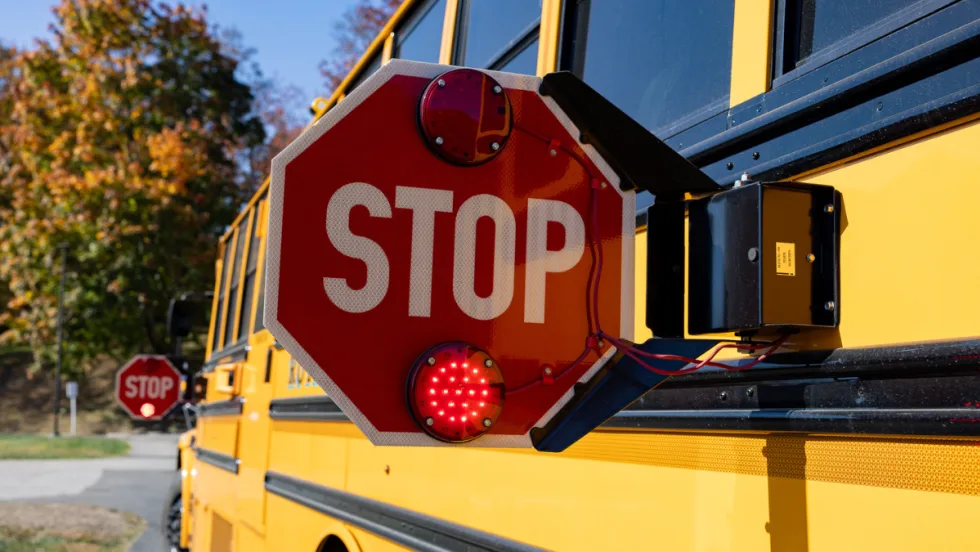
Illegal School Bus Passing Drops 24% in New York Districts
With fewer than 5% of citations involving repeat offenders, Westchester County officials said enforcement, education, and community partnerships are helping change driver behavior.
Read More →
School's Back. Here's What Happened to Traffic, Speeding & Distraction
What happens to traffic when school resumes? New data analysis examines changes in distracted driving, congestion, and speeding around schools.
Read More →
Geotab Expands Fleet Safety Tools With Video Coaching, Risk Insights
New safety and video capabilities aim to help fleet managers assess risk, support drivers, and take targeted action through video coaching, red-light violation detection, and more.
Read More →

How to Build a Better School Bus Driver Training Program
Is it time to strengthen your driver training? Here’s how to pick the right talent and improve recruitment, retention, and safety. This video is brought to you by IC Bus.
Read More →
Recent School Bus Accidents Leave 2 Dead, 2 Injured
Four school bus crashes in Florida, Illinois, and Georgia highlight risks in transportation lots, at bus stops, and during student loading and unloading.
Read More →
When Every Second Matters, Clarity Keeps Routes Moving
From routine delays to urgent incidents, strong communication practices help drivers, dispatchers, schools, and families respond with confidence.
Read More →
What Happens When a School Bus Catches Fire — and What Can Help
School bus fires are rare but can be devastating. Learn how advances in fire suppression and asset protection help fleets detect fires earlier, reduce damage, and improve safety.
Read More →
Geotab Launches Tool to Help Fleets Investigate Road Incidents
Geotab Investigations combines telematics data, video, documents, and other evidence to help fleets reconstruct incidents, resolve claims, and determine what happened.
Read More →
Texas Sixth Grader Wins 2026 National School Bus Safety Poster Contest
Sai Darshana Yekolu of Moseley Middle School in Prosper, Texas, was named the newest winner for her artwork, bringing the theme of “Safe Rides, Everyday Heroes” to life.
Read More →
Doing More With Less: How Transportation Directors Can Prioritize Safety Amid Budget Uncertainty
With diesel prices soaring and nearly one-third of transportation directors expecting budget cuts, maintaining student safety has never been more challenging. Download this guide to learn how leading districts are prioritizing risk, funding critical safety technology, and building stronger budget cases with data.
Read More →