




NSTA Advocacy in Action — 6 Ways to Achieve Regulatory Relief
There are six options to provide regulatory relief: the Congressional Review Act, executive orders, appropriations legislation, authorization legislation, courts, and the rulemaking process.
One of President Trump’s top priorities upon taking office was to provide regulatory reform. The school transportation industry is heavily regulated, so it stands to reason that some of the regulatory reform will ease our burden a bit.
The question is, however, what can the president and Congress actually do to relieve the burdens imposed by the Obama administration?
There are six options to provide regulatory relief: the Congressional Review Act, executive orders, appropriations legislation, authorization legislation, courts, and the rulemaking process. Here are explanations of each.
1. The Congressional Review Act, which was approved by Congress in 1996, provides the opportunity to repeal regulations within 60 legislative days of when they became effective. The advantages of pursuing repeal through this option are that it is an expedited, time-limited process and Senate passage can be achieved by a simple majority. Under the provision, the entire rule must be repealed, and it can only be used on one rule at a time rather than applied to a group of rules. As of this writing, Congress has already successfully deployed this on a handful of regulations, and more are in the works. However, the clock is ticking, and soon the option will no longer be available.
2. Executive orders are legally binding orders given by the president to governmental agencies. President Trump has issued several executive orders relating to regulatory reform since taking office. One of those is a ban on all new and pending regulations until sufficient review is conducted by the new agency heads and their teams. Another is the required repeal of two regulations for any new significant regulation. Executive orders are also quite effective, but they are only in force as long as the president who signs them is in office. They are not a panacea, but in limited applications this can be a quick tool to change policy direction. Given our system of balanced powers, some actions still require congressional approval.
3. Appropriations legislation, which Congress must pass each year, can also come into play for regulatory reform. These bills keep governmental agencies funded and are required under the Constitution. Given that these are deemed “must-pass” bills, they are often seen as a vehicle to include other legislative provisions. In the case of regulatory action, provisions can be included that disallow funds from being spent to finalize or enforce a regulation. In essence, without funding the proposal simply dies. This is effective in years where appropriations bills, rather than continuing resolutions, are actually passed. A continuing resolution often keeps the agencies operating on last year’s revenue numbers, and no outside provisions are allowed in the legislation. The method is effective, but it is only in effect for the fiscal year in which the appropriation bill applies.
The school transportation industry is heavily regulated, so it stands to reason that some of the regulatory reform will ease our burden a bit.
4. Authorization legislation is another avenue available to Congress, but this is usually a slow process. Once a member of Congress introduces a bill, it is referred to the appropriate committee for consideration. Once the committee acts, it then forwards the bill to the floor for consideration. All of this takes time. In addition, a supermajority of 60 votes is required in the Senate to pass most legislation. Given the political divide in the Senate, this will be difficult to achieve on anything controversial. In addition, many bills addressing one particular issue are difficult to move outside of a larger and broader authorization bill. So while this is an option, it is a slow and unwieldy one that is not likely to bring swift repeal.

Ronna Weber is executive director of the National School Transportation Association.
5. The courts are another option that is available for regulatory reform efforts, but this is also a slow process with an uncertain result, so it is even less appealing.
6. The rulemaking process is another avenue. The administration can simply rescind regulatory proposals that are not yet final. This can be a very swift process and does not require congressional action. For final rules, agencies can begin the regulatory process anew and bring forth regulations to undo those currently in place. This is an effective strategy, as it does not require congressional action, but it’s a very slow resolution — it takes months, if not years, to move through the regulatory process.
In the end, there are many tools available to bring regulatory relief. Some are more appealing than others, but there is no one-size-fits-all solution, so all options must be weighed carefully.
More Management

STA Acquires Sunrise Transportation
Student Transportation of America expands in Illinois and Connecticut through Sunrise's fleet of nearly 1,000 vehicles.
Read More →
EPA Opens $180M DERA Funding Round for Diesel Upgrades
The 2026 Diesel Emissions Reduction Act program seeks applications from eligible organizations to accelerate the retirement of legacy diesel vehicles.
Read More →
HopSkipDrive’s CareEngine Targets the ‘Exceptions’ in Student Transportation
The new platform works alongside districts’ existing transportation management systems to coordinate specialized rides, automate last-minute changes, and turn ride data into operational improvements.
Read More →


The Right Ride for Every Student: Navigating the New Student Transportation Ecosystem
How should districts blend school buses with small-vehicle transportation and other options? EverDriven CEO Mitch Bowling discusses safety, costs, partnerships, and strategy.
Read More →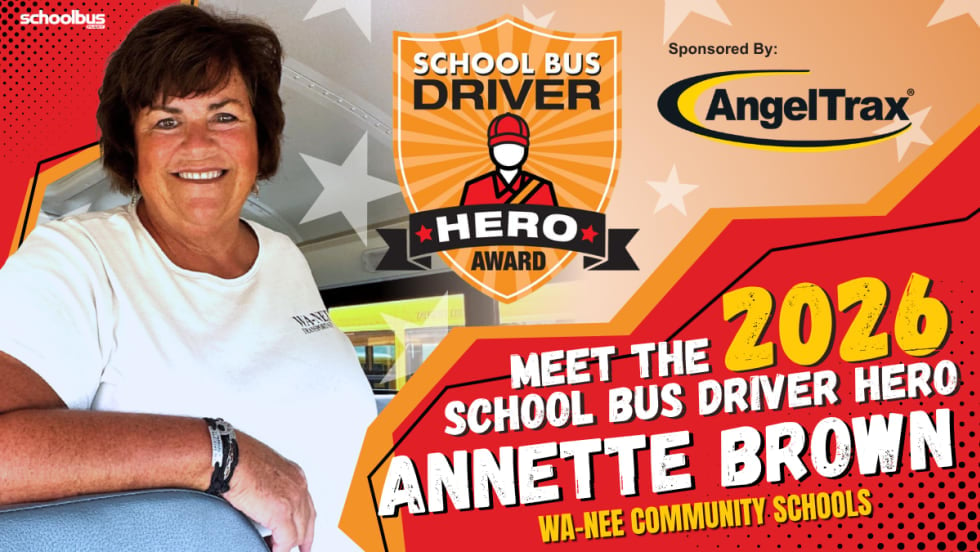
Annette Brown Always Takes the Extra Time: Meet Our 2026 School Bus Driver Hero
For more than 30 years, the Wa-Nee Community Schools driver has treated students like family, combining safety, compassion, and servant leadership to make a lasting difference on and beyond the school bus.
Read More →
How to Build a Better Driver Training Program
Ready to boost up your school bus instructor training? Here’s how to pick the right talent and improve recruitment, retention, and safety.
Read More →
CALSTART and Forth Combine to Form Catalyst Mobility
The new name represents a renewed vision for the nonprofit focused on advancing clean, equitable, and affordable transportation solutions that move people and goods.
Read More →
What Makes a Great School Bus Driver Trainer?
Choosing the right school bus driver trainer takes more than experience. Learn six keys to selecting and developing trainers and evaluating program effectiveness.
Read More →
School Bus Contractors Expand Through New Deals, Acquisitions & Partnerships
STA's Canadian division acquires Ontario-based G&L Stevenson Transport; Durham School Services adds a new district in California; First Student expands in New Jersey; and Minnesota Coaches rebrands and acquires Halo Transportation.
Read More →
Logan Bus Company Rolls Out AI Phone System for NYC School Bus Families
A summer pilot found that AI agents could handle most routine calls, freeing up time for customer service staff to focus on emergencies and complex family concerns.
Read More →