




New Technology, Student Discipline Tackled at Southeastern Conference
Conference celebrates 50th anniversary by addressing key pupil transportation issues, such as new technology, student discipline and operator liability.
The Southeastern States Pupil Transportation Conference returned to the site of its first gathering — Daytona Beach, Fla. — in mid-July to celebrate its 50th anniversary. More than 600 people, including 270 delegates, attended the event, which addressed key pupil transportation issues such as new bus technology, student discipline and transporter liability. Attendees also had a chance to view the latest school bus equipment and talk to vendors at the trade show.
A look down the road
Charlie Gauthier, executive director of the National Association of State Directors of Pupil Transportation Services, led a session examining recommendations and rulemakings that may affect the industry in the coming years. Among the issues he addressed were restrictions on hours of service for drivers, new “multi-purpose” school bus designs, school bus–specific CDLs and intelligent vehicle technologies. Gauthier also discussed the possible installation of event data recorders in school buses, as recommended by the National Transportation Safety Board. The devices would collect data on crashes, including severity, brake application, throttle position and motion of the bus. “They will provide an understanding of the crash dynamics and result in better safety countermeasures,” he said.
Discipline on the bus
Dealing with student discipline problems continues to be a hot transportation issue. Addressing this concern, the Kentucky Department of Education has forged three model discipline policies gathered from local operations. Bobby Sheroan of Hardin County Schools presented attendees with his district’s policy, which is one of the education department’s three models. The policy includes a revised incident report form, rules and regulations for bus riders, a student/parent transportation agreement and more. The improved policy resulted from a review of discipline policies from other districts, an analysis of one year’s worth of student write-ups and numerous meetings with administrators and drivers. The main goal was to establish consistency in write-ups from all drivers, said Sheroan. Administrators assisted in the design of the new incident reports and the school board adopted the reports as official policy, so drivers are fully supported in their discipline efforts. “Establishing a board policy gives you something to back you up when parents call to complain,” said Sheroan. The policy only works, however, if drivers strictly adhere to it. They cannot make up their own rules outside of those listed on the incident reports. Sheroan said that previous to the policy changes, exit interviews showed student discipline as the No. 1 reason drivers were leaving the district. The No. 2 reason was lack of administrative support on discipline issues. Armed with that knowledge, Sheroan redesigned the system such that it would improve working conditions for drivers and reduce the impact of the driver shortage. “I have a lot of time and money invested in my drivers and that’s more valuable to me than training new ones,” explained Sheroan. With redesigned reports and consistent driver enforcement of the rules, student discipline improved. Sheroan said that his drivers aren’t writing nearly as many incident reports as before. But what makes the process seamless is a computer software program that allows all administrators (including principals, counselors and transportation officials) to share student information district-wide. When an administrator pulls up a student’s report on the computer, he sees classroom as well as bus behavior reports. This helps in understanding a student’s pattern of behavior and in discussing that behavior with a parent, said Sheroan.
Key liability concerns
In her presentations on legal issues, Peggy Burns, staff counsel for Adams Twelve Five Star Schools in Northglenn, Colo., stressed the importance of understanding liability and of documenting department decisions. She used as an example last year’s verdict in the case of Warrington v. Tempe (Ariz.) Elementary School District. In that case, 7-year-old Andrew Warrington was seriously injured after he was safely discharged from his school bus at his regular bus stop. Another boy began chasing Andrew when they were about 35 feet away from the stop. Andrew ran 100 feet south of the stop, crossing a sidewalk, a frontage road and a median, before he was struck by a car on a busy road. The school district was found 15 percent negligent for the location of the bus stop, because the court said it was predictable that children would behave the way the two boys had. The district had a duty to provide the child with a safe bus ride and to ensure stops were located in safe areas. “There can’t be liability unless there is first a duty to do something,” explained Burns.
Keep good records
“To reduce the likelihood of liability, make sure to document your thinking,” said Burns. Keep a record of your reasons for locating stops in specific areas, particularly when those areas are a concern to parents or others. You cannot please everyone, but if you can present documents to prove that you thought the matter through and had the child’s safety in mind, you are one step closer to winning the legal battle. “Don’t let the laws paralyze you,” warned Burns. Though you should be aware of potential liability, your main concern should be safety. Do not compromise safety for fear of liability. If a parent asks you to make accommodations that you feel will compromise the safety of the students, make the safe choice and document your thinking. “Safety trumps everything,” said Burns.
More Management

EverDriven Launches Route Consolidation Calculator to Estimate Diesel Savings
As diesel prices hit record highs, the largest alternative transportation provider says a 10% route consolidation could save a 120-route district more than $78,000 a year in fuel alone.
Read More →
Zum Secures Continued Financing Support for School Bus Expansion
Generate Private Credit has financed approximately $75 million in school bus deployments across three states, supporting more than 500 buses as Zum expands across the county.
Read More →
Beyond Discipline: A Different Approach to Student Behavior on the Bus
After implementing a dean of students program in Oregon, North Clackamas is seeing positive improvements. Here’s how it worked. The Route is brought to you by IC Bus.
Read More →
A Dean of Transportation's Different Approach to Student Behavior on the School Bus
After implementing a dean of students program in Oregon, North Clackamas is seeing positive improvements on the bus. Here’s how it worked.
Read More →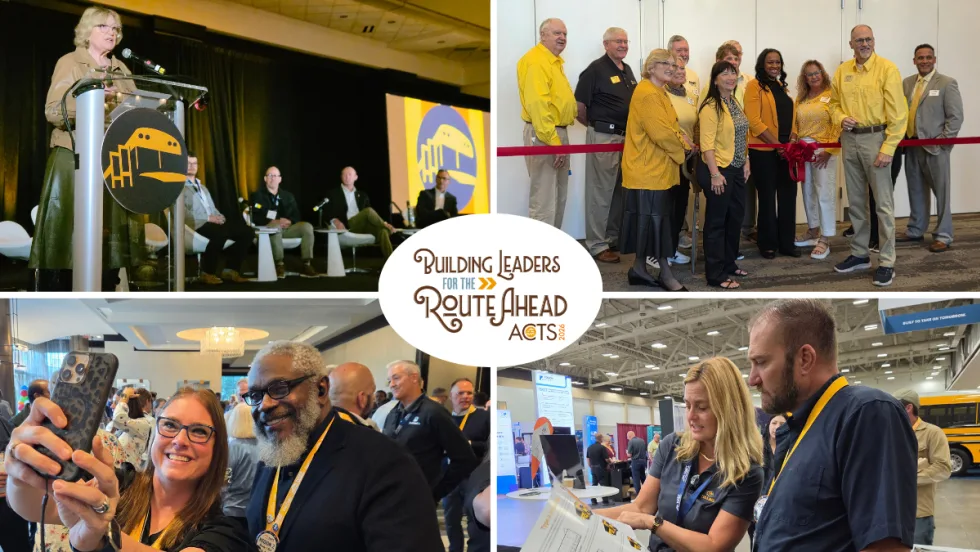
Inside NAPT ACTS 2026: Highlights from Louisville
From federal updates and student behavior strategies to new school bus technology and industry awards, see highlights from NAPT ACTS 2026 in Louisville.
Read More →
Meet the 2025 School Bus Driver Hero Winner: Annette Brown
We caught up with Wa-Nee Community Schools' Annette Brown on site at SBFX, where she was named the 2026 School Bus Driver Hero Award winner. Hear about her reaction, what she loves most about being a school bus driver, and more!
Read More →
Predictability Is Like Ketchup (According to 6-Year-Olds)
To students, a different school bus can feel like a full-blown crisis. One driver reflects on why familiar routines, showing up on time, and being reliably boring matter more than we think.
Read More →
Samsara Launches Free Driver Rewards Program
The new Driver Perks program gives eligible professional drivers access to discounts and offers without adding a cost for participating fleets.
Read More →
How Tax-Exempt Municipal Leases Can Help Finance School Buses
Let’s explore school bus financing options, including municipal leases, vendor payable accounts, and balloon payments, and how they can help stretch fleet budgets.
Read More →
Nominate Rising School Transportation Pros Under 40!
We’re searching for the next generation of leaders making an impact across the K-12 student transportation industry to recognize as SBF’s 2027 Trailblazers. Nominations are open now!
Read More →