Navigating the Road Ahead for MDT Policies and Practices
This final installment looks at federal rules on distracted driving and state specs on mobile data terminals. As with the technology itself, regulations need to be honed based on experience.
This is the fourth and final article in a series that covers the use of mobile data terminals. The first, second, and third articles appeared in the January 2018, February 2018, and March 2018 issues, respectively.
Mobile data terminals (MDTs) are still new technology, and the applications are still emerging — along with associated laws, rules, and regulations. Change presents challenges.
As an example, when talking with folks outside the industry, I sometimes hear that school bus stops are confusing because of the yellow lights: “To get people to stop, they need to see red — like we used to do it.” Well, the last time school buses were put in service in North Carolina with red lights only (no ambers) was well over three decades ago. Those buses are long gone, but change takes time for some people.
Further, when change involves an aspect of safety, those of us in the safety business tend to exercise caution. Sometimes extreme caution.
In this final installment in a series on the use of MDTs in school bus transportation, we summarize the issues and survey the current state of applicable regulation.
Ad Loading...
Recapping MDT Issues
When implementing MDT technology or developing related policies, the key issue is driver distraction. According to the National Highway Traffic Safety Administration, in 2015 there were nearly 3,500 traffic deaths attributable to distracted driving.
This issue is real, and we can’t ignore it. Just as real, however, are the efficiency, safety, and security benefits of the applications available on MDTs.
The first article in this series (January 2018) addressed the quandary of potential benefits vs. potential distractions.
In segment 2 (February), we focused on applications that can help ensure that, very simply, we don’t lose track of students. MDT-based apps provide the driver with information about which students are authorized to get on and off at each bus stop.
In article 3 (March), the issues surrounding turn-by-turn directions were discussed. The benefits of many apps are magnified for the substitute driver.
Without belaboring the audio-active/video-active issue that we explored in some depth, I submit that audio-only directions may not keep the substitute driver from driving with the printed route sheet in one hand in the darkness of early morning.
To see how you would adapt, try driving in an unfamiliar area using your personal in-vehicle GPS with the display covered up or facing away from you. It might be manageable, or you might find that you need the map display to best process instructions for upcoming turns.
Despite the advantages of MDTs, though, I also recognize that a driver could become distracted while looking at the display for driving directions.
Federal Law and Guidance
Federal law clearly prohibits texting, and no one suggests that school bus drivers should be allowed to interact with an MDT while the bus is moving. Beyond that, however, the rules are not clear.
School transportation and government operations are exempt from most federal motor carrier safety regulations (FMCSRs), such as pre-trip inspections, log books, and medical exams (“DOT Medical Card”). This exception is outlined in 49 CFR 390.3(f).
However, FMCSRs related to mobile phone use and texting specifically include school bus drivers (see 383.3[b]).
These FMCSRs were enacted because of a demonstrated need to eliminate distracted driving among commercial drivers. The Federal Motor Carrier Safety Administration (FMCSA) distracted driving web page highlights this issue and the need for the rules.
On the flip side, in regulation relevant to all commercial drivers, the following clarification distinguishes MDT fleet applications from “texting.” In the 390.5 definitions, the regulation says that texting does not include:
“Using a device capable of performing multiple functions (e.g., fleet management systems, dispatching devices, smart phones, citizens band radios, music players, etc.) for a purpose that is not otherwise prohibited in this subchapter.”
In fact, FMCSA acknowledges the benefits of navigation compared to paper maps in a CMV Driving Tips document:
“GPS units are much safer to use while driving as compared to maps, as long as you are not trying to enter information into the unit while driving. However, studies have shown that using these kinds of systems can still take your eyes off the road. Therefore, never try to enter information into a GPS unit while driving!”
State Specs and Policies
As school bus operators look to their states for guidance, states also need to consider the experiences at the local level when enacting laws or policy.
In a survey conducted last year by the National Association of State Directors of Pupil Transportation Services, most responding state directors reported that there is no state law, policy, or regulation in place that specifically addresses the use of MDTs on school buses in their states. This may be a good thing, since the technology is still emerging — as is the experience of school bus operators.
Some states — including Washington, Wisconsin, Indiana, Kentucky, and Iowa — have proactively put something in place to provide initial guidance to school bus operations that want to implement MDT technology. There is every likelihood that these will evolve along with the technology and its applications.
Here are details on those five states’ current policies:
• Washington state addresses the key issues that we addressed in article 1. The MDT can’t block the driver’s vision and can’t cause a snagging hazard near the door. It is allowed to project video and audio turn-by-turn instructions. This allowance acknowledges the potential benefits, but leaves the flexibility to implement various configurations to the school district. • Indiana school bus specifications address view screens associated with GPS systems specifically, which must not be active while the bus is in motion. Audio turn-by-turn directions are allowed, but they must not be connected to the AM/FM speakers. • Kentucky allows tablet devices to be installed “as a part of routing, GPS and pre-trip systems” and must be removable. Similar to the Indiana requirements, the tablet must be able (but is not required) to go dark and silent when the vehicle is in motion. See schoolbusfleet.com/Apr18i. • Iowa Department of Education guidance and Wisconsin administrative code mimic the definition of “driving” used by FMCSA in 49 CFR 383.51 (used with respect to CDL disqualification resulting from a conviction for texting). That definition of “driving” excludes when the vehicle is stationary on the side or off of the road, even with the motor running. • Wisconsin also addresses the mounting and vision obscuration issues and specifies that, “Software programs, if utilized, shall be specific to school bus operations such as, but not limited to, passenger accountability, routing, navigation, emergency notification, tracking, messaging and equipment monitoring.” The code also specifies that the MDT may not cause a distraction.
Derek Graham is an industry consultant with clients that include Education Logistics (Edulog), a provider of school bus routing software solutions, school bus GPS tracking, and other related systems. He previously served as state pupil transportation director in North Carolina for 21 years.
Work Ahead
There is still a long way to go with MDTs. Technology companies are in the relatively early stages of application development and deployment. School bus operators are still in the early stages of evaluating those apps, and regulators don’t have sufficient data and impact statements to establish a final, comprehensive regulatory framework.
But the pieces are coming together. We can see the potential in efficiency, safety, and security that MDT-based apps offer. Lessons are being learned, and initial policies and regulations are being put in place.
Yes, distraction is an issue — whether resulting from reading an MDT screen, trying to read a route sheet in the dark, or staring at an unruly passenger in the rearview mirror. Application rollout and driver training must go hand in hand to minimize distraction while maximizing operational efficiency and student security.
There are numerous opportunities emerging. I’m excited to see where they will lead us.
MDT Operational Issues: Pros and Cons
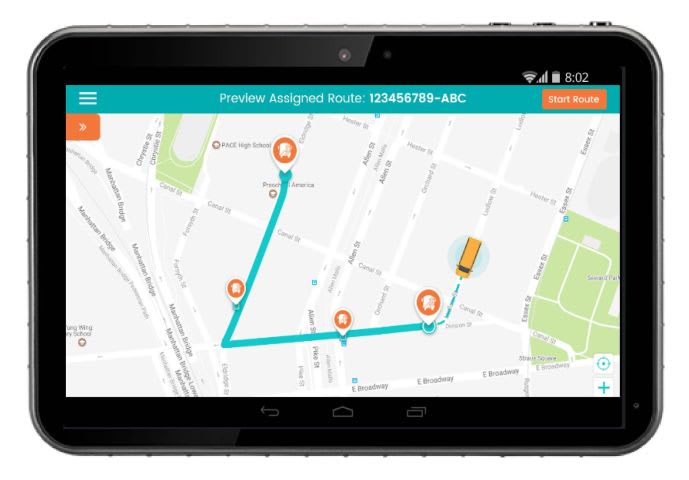
Visual navigation: Turn-by-turn directions are available to the driver, visually, where the map can be seen in relation to upcoming turns and stops. It could also include text-based driving instructions and stop descriptions.
Pro: “Visual learners” can more easily grasp when the next turn on the bus route is supposed to be (especially useful for substitute drivers). Visual of map is less distracting than trying to read directions on paper, especially in darkness.
Con: A driver looking at an MDT screen while driving can be distracted from driving. A driver looking at an MDT screen at a passenger stop can be distracted from monitoring the student loading/unloading process.
Messaging via MDT: Dispatch can use this feature to communicate with drivers.
Pro: Sending text messages via MDT is an efficient way to get important info to drivers (e.g., route changes, student attendance changes).
Con: This can be a distraction if active while bus is moving or during loading/unloading process.
Audio navigation: Turn-by-turn directions are available to the driver in audio mode, where spoken words provide info on upcoming turns and stops.
Pro: Hearing turn-by-turn directions should eliminate need to hold and read printed directions while driving. No distraction while stopped at bus stop.
Con: Driver listening to turn-by-turn directions can be distracted from driving and may not hear other things (depending on volume level).
Student ridership: Driver gets visual notification that student who just swiped on or off is assigned to that bus stop.
Pro: District has accurate records regarding which students have gotten on or off the bus.
Con: Driver can be distracted from other parts of the loading/unloading process.
Inspections: Tablet is available for driver’s use to record results of pre-trip and post-trip inspections.
Pro: Allows relevant info about inspections to be recorded in real time and alert maintenance personnel as needed.
The new name represents a renewed vision for the nonprofit focused on advancing clean, equitable, and affordable transportation solutions that move people and goods.
Choosing the right school bus driver trainer takes more than experience. Learn six keys to selecting and developing trainers and evaluating program effectiveness.
STA's Canadian division acquires Ontario-based G&L Stevenson Transport while Durham School Services adds a new district contract in California, First Student adds a New Jersey contract, and Minnesota Coaches acquires Halo Transportation.
A summer pilot found that AI agents could handle most routine calls, freeing up time for customer service staff to focus on emergencies and complex family concerns.
A Texas transportation supervisor shares lessons on self-awareness, accountability, managing stress and building trust — and why investing in leadership development matters at every stage of your career.
Who earned national recognition for their work in student transportation? This year, NAPT named five recipients of its 2026 awards for service, safety, and leadership, plus its newest Hall of Famer.
Driver shortages. Rising costs. Growing safety expectations. More data, but not enough time to act on it. The 2026 State of Student Transportation Report reveals what transportation leaders say is putting the most pressure on their operations—and where they’re investing next. See how your priorities compare.
What makes emotions run high, and how should you handle an angry colleague or parent? Follow these steps for staying calm, listening, showing empathy, and resolving conflict.
Learn about the challenges shaping the 2026–2027 school year, from persistent driver shortages and budget pressure to technology and readiness gaps. See how school districts are responding and adapting in Zonar’s 2026 Back-to-School Readiness Report.