




To See or Not to See? Weighing the Benefits of Visual Navigation
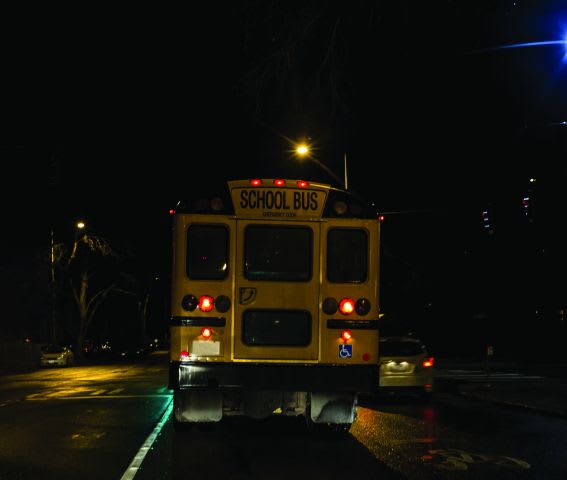
For substitute drivers, an illuminated display with directions might be a safer alternative to fumbling in the dark with a hand-held route sheet.

Getty image © captivecookie
Getty image © captivecookie
This article is the third in a series that covers the use of mobile data terminals. The first article appeared in the January 2018 issue and the second article appeared in the February 2018 issue.
When school bus drivers take on unfamiliar routes, what is the best way to guide them through the turns without taking too much focus off of the road?
That’s one of the key issues to address when considering the use of mobile data terminals (MDTs), such as driver tablets and GPS units.
In previous articles, we discussed a variety of applications of MDTs in school bus operations, including current regulation and policy. The regulations that exist — and there aren’t too many yet — focus mainly on mounting the equipment, and they are fairly uniform.
Emerging regulations address the location and stability of the MDT, disallowing any location that blocks the driver’s line of sight and requiring that the mounted device does not create a snagging hazard as students exit the bus.
There is no such regulatory consensus on the basic features that set the tablet apart from the clipboard: audio and video.
A rapidly developing MDT-based application — one to which we have become accustomed in our personal vehicles — is GPS navigation, including turn-by-turn directions. In fact, without the potential for navigation, transportation providers could choose to stick with existing technology to accomplish the goals of many other MDT-based apps (e.g., student tracking, messaging, and vehicle inspections).
Audio Vs. Video
Clearly, there are advantages to providing more information, in real time, to the school bus driver. Most importantly, providing audio and video driving directions to a substitute driver can help keep the bus running on time. This maintains student service levels while helping to keep the “downstream” passengers from waiting extra time roadside at the bus stop.
For some drivers, however, audio-only directions are an incomplete solution. References to a turn in “250 feet,” “1,000 feet,” or “0.3 miles” can have little meaning to some drivers, whereas an image that lets them see that the next turn is at the second intersection is much more intuitive.
In the January issue, I related my experience navigating the complicated highway system in Southern California using the GPS in my car. For many of us, a visual map is much more useful than audio-only directions. Could I get used to audio-only instructions, learning to make sense of what it means to “turn left in 1,000 feet”? Maybe. Probably.
Some consensus seems to be forming on the audio part of this puzzle. Local and state officials for the most part acknowledge the benefits of audio navigation instructions.
That brings us to the most controversial aspect of MDT implementation: the video display. And maybe “controversial” is not the right word. Pupil transportation professionals with years of experience can come down on opposite sides of the “active display” debate for all the right reasons.
Being informed where to turn and where to stop — while keeping both hands on the wheel — can be a significant improvement in safety, compared to trying to read the route from a faxed sheet of paper.
Risks of Distraction
Without a doubt, school bus drivers need no unnecessary distraction. Driver distractions can endanger students on the bus and students waiting at or walking to a bus stop, not to mention occupants of other vehicles, most of which are smaller than a 26,000-pound school bus.
Any time a driver looks away from the roadway, there is potential for a distraction-related incident. This can be true whether glancing at an MDT, the passenger compartment mirror, or a hand-held route sheet in the darkness of early morning.
Does it compromise safety for a driver to stare at an MDT screen while driving or while students are loading or unloading? Absolutely! This can be controlled by disabling the screen.
Does it compromise safety for a driver to stare at a hand-held route sheet while driving or while students are loading or unloading? Again, yes. But there is no way to “disable” the hand-held route sheet.
So let’s not jump to the conclusion that the navigation screen introduces more distraction than already exists, especially for the sub driver. A colleague commented on the January article, relaying his experience driving a route as a substitute:
“It was just like you described in your article. Route description in one hand and steering wheel in the other,” he said. “I think I would have been more focused on safety using the GPS than with the paper in hand and a student telling me where to stop.”
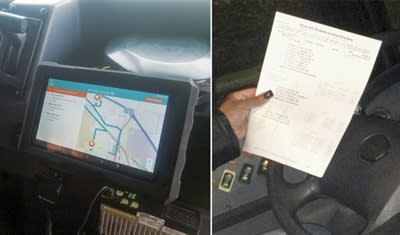
With MDTs or with route sheets, training and procedures are needed to ensure that the driver is not preoccupied when essential safety tasks are required.
Ruling Out Video?
It is still early in the evolution of navigation technology for school bus drivers. Developing operational policy can send us in circles, it seems.
One school of thought is that the video screen must be disabled while the bus is moving. The driver must not be tempted to look anywhere other than at the road while driving.
A similar school of thought is that the video screen must be disabled at the bus stop, because the driver must not be tempted to look at anything other than the entire landscape of the student boarding or exiting process.
Each of these is a valid concern, but combining these two schools of thought leaves us with a policy that disables the MDT video at all times except while the bus is in the compound, or maybe when pulled off the road and parked.
Perhaps these restrictions are appropriate, but consider trying to absorb everything your GPS has to show you before you leave for a 45-minute trip in an unfamiliar area. It’s just not the same. A “no video” policy greatly restricts what the app can provide to the driver.
Supporting the Substitute
In a situation where a regular school bus driver is driving a consistent route on a daily basis, electronic navigation may not be needed. After the driver learns the streets, the stops, the turns, and the students, additional prompting is likely unnecessary. Even with an MDT equipped with navigation, the district may opt to leave this function off on a normal school day with the regular driver on a familiar route.
A substitute school bus driver, on the other hand, faces a much different environment. Even if the sub driver is familiar with the general area of the route, he or she might not have a grasp of the specifics.
Current practice is to study the route sheet ahead of time and refer to it along the way, possibly in the dark. The revised route might have been faxed just minutes prior to the school where the route begins. The instructions given to the driver might even be to “pick up the first kid and (s)he will tell you where to go from there.”
In such a case, the MDT with turn-by-turn directions can be extremely useful. Being informed where to turn and where to stop — while keeping both hands on the wheel — can be a significant improvement in safety, compared to trying to read the route from a faxed sheet of paper.

Derek Graham is an industry consultant with clients that include Education Logistics (Edulog), a provider of school bus routing software solutions, school bus GPS tracking, and other related systems. He previously served as state pupil transportation director in North Carolina for 21 years.
Consider New Ideas
With or without MDTs, training and procedures are necessary to ensure that the school bus driver is not preoccupied when essential safety tasks are required, particularly while driving and during the boarding or exiting process.
As for the display of an MDT, perhaps some hybrid policy can allow the substitute driver to benefit from video navigation to know how to proceed to the next stop.
While the technology evolves, state and local policymakers must resist the temptation to shut the door on new ideas. Instead, they should seek to balance those new ideas with the safety priorities that define the school bus industry.
More Safety

How to Build a Better School Bus Driver Training Program
Is it time to strengthen your driver training? Here’s how to pick the right talent and improve recruitment, retention, and safety. This video is brought to you by IC Bus.
Read More →
Recent School Bus Accidents Leave 2 Dead, 2 Injured
Four school bus crashes in Florida, Illinois, and Georgia highlight risks in transportation lots, at bus stops, and during student loading and unloading.
Read More →
When Every Second Matters, Clarity Keeps Routes Moving
From routine delays to urgent incidents, strong communication practices help drivers, dispatchers, schools, and families respond with confidence.
Read More →

What Happens When a School Bus Catches Fire — and What Can Help
School bus fires are rare but can be devastating. Learn how advances in fire suppression and asset protection help fleets detect fires earlier, reduce damage, and improve safety.
Read More →
Geotab Launches Tool to Help Fleets Investigate Road Incidents
Geotab Investigations combines telematics data, video, documents, and other evidence to help fleets reconstruct incidents, resolve claims, and determine what happened.
Read More →
Texas Sixth Grader Wins 2026 National School Bus Safety Poster Contest
Sai Darshana Yekolu of Moseley Middle School in Prosper, Texas, was named the newest winner for her artwork, bringing the theme of “Safe Rides, Everyday Heroes” to life.
Read More →
Doing More With Less: How Transportation Directors Can Prioritize Safety Amid Budget Uncertainty
With diesel prices soaring and nearly one-third of transportation directors expecting budget cuts, maintaining student safety has never been more challenging. Download this guide to learn how leading districts are prioritizing risk, funding critical safety technology, and building stronger budget cases with data.
Read More →
Walton County Schools Adds Gatekeeper Stop-Arm Enforcement System
The Florida district will deploy Gatekeeper’s updated Student Protector technology, which now incorporates AI to improve video evidence.
Read More →
How To Build a More Secure School Bus Yard During and After Hours
As thefts and overnight security threats continue, school transportation leaders are combining stronger operational practices with AI-enabled surveillance to better protect buses, facilities, and staff.
Read More →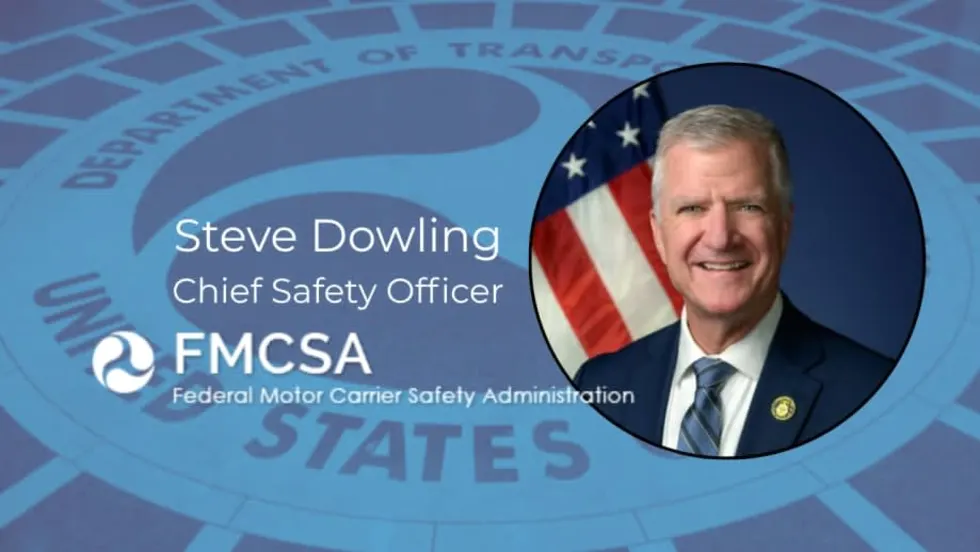
FMCSA Names New Chief Safety Officer: What School Bus Operators Should Know
Steve Dowling is set to lead the federal agency's efforts to advance commercial motor vehicle safety and reduce crashes, fatalities, and injuries on the nation's roadways.
Read More →