




NAPT News & Views — Adapting and Surviving or Thriving?
We are in the midst of a paradigm shift in how we connect as human beings, and it includes transportation.

Mike Martin is executive director of NAPT.

Mike Martin is executive director of NAPT.
Remember “The Flintstones”?
The circa-1960 cartoon was set in the Stone Age town of Bedrock, where dinosaurs co-existed with cavemen. Fred, Barney and their families and friends used rock “technology” and dinosaur power to support their comfortable lifestyle.
Another fictional family created at the same time lived in a futuristic utopia filled with elaborate robotic contraptions, aliens, holograms and whimsical inventions. The Jetsons lived in Orbit City in the year 2062. George Jetson commuted to his job at Spacely’s Space Sprockets in an aerocar that looked like a flying saucer.
These cartoon shows are metaphors for our current societal transition from analog to digital realities.
Analog is Bedrock. Digital is Orbit City. Digital presents new opportunities that analog can’t offer. Anyone who has been able to immediately share pictures and videos of their kids in real-time with family elsewhere in the country or world can attest to this.
In the realm of public education, we sometimes act as though the reality of today’s digital world is still a ways off. It’s not. The digital revolution is causing big changes in fundamental aspects of our education system. Here are a few examples of changes that reputable experts are predicting for public education by the year 2020, a mere four years from now:
• Network-based concepts like workflow, collaboration and dynamism (management of simultaneous operations) will reshape the classroom. The result? Fewer desks.
• The prevalence of smartphones and hand-held computers will reduce, if not eliminate, the need for “single-function” space (think language labs), paper (expect a decrease of at least 90%) and textbooks (even e-books will be an endangered species).
• Traditional boundaries between home and school will disappear. Kids may go to school less but actually study and learn more.
• Traditional college entrance testing will be replaced with individualized digital portfolios to document a student’s preparedness for the next level of education. The result? No more standardized testing.
• The structure of K-12 will be fundamentally altered by peer group learning. Local teachers will use (and are already using) social media and public learning cooperatives to interact with teachers elsewhere to brainstorm and exchange ideas.
• At the same time, student education will also become more individualized. Students will form peer groups by interest and petition for specialized learning, tailored to their specific needs and interests. Middle schools will be foundational content providers, and high schools will be places for specialized learning.
• As a result, school buildings will become smaller. They will be a place where learning is facilitated, not facilities where all learning happens. Teachers and students will go out into their communities for experiential learning in non-traditional settings at non-traditional times. The result? Customized and specialized transportation will be essential.

We are in the midst of a paradigm shift in how we connect as human beings, and it includes transportation.
If your initial reaction to some of these ideas is, “Here we go again. I’ve heard all this before,” I strongly encourage you to think again. We are in the midst of a paradigm shift in how we connect as human beings, and it includes transportation.
According to a recent report about the future of K-12 education by a consortium of educational groups, we should all be aware of the power and increasing prevalence of learning analytics, the practice of analyzing data from digital learning platforms and using it to shape teaching strategies for individual students.
In other words, data collection, data analysis and the use of data to make decisions are not just moving to center stage, they are center stage.
What does that mean for school transportation? It means it’s no longer good enough to simply believe in what you do and say it’s valuable. You are competing with others who also believe what they do is critical. You must doggedly document your performance, objectively quantify outcome, express it clearly in numbers, and then use the data to improve your organization’s overall “profitability” or “success.”
My good friend Mark Aesch, bestselling author of the book “Driving Excellence,” told us at the 2011 NAPT Summit: “High performance organizations are built and sustained by clearly staking out a destination, designing a measurement system to track success and having the courage to make the necessary decisions to get there. Do not assume that because you work very hard every day, and have an exemplary safety and performance record, that community support or support from your state or local education administrators will be there when you need it.”
Aesch’s overarching message is as true today as it was five years ago: “Metrics” are here to stay, and if you don’t learn how to use them to your advantage, someone else may use them to your detriment.
More Management

EverDriven Launches Route Consolidation Calculator to Estimate Diesel Savings
As diesel prices hit record highs, the largest alternative transportation provider says a 10% route consolidation could save a 120-route district more than $78,000 a year in fuel alone.
Read More →
Zum Secures Continued Financing Support for School Bus Expansion
Generate Private Credit has financed approximately $75 million in school bus deployments across three states, supporting more than 500 buses as Zum expands across the county.
Read More →
Beyond Discipline: A Different Approach to Student Behavior on the Bus
After implementing a dean of students program in Oregon, North Clackamas is seeing positive improvements. Here’s how it worked. The Route is brought to you by IC Bus.
Read More →
A Dean of Transportation's Different Approach to Student Behavior on the School Bus
After implementing a dean of students program in Oregon, North Clackamas is seeing positive improvements on the bus. Here’s how it worked.
Read More →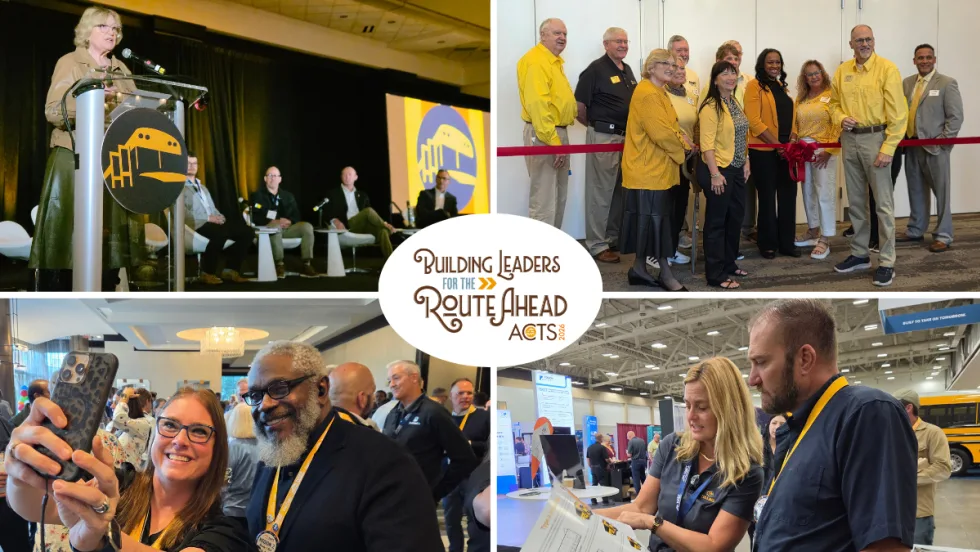
Inside NAPT ACTS 2026: Highlights from Louisville
From federal updates and student behavior strategies to new school bus technology and industry awards, see highlights from NAPT ACTS 2026 in Louisville.
Read More →
Meet the 2025 School Bus Driver Hero Winner: Annette Brown
We caught up with Wa-Nee Community Schools' Annette Brown on site at SBFX, where she was named the 2026 School Bus Driver Hero Award winner. Hear about her reaction, what she loves most about being a school bus driver, and more!
Read More →
Predictability Is Like Ketchup (According to 6-Year-Olds)
To students, a different school bus can feel like a full-blown crisis. One driver reflects on why familiar routines, showing up on time, and being reliably boring matter more than we think.
Read More →
Samsara Launches Free Driver Rewards Program
The new Driver Perks program gives eligible professional drivers access to discounts and offers without adding a cost for participating fleets.
Read More →
How Tax-Exempt Municipal Leases Can Help Finance School Buses
Let’s explore school bus financing options, including municipal leases, vendor payable accounts, and balloon payments, and how they can help stretch fleet budgets.
Read More →
Nominate Rising School Transportation Pros Under 40!
We’re searching for the next generation of leaders making an impact across the K-12 student transportation industry to recognize as SBF’s 2027 Trailblazers. Nominations are open now!
Read More →