




NAPT News & Views
Green at the grassroots Everyone in school transportation knows anti-excessive idling policies are now the norm within the industry to cut...

Green at the grassroots
Everyone in school transportation knows anti-excessive idling policies are now the norm within the industry to cut down on emissions.
It is also common knowledge that school buses are being replaced routinely by the newest clean diesel engines that offer excellent environmental performance.
That’s why NAPT recently distributed a news release nationally, pointing out an important fact that every “green” media story written to date missed: Yellow is the green way to get to and from school!
Not only can parents literally reduce the family’s carbon footprint, they can figuratively move to an entirely smaller shoe size by simply insisting that their teenagers take a school bus rather than drive themselves to school.
Taking a school bus even just once a week reduces the impact high school students have on the environment. It’s also the safest way for them to get to and from school.
While using mass transit typically is high on most lists of things to help save the planet, taking a yellow school bus is never mentioned in that context. Yet increasing school bus usage should be an important part of any “we need to get more people to use mass transit” discussion.
In many communities school buses are underutilized, while roads are clogged with teenagers driving to school during rush hours. If more rode school buses, there would be environmental, safety and reduced traffic congestion benefits for the entire community. Teens could also pocket a lot of gas money to spend on other things.
Ironically, California — the state most renowned for its environmental activism and laws — has among the lowest percentage of school bus ridership in the nation. Despite energetic information efforts by the California Association of School Transportation Officials, many California parents still do not insist that their children use school buses, missing one of the easiest ways to be environmentally responsible.
Being “green” is the rage now and we are bombarded daily with messages about how we can make a difference environmentally. Everywhere, people are striving to conserve resources and reduce their “carbon footprint.” And NAPT is doing its part!
In fact, long before all the current emphasis, NAPT sought to conduct its business in ways that are as efficient as possible and contribute to environmental sustainability. Doing so involves many small steps that contribute to the aggregate societal good.
Here are some examples of things we have done or are doing that contribute at a grassroots level:
Nearly eight years ago we stopped printing a hard copy member handbook, and six years ago did the same for our newsletter, instead providing the information online.
We stopped issuing plastic membership cards and shrunk our member benefits flier to a single page.
We eliminated plastic water bottles at the annual conference and water is now provided in biodegradable cups made from recycled materials. Similarly, our annual conference program and our trade show directory have been reduced in paper quantity by half.
New NAPT members will soon receive a reusable grocery bag (to help cut down on the use of plastic bags) and a compact fluorescent light bulb as part of the materials they receive welcoming them to the association.
Finally, much is reported in the media (often with a raised eyebrow) about how celebrities try to “offset” their use of private jets and yachts by purchasing “carbon credits” or planting trees. Well, at NAPT we don’t have any lavish lifestyle practices to feel guilty about. But we are planting trees — a lot of them — because it’s another way for our industry to make a contribution to the communities we serve.
NAPT has recently partnered with a prominent and well-respected environmental steward to create the “NAPT Forest.” Initially, we are going to plant nearly 2,500 trees representing each of our members. Another tree will be planted thereafter every time a new member joins our association.
In short, “green” is more than just a public relations gimmick at NAPT. It is part of our culture — individual actions that add up to a big contribution. We encourage you to join us and help us create an even safer environment for the children we all care so passionately about.
More Alternative Fuels

Why Gasoline School Buses Are Making a Comeback
Gasoline is gaining ground in full-size school buses. See how today’s options stack up against diesel on cost, maintenance, emissions, performance, and more.
Read More →
EPA Opens $180M DERA Funding Round for Diesel Upgrades
The 2026 Diesel Emissions Reduction Act program seeks applications from eligible organizations to accelerate the retirement of legacy diesel vehicles.
Read More →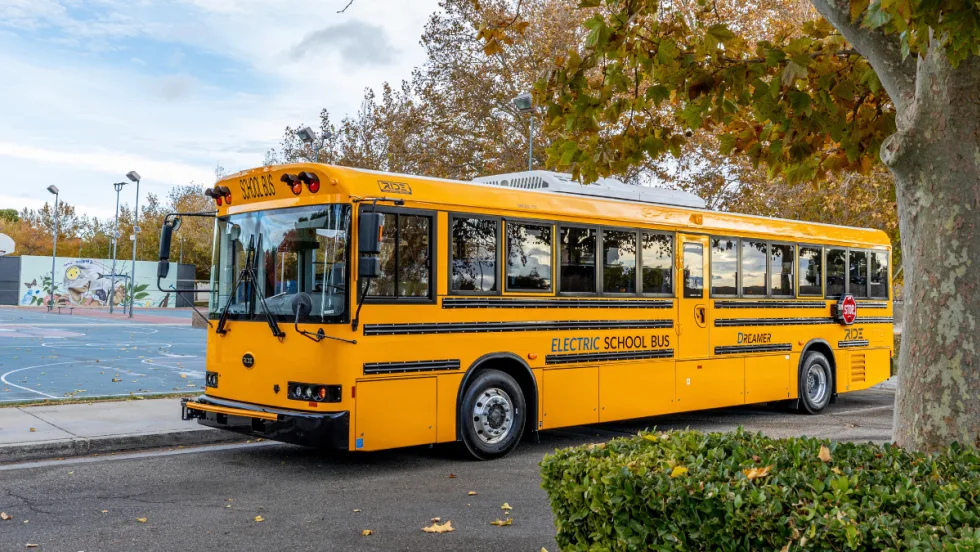
The Secret Life of an Electric School Bus Battery
Batteries change throughout years of daily routes, but degradation doesn’t necessarily mean the end. Here’s what operators should know about performance, safety, and second life.
Read More →
CALSTART and Forth Combine to Form Catalyst Mobility
The new name represents a renewed vision for the nonprofit focused on advancing clean, equitable, and affordable transportation solutions that move people and goods.
Read More →
Alt-Fuel Moves: New Buses, Charging Hubs & Real-World EV Testing
Propane and electric school bus deployments continue to grow as districts add new vehicles, expand charging infrastructure, and gather more real-world operating data.
Read More →
Fewer Electric School Bus Models Reshape the U.S. Market
WRI’s latest buyer’s guide points to a consolidating electric school bus market, but fewer options may reflect a maturing industry rather than fewer meaningful choices for school bus operators.
Read More →
The Fuel Budget You Can Actually Predict: How Propane Autogas Keeps Money in the Classroom
Learn how propane autogas helps school districts manage fuel costs with predictable pricing, lower maintenance, and reduced emissions from former transportation director Joel Stutheit.
Read More →
Hendrickson, Driventic Introduce New Electric Powertrain for School Buses
ELECTRAAX, the electrified, lightweight drive axle offers integrated ePowertrain efficiency and modular flexibility for Class 6–7 school bus use.
Read More →
The Mobility House Joins PowerFlex in Fleet Electrification Deal
The acquisition combines intelligent charging software, bidirectional charging expertise, and fleet electrification services to support the growing adoption of electric school buses across North America.
Read More →
Alt-Fuel Moves: Electric School Bus Investments Hit the Road
See which districts across the U.S. are putting electric school buses into service, expanding charging infrastructure, and planning the next phase of fleet electrification.
Read More →