




Is Your Fleet Ready for Winter?
The season’s weather can create dangerous driving conditions for employees and slippery bus steps for students, but products are available to help eliminate these hazards. Manufacturers of automatic tire chains, a traction sander and a step heater discuss their features, safety benefits and installation options.

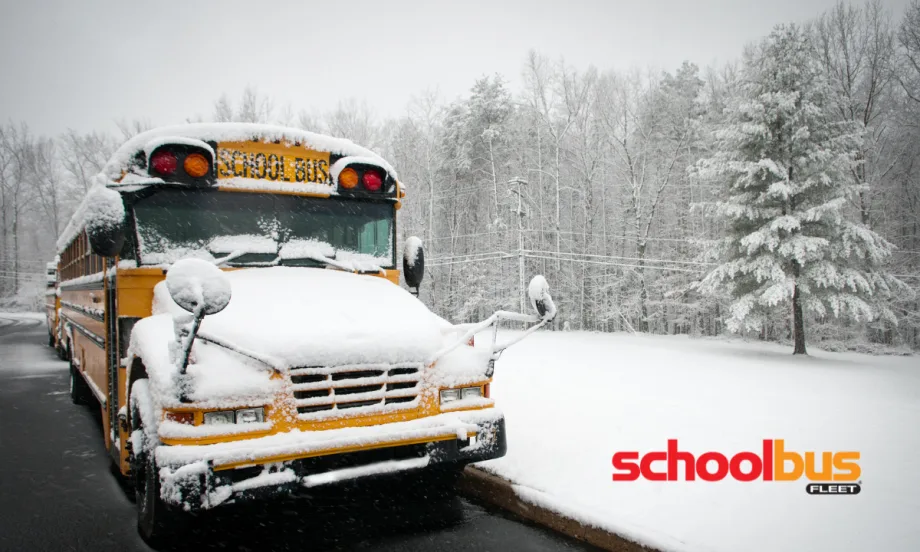
School Bus Fleet
Snow and ice can make roads slippery and create a hazard when students board and disembark their buses. With winter not far away, pupil transporters will need equipment on their buses that enables them to continue to safely transport students.
Manufacturers offer several products designed to help ensure the safety of everyone on a school bus during winter weather, from systems that provide increased tire traction to a step heater that melts snow and ice.
Here, the manufacturers provide details on the products’ features, the benefits of utilizing such equipment, and the processes for installation and operation.
Elston Manufacturing Inc.
One system available to pupil transportation officials to improve tire traction on school buses is the Elston Traction Sander. Jeanine Zabel, sales coordinator for the company, says that the sander is rapidly becoming a popular tool to provide additional safety enhancements for school buses, and that the system is mandatory on school buses in many northern states.
The Elston Traction Sander mounts in front of a bus’ drive wheels. It is wired to a switch on the bus’ dashboard, so when the driver flips it on, a carpet of grit drops on the snowy or icy ground to increase traction. This reduces wear and tear on drivetrain components and the tires, and it enables the driver to stop and start driving more quickly.
One of the biggest advantages of using a sander over a conventional tire chain system, Zabel says, is that it saves time and is safer for the driver.
“You don’t have your drivers out there chaining the wheels, and you don’t have to stop to put the chains on and take them off,” she explains.
Zabel also notes that it is an economical solution because an end user does not have to replace worn chains.
Moreover, Elston Traction Sanders require little maintenance, and the inside of their tanks is coated with a product that prevents rusting.
Replacement parts may occasionally need to be purchased, but the most maintenance needed is replacing the grit when it runs out. Zabel recommends SafeTSorb by Moltan Co.
“It’s heavy enough that it will hit the ground and stay on the ground. It doesn’t freeze when wet, and it doesn’t get clumpy,” she says.
Elston offers several Traction Sanders for school buses. The S-B 200 is designed for Thomas Built buses. The company also manufactures the Blue Bird Special and Blue Bird Standard, and can custom-build sanders to meet customers’ needs.
Zabel says that the simple, self-explanatory installation process will allow an end user to mount a sander in three to four hours.
Lighthouse International Ltd.
Along with improving tire traction in winter weather, maintaining a safe entry and exit area for students, bus drivers and aides as they board and disembark school buses is equally important.
Bill Dyer, president of Lighthouse International Ltd., says that in the past, a duct system that was part of a bus’ defrost system blew hot air onto the steps to melt snow and ice. The company’s Warm Welcome Step Tread Heaters are a more efficient and long-lasting alternative to the duct/blower system.
The heaters are about 1⁄32 of an inch thick and are available in 75 models ranging from 12 to 24 volts. They are installed underneath the tread of a bus’ steps to directly heat the tread.
Some of the models operate on freeze-protection thermostats. When the temperature outside drops below 32 degrees Fahrenheit, the unit will turn on and heat up; once the temperature outside rises to a certain degree, the heater shuts off.
“The positive thing about the heater is that it melts snow off immediately and it will also evaporate the water,” Dyer says, noting that the rate of evaporation depends on the temperature outside.
In addition to increasing safety for everyone riding a bus and reducing liability for school districts and bus companies, Dyer says that utilizing Warm Welcome Step Tread Heaters is a “green” method of removing snow and ice from bus steps because it eliminates the need for chemical de-icers and salts, which can also cause corrosion.
Lighthouse sells its Warm Welcome heaters to all major school bus manufacturers in the U.S. and Canada, and many are installed at the factory level. However, the heaters can also be retrofitted on existing buses.
“Technical help can be accessed through either the manufacturer whose bus the heater is being installed on, or the customer can call us for various installation options,” Dyer says.
Lighthouse also offers Warm Welcome heaters for wheelchair lifts.
Onspot of North America Inc.
A second option to improve tire traction in snowy or icy driving conditions is to outfit buses with automatic tire chains. The fact that Onspot of North America specializes in manufacturing these chains is one of the company’s greatest strengths, President Patrick Freyer says.
The Onspot Automatic Tire Chain System, which can be installed on Thomas Built, Blue Bird and IC Bus units, permanently mounts on a bus’ rear suspension.
When the driver activates a dashboard switch, the system’s chainwheel descends and rotates, and the chains branch out in front of the tire.
Six lengths of chain on the chainwheel ensure that there are always two chains between the tire and the road surface. Increased traction is obtained while driving in forward or reverse.
Freyer says that the Onspot system is safer than conventional chains on several levels.
“You’re not getting out of the vehicle [to put on chains] and leaving it unattended, and it could conceivably save a life,” he explains. “If you’re in a school bus that’s sliding down an icy hill, you can turn on a switch and in two seconds have chains on.”
He adds that tests have shown that the system can help to reduce stopping distance by as much as 20 percent.
In addition to the Onspot system’s safety benefits, it has durable components. Freyer says that replacement parts may need to be purchased at some point due to normal wear (Onspot sells all of the parts), but the system itself will typically last the life of the vehicle.
“We supply what we feel is the best material in the business as far as steel, anodized cans, swing arms and reinforced air cylinders,” Freyer says. “For the chains, we use what we call ‘through-hardened steel alloy.’”
For customers who want to install the system as a retrofit, Freyer says they simply need to measure the bus and Onspot will supply a kit with a full set of installation instructions. He notes that Onspot’s ability to provide a customized system sets it apart from other automatic tire chain suppliers, and he says that the company will provide installation training upon request.
RUD-Chain Inc.
RUD-Chain Inc. manufactures three Rotogrip Automatic Tire Chain systems, all of which are ISO 9001-certified. The Classic version is the model most commonly used on school buses.
While the system operates similarly to other automatic tire chain systems (the flip of a switch installed in the vehicle’s cab activates the chainwheel, which then engages with the tire, and the chains fan out to provide traction), its mounting system is different.
The universal mounting system is adjustable, which allows the installer to easily position the chainwheel accurately, helping to achieve optimum performance, according to Rick Ransom, Rotogrip product manager.
The universal mounting system also enables the Rotogrip Classic system to fit a wide range of vehicles.
The Rotogrip Classic system works when the driver is operating the vehicle in forward or reverse, and it provides traction at speeds as low as 3 to 4 mph.
Ransom notes that Rotogrip tire chain systems are high quality and designed to last. “It is not unusual for an end user to get 10 years out of a system,” he says. “The first system that we installed over 20 years ago is still in service.”
The Rotogrip wheels feature square steel link chains and replaceable wear rings. The spring-mounted chains help during low-speed operation and can also improve traction during incremental braking.
Ransom says that the Rotogrip Classic system is installed at the OEM level and through the company’s network of dealers, but he adds that it can be installed as a retrofit.
“The installation process takes four to five hours, and RUD-Chain offers installation training and support services,” he says.
More Maintenance

Easy Ways to Reduce School Bus Emissions: Q&A with John Gonzales
Learn how preventive maintenance, driver training, reduced idling, smarter routing, and the right fuel choices can help districts reduce emissions — without investing in new buses.
Read More →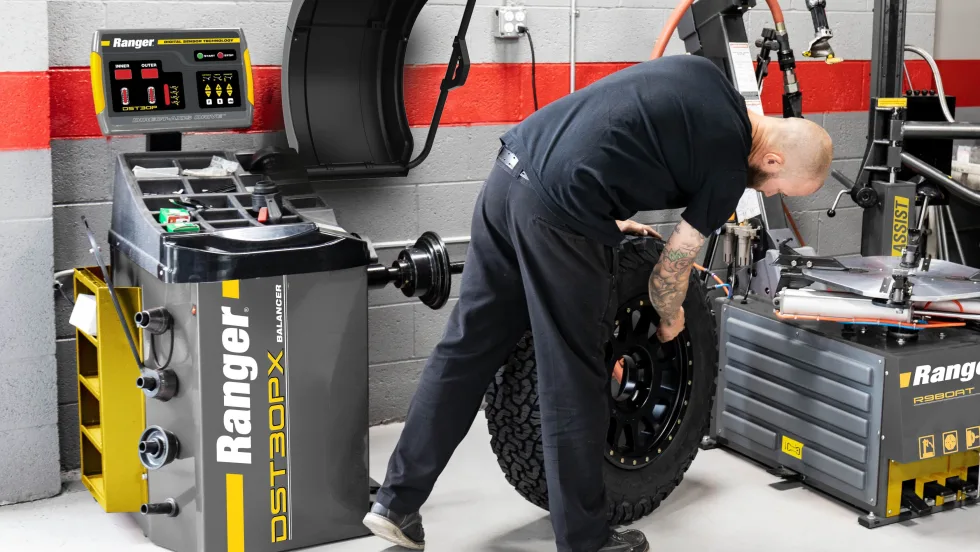
BendPak Launches Ranger DST30PX Wheel Balancer
BendPak's new wheel balancer handles tires up to 43 inches in diameter, with a reinforced design, precise weight placement, and faster service cycles.
Read More →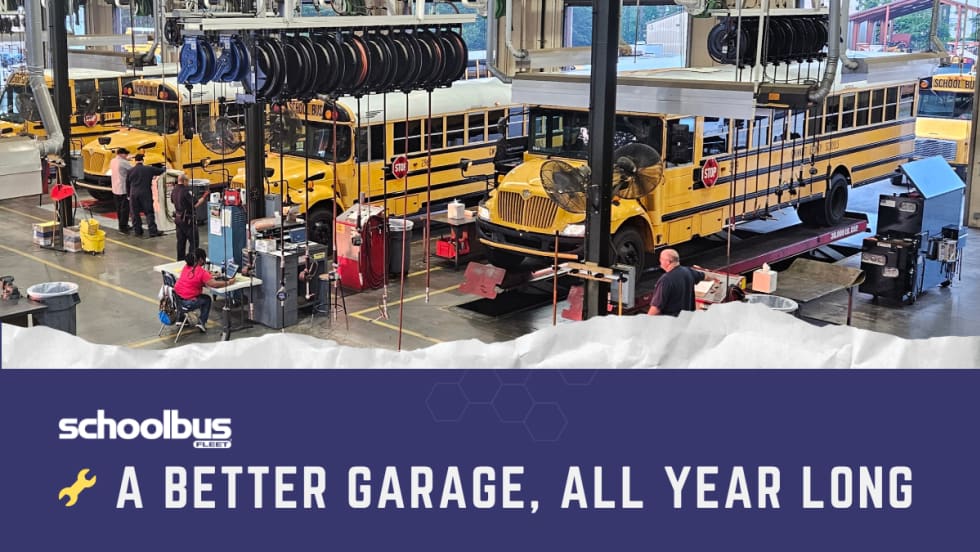
Tips for Ensuring School Bus Garages Are Safe and Warm Year-Round
Cold maintenance bays and rising heating costs? Learn how school bus garages can improve comfort with targeted heating, better airflow, and winter preparation.
Read More →
ASE Highlights School Bus Technician Certification Requirements
ASE is encouraging school bus maintenance professionals to maintain their certifications, highlighting seven specialized tests and five-year renewal requirements.
Read More →
International Adds E-Commerce Capabilities to Fleetrite.com
IC Bus customers can now browse, buy, and track shipments for more than 400,000 aftermarket parts online.
Read More →
The Most Expensive Thing You Do Before Selling a School Bus: Wait
When should you sell an aging school bus? Learn how maintenance, mileage, corrosion, specifications, and timing can affect resale value long before the auction.
Read More →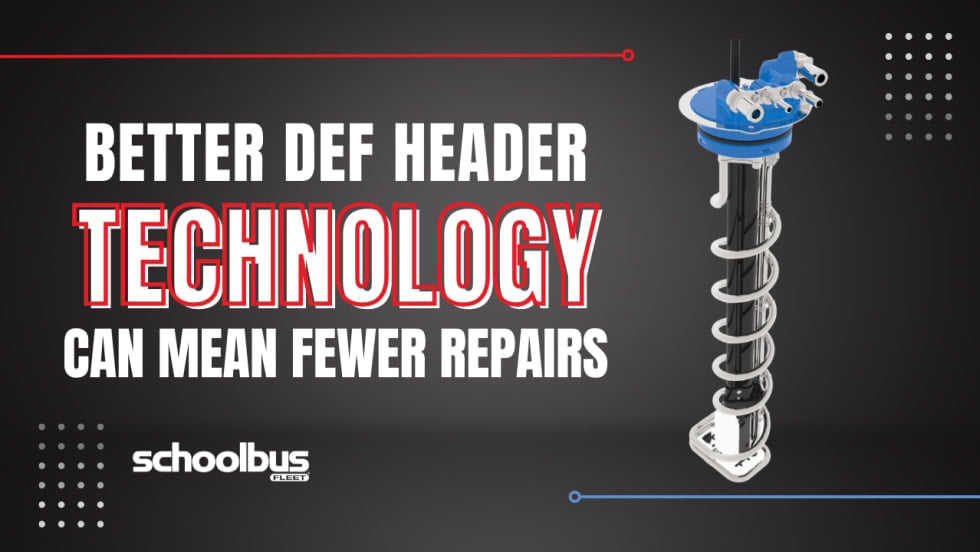
The Evolution of DEF Header Technology: What School Bus Operations Should Know at Replacement Time
See what school bus fleets should consider when replacing DEF headers to improve reliability, reduce repeat repairs, and control maintenance costs.
Read More →
The Essential Guide to School Bus Maintenance and Student Safety
Your district's buses carry students to school every day. This guide shows how predictive maintenance powered by fleet data helps keep buses reliable, drivers accountable and students safer from the first bell to the last stop.
Read More →
Kerry Brothers Grows Michigan School Bus Repair Network
The acquisition of Downriver Truck and Bus expands Kerry Brothers’ school bus maintenance footprint across southeast Michigan, adding repair capacity, diagnostic resources, and state inspection support.
Read More →
Noregon Introduces CAN Bus Diagnostic Tool, Expands JPRO Features
CAN Mentor and the latest JPRO update aim to simplify vehicle network diagnostics and improve repair efficiency for technicians of all experience levels.
Read More →