




In an emergency, whose language is it anyway?
The following is a re-creation of a dialogue that took place in the Forum at schoolbusfleet.com. The names of the participants have been cha...

The following is a re-creation of a dialogue that took place in the Forum at schoolbusfleet.com. The names of the participants have been changed. The discussion revolves around whether the labeling of emergency equipment in school buses should be only in English.Kenneth: In Canada, most emergency equipment is labeled in two languages, English and French. This is a good idea and should be required in school buses in states along the U.S.-Canadian border. Accordingly, states bordering Mexico should have Spanish and English labels. I think it’s a good idea because I do see a lot of Canadian plates here in Michigan, and if a Canadian needed to help in an emergency, they may need the French emergency labels. What do you think? Jerry: I think if folks come to our country to live and be educated, they should communicate in English! If that is a problem, then they can return! Mitchell: Jerry, how can you say that and live in south Florida? I agree with Kenneth. Multilingual labeling is needed, especially in major metropolitan areas. You know, most safety equipment is labeled in bilingual text on public transit buses. Why not on school buses? Jerry: I say that because I live here and maintain buses for a living! Before you know it, the state department of education would have our buses “out of service” because the Spanish instructions were faded! No thanks, English is sufficient for us. Brett: I agree with Jerry. They will require us to have all emergency equipment labeled in Spanish and/or French, and if one little thing is wrong with it, our buses may not pass inspection depending on how strict the state’s laws would be on something like that: “We are sorry, but your bus is being yellow-tagged because you are missing the letter E on Espanol.” I don’t think so. Let’s work on getting all states to require crossing arms, or something else that could help keep buses safer. Mitchell: Well, our buses seem to pass inspection with the English instructions faded and sometimes missing altogether. Kenneth: Other countries seem to pull it off. The decals only cost about $2 each for the English ones and probably the same for the French or Spanish. Brett, in Michigan I think they should have the French, since we’re so close to Canada. Not Spanish. Also, the Detroit airport seems to pull it off with the Japanese labels on their shuttle buses. Brett: I just feel since emergency equipment is in red containers, passengers will know where it is. In my case, I have most of my emergency equipment in my overhead storage compartment on my bus. It’s a Thomas, and most of them have this. There is a clear piece of glass that has two red cross symbols on it, so I think they would know where to look. Jerry: In south Florida we would need Spanish, Creole, French and Hindu, in addition to English, and probably several others! Leaving anyone out risks offending someone! No thanks, English will do for me. Bob: It is all for safety. Why not just put it on there and stop arguing? Think about it, if you were driving a bus full of young Spanish-speaking children and you got knocked unconscious and the bus caught on fire, wouldn’t you want one of those kids to be able to read the instruction tag on the fire extinguisher? I would. Jerry: Let’s see. That’s $2 per decal times 800 buses, which equals $1,600. Don’t forget to add the time for each bus inspector to check the decal during each monthly inspection. That’s 800 buses times 0.5 minutes, which equals 400 minutes. If you multiply 6.66 hours times $25 per hour (average salary, including benefits), you get $166.50 each month just to ensure that the labels are there and legible. Are you beginning to see my objection? Kenneth: So are you saying you’d rather have money than safety? You think it’s so hard to do when other places have done it real easily? Jerry: There’s much more to it than money! Certainly for a large fleet it’s very expensive. The flip side of this is there hasn’t been a need for this type of thing. No perceived need equals no added needless expense. Because a handful of passengers on one trip or another happen to speak another language (or two) doesn’t mean we need to change the specs for all of our buses and how we maintain them. It simply isn’t necessary. We teach these folks to begin to speak our language and follow our rules before they ever set foot on a bus (in most cases). What I’m saying is I’d rather spend my money where it is needed, not where it isn’t! Tony: I agree with Jerry (the first time I think I have ever done that). Something on a scale that massive would be a waste of money that could otherwise be spent elsewhere, for textbooks or for expanding classroom sizes. Spending $2,000 for a set of decals for a large fleet of buses isn’t necessary. And the red cross is universal, no matter where you go. In Europe, fire extinguishers are basically the same as they are here in the U.S., from what I’ve read. I live in Washington state, and the need for bilingual buses isn't there because British Columbia is predominantly English speaking. And the evacuation drills we do are sufficient for a Spanish-speaking person to comprehend. All of our first aid kits are marked with a red cross, and the fire extinguishers are of the ABC type. They’re so easy to use that my 6-year-old brother can use them without a problem! Kenneth: I’m going to stand by my opinion. I think they would be helpful. School districts that cannot afford to add the foreign-language decals all at once should phase them in over a period of months or years. Also, states should be less strict with decal inspections for a few years. Plus, the decals don’t fade that much. My 1985 school bus has the original decals, and they’re still completely visible. If the decals do fade, find another decal company. If a school bus is being chartered and foreign children are riding on it for just one day, I don’t think it’s likely that the school district will do an evacuation drill just for them. Are you seeing my point? Terrell: Hey, Kenneth, what would happen if you had a student on your bus who only spoke a foreign language, not English? What if something were to happen to that student and that student was not able to communicate with the bus driver? I mean, if you are going to have emergency equipment labeled in Spanish, it only makes sense that you hire a bus driver who can speak Spanish and English, right?
More Safety
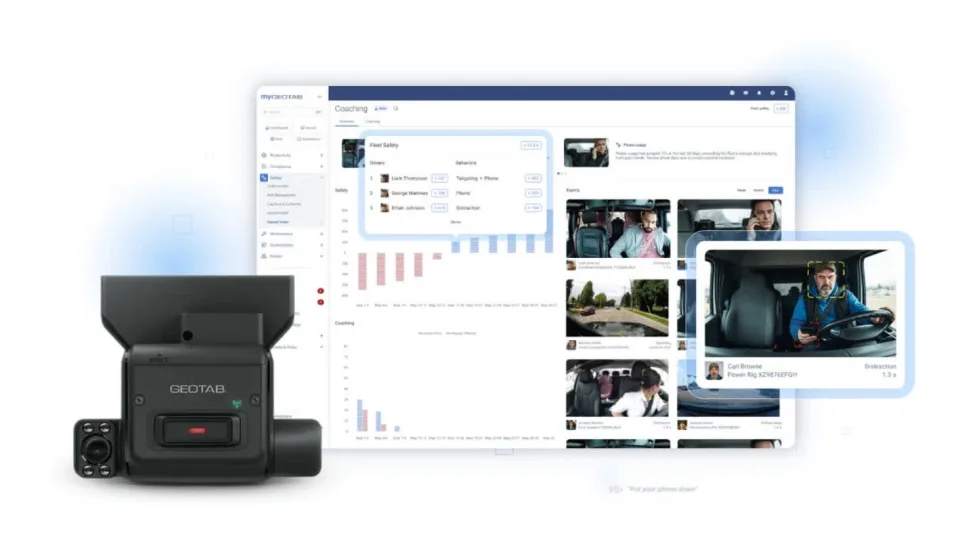
Geotab Expands Fleet Safety Tools With Video Coaching, Risk Insights
New safety and video capabilities aim to help fleet managers assess risk, support drivers, and take targeted action through video coaching, red-light violation detection, and more.
Read More →
How to Build a Better School Bus Driver Training Program
Is it time to strengthen your driver training? Here’s how to pick the right talent and improve recruitment, retention, and safety. This video is brought to you by IC Bus.
Read More →
Recent School Bus Accidents Leave 2 Dead, 2 Injured
Four school bus crashes in Florida, Illinois, and Georgia highlight risks in transportation lots, at bus stops, and during student loading and unloading.
Read More →

When Every Second Matters, Clarity Keeps Routes Moving
From routine delays to urgent incidents, strong communication practices help drivers, dispatchers, schools, and families respond with confidence.
Read More →
What Happens When a School Bus Catches Fire — and What Can Help
School bus fires are rare but can be devastating. Learn how advances in fire suppression and asset protection help fleets detect fires earlier, reduce damage, and improve safety.
Read More →
Geotab Launches Tool to Help Fleets Investigate Road Incidents
Geotab Investigations combines telematics data, video, documents, and other evidence to help fleets reconstruct incidents, resolve claims, and determine what happened.
Read More →
Texas Sixth Grader Wins 2026 National School Bus Safety Poster Contest
Sai Darshana Yekolu of Moseley Middle School in Prosper, Texas, was named the newest winner for her artwork, bringing the theme of “Safe Rides, Everyday Heroes” to life.
Read More →
Doing More With Less: How Transportation Directors Can Prioritize Safety Amid Budget Uncertainty
With diesel prices soaring and nearly one-third of transportation directors expecting budget cuts, maintaining student safety has never been more challenging. Download this guide to learn how leading districts are prioritizing risk, funding critical safety technology, and building stronger budget cases with data.
Read More →
Walton County Schools Adds Gatekeeper Stop-Arm Enforcement System
The Florida district will deploy Gatekeeper’s updated Student Protector technology, which now incorporates AI to improve video evidence.
Read More →
How To Build a More Secure School Bus Yard During and After Hours
As thefts and overnight security threats continue, school transportation leaders are combining stronger operational practices with AI-enabled surveillance to better protect buses, facilities, and staff.
Read More →