




Helping School Bus Drivers Turn Downtime Into Uptime
Texas and North Carolina transportation departments fill the gap in drivers’ schedules with work opportunities beyond more routes, such as administrative, cleaning, and technical tasks, and tap other staff to ease driver shortage. Meanwhile, an Illinois contractor offers space for socializing and relaxation.


Glenda Daughtry, who recently retired, had worked as a bus driver and teacher’s aide for Sampson County Schools in Clinton, N.C. Many districts in the state require certain staff members to obtain their CDL and drive buses when needed. Photo courtesy Vicki Westbrook

Glenda Daughtry, who recently retired, had worked as a bus driver and teacher’s aide for Sampson County Schools in Clinton, N.C. Many districts in the state require certain staff members to obtain their CDL and drive buses when needed. Photo courtesy Vicki Westbrook
One ongoing challenge in retaining school bus drivers is offering enough hours of employment. When discussing driver shortage, the issue of the morning and afternoon shifts with a significant gap in between often comes up as a hurdle, although some drivers appreciate having the time midday to run errands or just take a break.
To increase recruitment and retention, some pupil transporters are able to work with other departments to get drivers extra hours taking care of administrative tasks, or to train other staff members to work as drivers and fill the gap in their ranks. Alternately, one contractor School Bus Fleet spoke with enables drivers to use their downtime between shifts to focus on fitness, religious reflection, socializing, or rest.
Varied Work, Extra Pay
In addition to extra routes, at Klein (Tex.) Independent School District (ISD), there is ample midday work to fit a variety of skills. Drivers can take on tasks for extra pay such as pulling video footage, washing buses and getting parts, and answering phones and translating conversations during the lunch hour.
During the secretary’s lunch break, two drivers spend part of their day in the office translating phone conversations in Spanish for those who don’t speak the language, says Steven Ilten, associate director of transportation for the district.
There is also a technical opportunity on offer. School administrators sometimes request video of an incident. After buses return from the morning routes, drivers who are assigned to the task go out to the bus in question, pull the tape, locate the incident, and bring the film to administration staff. (The district is currently using analog video, but is in the process of moving to Wi-Fi downloading.) If there is an emergency that requires that video footage to be reviewed, it is pulled immediately.
Helping out in the shop by washing buses, repairing seats, and going on runs for parts are other ways drivers can gain hours.
Drivers can also sign up for pre-K or “noon day” routes, taking students in the morning classes home and picking up students for their afternoon classes. That can add up to an extra hour and a half to a driver’s schedule, Ilten says. They can also serve as attendants on these routes.
After-school activity and tutorial routes, as well as field trips, are also available at a number of the district’s schools. Activity runs offer an extra two hours a day, three days a week, Ilten says.
Drivers who already work full time have the opportunity to volunteer for more hours, but the transportation department does prioritize minimizing overtime costs, and tries to ensure that as many team members as possible get a full-time workday if they want one.
“The number-one priority is to get the kids to and from school safely,” Ilten says. “However, we’re always looking to spread the wealth. If you’re a go-getter and want to put in that extra time, you can get close to 40 hours a week or even more.”
Although coordinating with the various departments and sometimes training drivers on these different tasks takes substantial effort, Ilten says that Klein ISD’s office and routing staff members and supervisors work together effectively on training.
“They do a wonderful job,” Ilten says. “It really is a team effort.”

Drivers for Klein (Tex.) Independent School District get extra pay for pulling video footage and answering phones and translating conversations during the lunch hour, as lead driver Cynthia Torres is shown doing here. Photo courtesy Steven Ilten
Other Staff Fill Shortage Gap
A 10-year-old practice at a school district in North Carolina that involves school staff members getting behind the wheel at times and drivers getting to pick up hours in other school departments has helped keep its buses rolling.
Bus drivers have had the option to work in the cafeteria or as teaching assistants at Sampson County Schools in Clinton, North Carolina. Meanwhile, employees hired as cafeteria workers, custodians, and teacher assistants have been required, as with many other districts across the state, to obtain a commercial driver’s license (CDL), unless they are unable to do so because of a disability.
The district runs 132 buses every day and has about 30 extra drivers, some of whom are primarily cafeteria or custodial workers and teaching assistants. Some of them drive full time and others primarily work in a classroom.
Many teacher assistants in particular love driving, especially once they see the difference it makes in their pay, says Vicki Westbrook, the transportation director for the district.
“It could get them a couple hours more, and some routes could add four-and-a-half hours to a workday,” she adds.
A couple routes may have one driver in the morning and another in the afternoon, but for the most part, the buses are stationed at the driver’s house, and routes start from there. After drivers finish their morning route, they park their buses at school, report to their other job, take students home in the afternoon, and park their bus at home.
Some bus drivers have gone beyond doing cafeteria or custodial work or being a teacher assistant between shifts, and have been hired full time when a position opened.
“It’s their way of getting their foot in the door,” Westbrook explains.
One challenge the district faces with this staffing system is, when cuts are made to state allotments to school systems, that impacts the number of teacher assistants that can pitch in and drive, she adds.
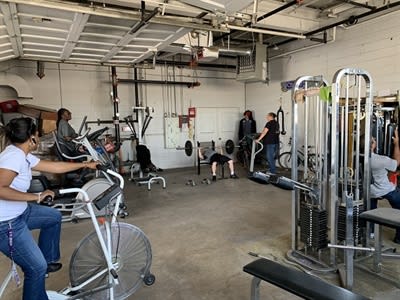
Lakeview Bus Lines in Bellwood, Ill., has five rooms that employees can use for a wide variety of activities, including exercising. Photo courtesy Jamie Enger
Rooms For R-and-R
Aside from additional employment, giving drivers space to themselves is one factor that has contributed to a high retention rate for Lakeview Bus Lines in Bellwood, Ill.
“It’s hard to find good, qualified people. You need to do everything you can to keep them,” says Michael Wagner, co-owner of the school bus company. “We treat them as best we can, and give them a nice, safe location.”
Lakeview’s location features five rooms that employees can stay in all day, and many do just that, instead of going home between shifts.
The rooms provide space for a wide variety of activities. They are designated for religious and book groups; board games and card games; exercise, with workout equipment provided; quiet, with the ability to play soothing music; and eating and socializing, like a typical lunch break room.
Lakeview is also working on a sixth room, for staff members to use by themselves.
Boosting Recruitment, Retention
Wagner, whose operation has experienced a nearly 90% retention rate over the last five years, says the rooms do help retain drivers, some of whom live in high-crime areas.
“We try to create for them a safe place to stay,” Wagner says. “It’s safer than some of their neighborhoods, and they don’t have to go back [midday] if they don’t want to.”
Meanwhile, the availability of extra hours has made it easier to recruit and retain drivers, Klein’s Ilten says.
“It has helped, without question, because at some districts drivers might have six hours and we’re saying, ‘We can give you six, but we have all these other opportunities for you,’” he adds.
Having other staff members take on that extra duty of driving a bus has minimized if not completely alleviated driver shortage, Sampson County’s Westbrook says.
“We are very fortunate that we have not had any buses that didn’t roll because of not having a driver,” Westbrook says. “We may not have an excess of substitute drivers, but we do have coverage for all of our regular routes.”
More Management

How to Build a Better Driver Training Program
Ready to boost up your school bus instructor training? Here’s how to pick the right talent and improve recruitment, retention, and safety.
Read More →
CALSTART and Forth Combine to Form Catalyst Mobility
The new name represents a renewed vision for the nonprofit focused on advancing clean, equitable, and affordable transportation solutions that move people and goods.
Read More →
What Makes a Great School Bus Driver Trainer?
Choosing the right school bus driver trainer takes more than experience. Learn six keys to selecting and developing trainers and evaluating program effectiveness.
Read More →


School Bus Contractors Expand Through New Deals, Acquisitions & Partnerships
STA's Canadian division acquires Ontario-based G&L Stevenson Transport while Durham School Services adds a new district contract in California, First Student adds a New Jersey contract, and Minnesota Coaches acquires Halo Transportation.
Read More →
Logan Bus Company Rolls Out AI Phone System for NYC School Bus Families
A summer pilot found that AI agents could handle most routine calls, freeing up time for customer service staff to focus on emergencies and complex family concerns.
Read More →
From Intent to Impact: What I Learned About Leadership from TAPT
A Texas transportation supervisor shares lessons on self-awareness, accountability, managing stress and building trust — and why investing in leadership development matters at every stage of your career.
Read More →
NAPT Names 2026 Award Recipients, Hall of Fame Inductee
Who earned national recognition for their work in student transportation? This year, NAPT named five recipients of its 2026 awards for service, safety, and leadership, plus its newest Hall of Famer.
Read More →
2026 State of Student Transportation Report
Driver shortages. Rising costs. Growing safety expectations. More data, but not enough time to act on it. The 2026 State of Student Transportation Report reveals what transportation leaders say is putting the most pressure on their operations—and where they’re investing next. See how your priorities compare.
Read More →
How to De-Escalate an Angry Person: 5 Steps for Handling Workplace Conflict
What makes emotions run high, and how should you handle an angry colleague or parent? Follow these steps for staying calm, listening, showing empathy, and resolving conflict.
Read More →
What Readiness Looks Like This School Year
Learn about the challenges shaping the 2026–2027 school year, from persistent driver shortages and budget pressure to technology and readiness gaps. See how school districts are responding and adapting in Zonar’s 2026 Back-to-School Readiness Report.
Read More →