




GPS Takes School Transportation by Storm
Initially designed to aid the U.S. Department of Defense, global positioning system (GPS) technology has been more widely used in the past few years. ...
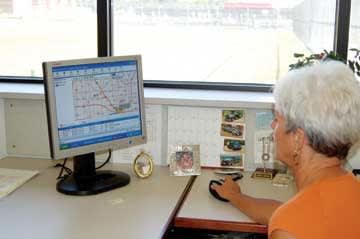
Lynn Hower, transportation and security director for the Metropolitan School District of Washington Township in Indianapolis, tracks buses using streetSmart by Synovia Corp.
Initially designed to aid the U.S. Department of Defense, global positioning system (GPS) technology has been more widely used in the past few years. For instance, once installed, it can help an individual locate a stolen vehicle.
It is this tracking ability, along with the other functions that GPS technology can perform, that has district officials around the U.S. installing it in their school bus fleets at an impressive rate.
Moreover, with different installation options at their disposal, transportation directors can reap its benefits at an affordable price.
Tracking buses and more
In addition to tracking buses, Lynn Hower, transportation and security director for the Metropolitan School District of Washington Township in Indianapolis, uses streetSmart’s (by Synovia Corp.) yard monitor daily. “It tells us that the buses have left, which is an excellent cross-check in terms of making sure that they’re on their routes in a timely manner,” she says.
Hower uses streetSmart to monitor speed as well. Periodically, people call her and claim that her drivers were speeding through residential areas. In this type of situation, Hower pulls up data on the buses and the system tells her the speed at which they were traveling.
Zonar Systems’ GPS package (EVIRNET) also has a speed report option, and it is a feature Dean Humphrey, the former transportation director of the Pendergast School District in Phoenix, found useful. Humphrey retired in early June, but had been using EVIRNET since September 2006. He used the feature to monitor his drivers’ speed as they pulled up to and out of drop-off spots. Humphrey says drivers appreciated this feature because it helped make them aware they were driving too fast in those areas.
Humphrey used EVIRNET’s schedule report as well. It documents, in real-time, when buses enter and exit schools, and it benefited him when he needed a bus to pick up students late in the afternoon. “I was able to see what buses were going to different schools in that area, and I found a bus that was just a couple of minutes away so we sent that driver over — we didn’t need to send out another bus,” he explains.
GE Security introduced its GPS software (NavLogix) to school districts recently, so it does not yet have users within this market. However, David Nark, the growth initiatives leader for GE Security, is optimistic about its future in the market. NavLogix not only tracks vehicles, it also provides a variety of information features, including e-mail alerts that report excessive idling or speed violations. According to Nark, the primary feature that makes it stand out from its competitors is its storage capacity. While other systems typically store between 30 and 40 days of vehicle history, NavLogix maintains a year’s worth.
Karen Williams, the transportation director for St. Lucie County (Fla.) Public Schools, had Everyday Wireless’ GPS technology installed in her buses in summer 2006. Since then, she has taken advantage of many of its functions. For instance, she monitors her drivers to ensure that they leave on time and has optimized her routes. “We were able to cut 16 to 18 bus routes by compressing them, combining them and deleting some because we didn’t need them,” she says.
Savings, security, efficiency
By optimizing her routes, Williams estimates her district has saved about $350,000 thus far. Humphrey’s district has also saved money. EVIRNET has an idle-monitoring feature, and by using it, he says, “I figure we’ve saved — in fuel costs alone — around $4,400 per year. The drivers are more aware too. They didn’t realize how long they would sit at a school waiting for students.”
Humphrey is also able to quickly generate 100-day reports — previously a lengthy, handwritten process. With EVIRNET, it takes under two minutes to gather the data and generate the report. “It’s huge to be able to have that kind of accuracy and speed,” he says.
{+PAGEBREAK+} These are not the only benefits that these transportation officials have experienced. Synovia’s software helps parents keep track of their children’s bus schedules. Hower reveals, “If a parent calls and says, ‘Bus 6 is running late. Can you tell me when it’s going to be here?’ I can pull up that route and give them the information.”
Hower also appreciates the added security streetSmart offers. With the growing concern of possible terrorist attacks on school buses, she says maintaining more efficient communication with her drivers brings her peace of mind.
The desire to contribute to its customers’ peace of mind shaped NavLogix’s development. GE gathers “Voice of Customer” reports where customers indicate features they want to be included in GE’s products. Nark says customers wanted increased security for their fleets, so GE notifies its customers if activity occurs that could be considered a security concern. Cellular vs. radio-based GPS
Everyday Wireless offers two software options: a cellular-based solution (iX-3) or a radio-based solution (TX-3 UHF). Cellular-based systems track vehicles within a wide geographic range, while radio-based systems have a more limited range. However, cellular-based users must pay a higher monthly fee for air time, and some radio-based systems have no monthly fee. Williams (a TX-3 UHF user) says this system works for her because 90 percent of her routes are within St. Lucie County. She acknowledges it has a more limited range, but notes that Everyday Wireless has accounted for this. “If a bus is in Miami, I’m not going to be able to see it on my computer screen,” she says. “But when it comes back into town, I can download its activity onto my computer.”
Hower’s buses travel a broad range of miles for field trips. Therefore, she is an advocate of cellular-based systems. “I feel you limit yourself if you use a radio-powered [system] and are not able to see the GPS activity in certain areas,” she says.
Affordable systems
When Humphrey began researching GPS software in the late ’90s, the average price of the equipment was about $1,500 and the monthly fee was between $35 and $40 per bus. Today, prices are more reasonable. He says that the capital outlay for EVIRNET is slightly more than half of what its competitors were offering him.
Hower assumed her current post in December 2006 — she was previously transportation director for Fort Wayne (Ind.) Community Schools. When streetSmart was installed in that district’s fleet, it paid roughly $200 per unit (excluding the monthly fee), and it had nearly 250 buses. Hower speculates that the Metropolitan School District of Washington Township paid nearly the same amount to have Synovia’s system installed in its 130 buses in mid-2004.
GE offers two payment options for its system. Customers can pay upfront for the hardware and installation and have a low monthly fee or, unlike with other cellular-based systems, they can use GE’s no upfront fee program. “This program allows customers to roll the cost of the hardware into their monthly services,” Nark says. “Generally, it’s about $40 to $50 per month with no cost upfront.”
The impact on drivers
Due to their monitoring capabilities, one could expect that drivers may view these systems as a way for their supervisors to “keep tabs” on them. Humphrey and Hower acknowledge that this is true to some extent, but they also point out that GPS technology protects drivers. “If an accident occurs and somebody says, ‘You didn’t use your stop arm or flashing lights,’ those things can tie into GPS to verify that drivers are using the proper equipment,” says Hower. Humphrey adds, “If drivers are doing their job, it helps support them.”
Enthusiasm for the future
Another feature of many GPS systems is student tracking. Everyday Wireless, for instance, offers several options, including a passive RFID system. Each student is given an RFID card with an identification number on it, and when entering and exiting buses, an RFID reader scans the number; the information is then transmitted to a server located within school transportation departments. Williams has not utilized Everyday Wireless’ student tracking options, but plans to. Hower is in the process of piloting streetSmart’s student tracking system.
Part of the reason these individuals have not yet utilized features such as student tracking is that they are still familiarizing themselves with everything this technology offers. Williams looks forward to expanding her use of Everyday Wireless’ attendance and payroll feature, which helps control driver payroll by monitoring daily activity. Hower plans to use streetSmart aggressively to establish more effective routes for her drivers.
Humphrey is disappointed he will not have the chance to use EVIRNET more fully due to his retirement. “I’ve been in transportation since 1990, and it’s the first major breakthrough in this arena for school buses,” he says.
More Management

How to Build a Better Driver Training Program
Ready to boost up your school bus instructor training? Here’s how to pick the right talent and improve recruitment, retention, and safety.
Read More →
CALSTART and Forth Combine to Form Catalyst Mobility
The new name represents a renewed vision for the nonprofit focused on advancing clean, equitable, and affordable transportation solutions that move people and goods.
Read More →
What Makes a Great School Bus Driver Trainer?
Choosing the right school bus driver trainer takes more than experience. Learn six keys to selecting and developing trainers and evaluating program effectiveness.
Read More →

School Bus Contractors Expand Through New Deals, Acquisitions & Partnerships
STA's Canadian division acquires Ontario-based G&L Stevenson Transport; Durham School Services adds a new district in California; First Student expands in New Jersey; and Minnesota Coaches rebrands and acquires Halo Transportation.
Read More →
Logan Bus Company Rolls Out AI Phone System for NYC School Bus Families
A summer pilot found that AI agents could handle most routine calls, freeing up time for customer service staff to focus on emergencies and complex family concerns.
Read More →
From Intent to Impact: What I Learned About Leadership from TAPT
A Texas transportation supervisor shares lessons on self-awareness, accountability, managing stress and building trust — and why investing in leadership development matters at every stage of your career.
Read More →
NAPT Names 2026 Award Recipients, Hall of Fame Inductee
Who earned national recognition for their work in student transportation? This year, NAPT named five recipients of its 2026 awards for service, safety, and leadership, plus its newest Hall of Famer.
Read More →
2026 State of Student Transportation Report
Driver shortages. Rising costs. Growing safety expectations. More data, but not enough time to act on it. The 2026 State of Student Transportation Report reveals what transportation leaders say is putting the most pressure on their operations—and where they’re investing next. See how your priorities compare.
Read More →
How to De-Escalate an Angry Person: 5 Steps for Handling Workplace Conflict
What makes emotions run high, and how should you handle an angry colleague or parent? Follow these steps for staying calm, listening, showing empathy, and resolving conflict.
Read More →
What Readiness Looks Like This School Year
Learn about the challenges shaping the 2026–2027 school year, from persistent driver shortages and budget pressure to technology and readiness gaps. See how school districts are responding and adapting in Zonar’s 2026 Back-to-School Readiness Report.
Read More →