




Driver Agility Testing: Variations and Applications Nationwide
Where and how agility testing requirements become part of the hiring process varies across the U.S. Here, we take a look at different ways agility tests are used, check in with states using a mandated, formalized test, and report on additional developments in agility test considerations.
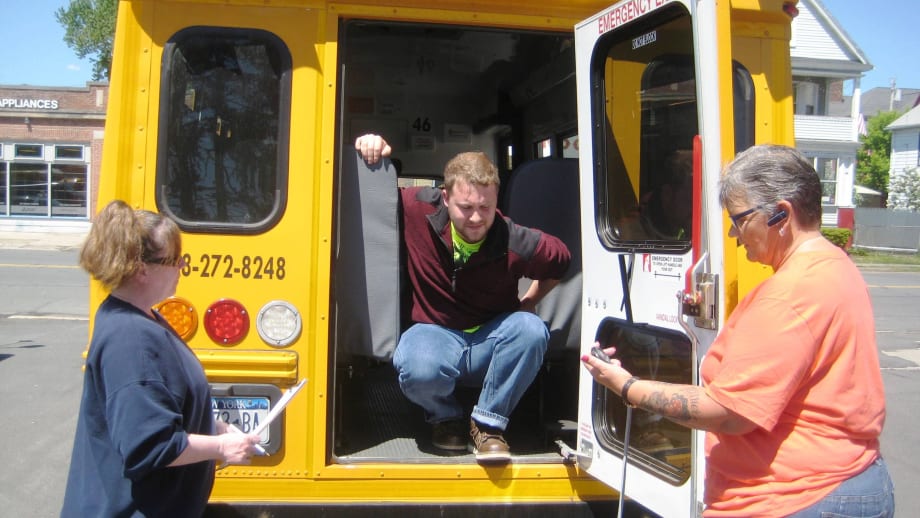
Moving from the driver’s seat to the rear exit is one job-related task that may be timed in an agility test. Drivers and a bus monitor are shown here performing a New York physical performance test.
As part of the prerequisite to employment, districts and companies may require drivers to pass an agility test, also known as a dexterity test. But where and how that requirement becomes part of the hiring process varies across the U.S. Here, we take a look at the different ways agility tests are used. We also check in with states currently using a mandated, formalized test and report on additional developments in agility test considerations.
A step beyond physicals
As part of the hiring process, driver applicants submit to a physical exam. The exam can include a medical professional’s assessment of the applicant’s cardiovascular, diabetic, hearing and vision health. It may also screen for past and present physical and mental conditions (seizures, injuries, etc.) and for current or past drug use.
The exam and the associated form, which varies by state, may also require the medical professional to attest to the person’s ability to perform specific tasks that are part of the driver’s job. In other words, they may be asked to consider whether the applicant/driver could safely and successfully perform job-related tasks. However, results can vary by location or person performing the physical, and the applicant/driver may or may not be asked to formally demonstrate specific job-related abilities.
On the other hand, when specific job-related physical requirements are literally put to the test, you have a formal, separate agility/dexterity test. In addition to the medical physical, this is an authorized test that’s commonly administered by a district professional in a real-world setting (including on board a bus). It measures if the new applicant or current driver can safely operate certain controls on the bus within certain time limits, and it measures if the person has the capacity to safely lift and drag weighted items in a certain amount of time.
What’s commonly included?
The agility test is intended to measure abilities and reaction times in real-world situations, including both normal and emergency conditions. For all, passing or failing relies on whether or not the task was performed correctly and how many times it can be performed within a certain time limit:
• Ascending and descending bus steps
• Alternating between throttle and brake
• Depressing and holding brake and clutch
• Manually opening and closing entrance door
• Right- and left-side controls
• Getting from the driver’s seat to the rear exit
• Lowering and lifting object from floor-level emergency exit to ground and back (may not be timed; only checked if done safely).
• Dragging 125 pounds 30 feet in 30 seconds (weight and time may vary)
Some exams test the above items separately, while others may combine tasks.
Florida’s 2006 update
In Florida, drivers are required to successfully pass an established dexterity test at least every 13 months, usually in conjunction with their physical examinations, which are required at least every 13 months. In 2006, Florida found that it was time to make updates to the test. It was becoming popular for districts to purchase larger capacity and transit-style buses, explains Claudia Claussen, public information officer with the Florida Department of Education, but the older test didn’t take those larger bus specs into consideration.
Another new consideration that was addressed was the then-recently added school bus specifications requiring air-operated entrance doors on the buses. Accordingly, the 2006 update also addressed the requirement for manually opening and closing an air-operated service door.
When the test updates were added, Florida also issued updated recommended guidelines for administering the test. The updated guidelines included where the examiner should be positioned when administering aspects of the test and what kind of responses should be flagged by the examiner as problematic.
[PAGEBREAK]

As part of an agility test at Arizona’s Litchfield Elementary School District, Eddie Solis moves 35 pounds from the floor of the bus to the ground, and then back up to the floor of the bus.
Arizona district adds attendant testing
Agility testing for Arizona drivers started in 2005 as a requirement for the Department of Public Safety’s Student Transportation Unit. The test is required every two years or if an employee is returning from medical leave.
Jeff Walker, director of transportation for Litchfield Elementary School District #79 in Litchfield Park, Arizona, says he also will test if there are questions on whether an employee can pass. “For example, if I see an employee limping because they hurt their knee, I will discuss the situation to ensure that they are safe to be operating a school bus,” Walker explains. “If I feel that there’s any question about it I will ask them to perform an agility test.”
Walker has found the employee response to be positive. “My staff has always been very good about complying,” he adds. “I have never had an issue with an employee refusing to complete an agility test when required or requested.”
Additionally, this school year Litchfield started its own department agility test for attendants.
“We feel that our monitors and their duties are every bit as important as the student transporters [drivers],” Walker says. “Monitors need to be able to perform the same duties in the event of an emergency, and we wanted to ensure that safety of our students is covered in all aspects.”
The attendant test is a modified version of the driver test with six standards, including:
• Ascending and descending stairs
• Repeatedly able to open/close service door
• Moving from the front of the bus to the emergency exit
• Lowering and lifting objects
• Weight drag
• Identifying, applying and releasing the parking brake
North Carolina recommends 5 physical standards
You may recall a North Carolina school bus fire that made national news about two years ago. Charlotte-Mecklenburg Schools made headlines when bus No. 295 was engulfed in flames on Feb. 8, 2012. The fire was captured on video and went viral across many news organizations.
“Fortunately, the driver of this bus was both physically able and mentally prepared to call upon her training to perform an emergency evacuation saving the lives of all students on board,” noted state draft standards documents developed by the Transportation Advisory Group.
Following the incident, the group, a subcommittee of the North Carolina Pupil Transportation Association, convened a Physical Standards Committee and set out to determine whether physical standards testing should become a requirement for North Carolina drivers. The committee went on to develop processes, procedures and physical standards that it recommended as requirements for obtaining school bus certification in North Carolina.
As outlined in the June 2013 draft of its “North Carolina Physical Standards for School Bus Drivers,” the committee developed five physical standards. In addition to commonly included standards such as stair climbing and throttle/brake operation, it included one regarding steering wheel operation.
The June 2013 draft reads, in part, “Standard 2: In a properly seated position with seat belt fastened, no part of the driver’s body may obstruct the steering wheel while making a hand-over-hand turn. Purpose: The test of Standard 2 ensures the bus can be steered in a hand over hand fluid motion without hesitation or obstruction. The standard will ensure a driver capability of steering the bus to avoid an accident or obstacles in the roadway.”
At press time, the North Carolina Division of Motor Vehicles was set to implement the standards in January 2015.
Don’t let appearances fool
The importance of ensuring a driver can safely perform the physical requirements of their job-related tasks can’t be overstated, nor can you caution enough against assuming without truly testing whether someone is proficient. “You cannot tell just by looking at someone what they are capable of,” reminds Craig Pruitt, program analyst for the School Finance and Pupil Transportation Unit of the Oregon Department of Education.
“How can you tell if someone has high blood pressure? A pressure cuff has to be used and a measurement has to be taken,” Pruitt notes. A certain physical build, age, amount of experience or any other outward appearances can be deceiving.
“In Oregon, the threshold was established years ago, and at times it does help to determine the next step in the driving career. In the interest of safety, agility testing and re-testing can be one of several tools used in the decision-making process,” he adds.
Lisa J. Hudson is a freelance writer based in Raleigh, North Carolina.
More Management

EverDriven Launches Route Consolidation Calculator to Estimate Diesel Savings
As diesel prices hit record highs, the largest alternative transportation provider says a 10% route consolidation could save a 120-route district more than $78,000 a year in fuel alone.
Read More →
Zum Secures Continued Financing Support for School Bus Expansion
Generate Private Credit has financed approximately $75 million in school bus deployments across three states, supporting more than 500 buses as Zum expands across the county.
Read More →
Beyond Discipline: A Different Approach to Student Behavior on the Bus
After implementing a dean of students program in Oregon, North Clackamas is seeing positive improvements. Here’s how it worked. The Route is brought to you by IC Bus.
Read More →
A Dean of Transportation's Different Approach to Student Behavior on the School Bus
After implementing a dean of students program in Oregon, North Clackamas is seeing positive improvements on the bus. Here’s how it worked.
Read More →
Inside NAPT ACTS 2026: Highlights from Louisville
From federal updates and student behavior strategies to new school bus technology and industry awards, see highlights from NAPT ACTS 2026 in Louisville.
Read More →
Meet the 2025 School Bus Driver Hero Winner: Annette Brown
We caught up with Wa-Nee Community Schools' Annette Brown on site at SBFX, where she was named the 2026 School Bus Driver Hero Award winner. Hear about her reaction, what she loves most about being a school bus driver, and more!
Read More →
Predictability Is Like Ketchup (According to 6-Year-Olds)
To students, a different school bus can feel like a full-blown crisis. One driver reflects on why familiar routines, showing up on time, and being reliably boring matter more than we think.
Read More →
Samsara Launches Free Driver Rewards Program
The new Driver Perks program gives eligible professional drivers access to discounts and offers without adding a cost for participating fleets.
Read More →
How Tax-Exempt Municipal Leases Can Help Finance School Buses
Let’s explore school bus financing options, including municipal leases, vendor payable accounts, and balloon payments, and how they can help stretch fleet budgets.
Read More →
Nominate Rising School Transportation Pros Under 40!
We’re searching for the next generation of leaders making an impact across the K-12 student transportation industry to recognize as SBF’s 2027 Trailblazers. Nominations are open now!
Read More →