




Don't let high fuel prices affect your safety program
All of us who drive regularly have felt the sting of sky-high fuel prices over the past several months.
All of us who drive regularly have felt the sting of sky-high fuel prices over the past several months. It’s frustrating because we have few transportation alternatives. Unless we choose to take advantage of public transportation, we must suffer the sticker shock of monthly gasoline bills that rival our car payments. For most people, this situation is an annoyance, not a crisis. But the transportation industry is being affected more dramatically. According to watchers of the heavy trucking industry, more than 35,000 rigs have been repossessed or turned in by independent owner-operators, mainly because of the spike in diesel fuel prices. The school bus industry, though not as severely harmed, has sustained damage. As Editor Steve Hirano explains in his article, “How to Keep High Fuel Prices from Throttling Your Budget,” school bus operators are being forced to expand their fuel allowances for the 2000-2001 school year, sometimes by as much as a third, to compensate for the jump in diesel fuel and gasoline costs. This represents a real danger. That extra padding in the fuel budget means that school districts will have to dip into their reserves or trim (or eliminate) programs. If they’re lucky, funding from state and local coffers will pick up the slack. The most likely scenario, however, is that transportation managers will be required to find other areas to absorb cuts.
Where will cuts be made?
That means that safety-related programs such as driver training could be curtailed. For example, school districts that pay drivers to attend in-service training could decide to end those payments. Will drivers attend non-paid training sessions? Yes, conscientious drivers will donate their time to continue their professional development. But those drivers generally are not the ones who need the training. It’s the apathetic, non-motivated ones who would most benefit. And those are the ones who skip these non-paid sessions. Even if driver training is untouched in the budget, that doesn’t mean that alternative safety-related cuts won’t be implemented.
New buses save money
Transportation managers could delay the purchase of new, fuel-efficient buses and continue to run 20-year-old vehicles that are neither fuel-efficient nor equipped with the latest safety enhancements. Although this strategy addresses an existing budget shortfall, it doesn’t make sense in the long run. New buses have significant advantages over their aged counterparts. They require less maintenance (and are under warranty), which reduces labor costs in the garage, and they can be easily programmed to maximize fuel mileage. They also have ergonomic improvements, which help to keep drivers happy. Drivers are the other part of the equation. With fuel prices creating budget uncertainties, school bus operators could put a hold on driver wage increases. Again, this is a short-sighted strategy that could make things worse. With the ongoing driver shortage, wages need to be made more competitive, not less. So where should the cuts be made? Good question. I don’t have a ready answer. Plead with your superintendent and school board to find other areas of the district budget to absorb the cuts. If that fails, implement austerity measures in areas that remain an arms-length from safety concerns. Here’s what I can suggest: Keep your focus on safety. Do what you can to reduce your fuel costs. Invest in new, fuel-efficient equipment. Assume that fuel prices will continue to head north — and pray that you’re wrong.
More Management

EverDriven Launches Route Consolidation Calculator to Estimate Diesel Savings
As diesel prices hit record highs, the largest alternative transportation provider says a 10% route consolidation could save a 120-route district more than $78,000 a year in fuel alone.
Read More →
Zum Secures Continued Financing Support for School Bus Expansion
Generate Private Credit has financed approximately $75 million in school bus deployments across three states, supporting more than 500 buses as Zum expands across the county.
Read More →
Beyond Discipline: A Different Approach to Student Behavior on the Bus
After implementing a dean of students program in Oregon, North Clackamas is seeing positive improvements. Here’s how it worked. The Route is brought to you by IC Bus.
Read More →
A Dean of Transportation's Different Approach to Student Behavior on the School Bus
After implementing a dean of students program in Oregon, North Clackamas is seeing positive improvements on the bus. Here’s how it worked.
Read More →
Inside NAPT ACTS 2026: Highlights from Louisville
From federal updates and student behavior strategies to new school bus technology and industry awards, see highlights from NAPT ACTS 2026 in Louisville.
Read More →
Meet the 2025 School Bus Driver Hero Winner: Annette Brown
We caught up with Wa-Nee Community Schools' Annette Brown on site at SBFX, where she was named the 2026 School Bus Driver Hero Award winner. Hear about her reaction, what she loves most about being a school bus driver, and more!
Read More →
Predictability Is Like Ketchup (According to 6-Year-Olds)
To students, a different school bus can feel like a full-blown crisis. One driver reflects on why familiar routines, showing up on time, and being reliably boring matter more than we think.
Read More →
Samsara Launches Free Driver Rewards Program
The new Driver Perks program gives eligible professional drivers access to discounts and offers without adding a cost for participating fleets.
Read More →
How Tax-Exempt Municipal Leases Can Help Finance School Buses
Let’s explore school bus financing options, including municipal leases, vendor payable accounts, and balloon payments, and how they can help stretch fleet budgets.
Read More →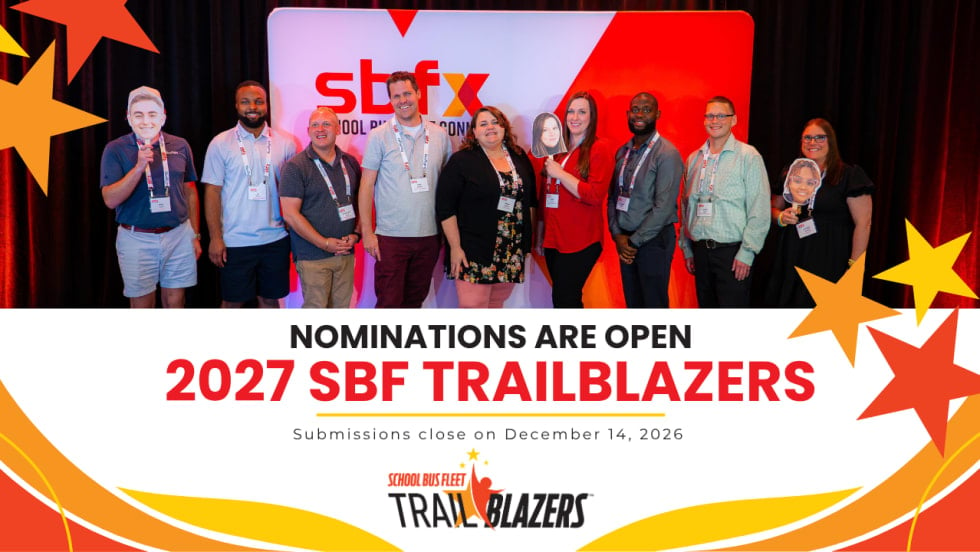
Nominate Rising School Transportation Pros Under 40!
We’re searching for the next generation of leaders making an impact across the K-12 student transportation industry to recognize as SBF’s 2027 Trailblazers. Nominations are open now!
Read More →