




Bus crashes: Tough lessons learned
Why do we cover tragic accidents? Mainly because we want to share with our readers any information that could help in improving school bus safety.
One of the tougher parts of what we do at SBF is report on major school bus crashes.
It’s always saddening to go over the details of an accident in which a young student’s life was tragically cut short. One such accident has just happened, and this one hits particularly hard because it took place in my state, New Jersey.
Police in Chesterfield Township said that on Feb. 16, a school bus carrying 25 students was en route to an elementary school when a dump truck struck the driver’s side rear of the bus at an intersection. The impact of the crash then caused the bus to strike a pole.
One student was killed — an 11-year-old girl who was the daughter of a state trooper — and 17 students sustained injuries.
Adding to the heartbreak, the girl who was killed was a triplet, and her two sisters were critically injured in the crash.
In a sign of how big of an impact this accident had in New Jersey, Gov. Chris Christie made a statement about it. “We are deeply concerned for the students on the bus and their families and can only imagine what they’ve been dealing with in the immediate aftermath of the crash,” he said.
The accident even got the attention of the feds. The National Transportation Safety Board (NTSB) sent a team to Chesterfield to investigate.
In a press briefing the next day, NTSB investigator Peter Kotowski said that the crash “drew our attention because of the fact that New Jersey is of one of six states that has seat belt requirements on school buses for passengers.” (The state has required lap belts on school buses for two decades.)
So why do we cover tragic accidents like this? Mainly because we want to share with our readers any information that could help in improving school bus safety.
As of this writing, the Chesterfield investigation had just begun, but the NTSB will likely uncover some of the key factors that contributed to the crash and may make safety recommendations related to school transportation.
Earlier in February, the agency issued its report on the fatal 2010 Gray Summit, Mo., crash that involved a pickup truck, a truck-tractor and two school buses.
The NTSB determined that the probable cause of the initial collision was distraction, likely due to text messaging by the pickup driver.
The agency found that the second collision, between the lead school bus and the pickup, was the result of the bus driver’s inattention to the forward roadway, and the final collision was due to the driver of the following school bus not maintaining the recommended minimum distance from the lead school bus.
NTSB also found problems with the brakes on both buses, including a 0.06- by 0.03-inch hole in one of the brake lines.
After the 2006 crash in Huntsville, Ala., in which four students died, an alarming finding was that the school bus driver was not wearing his seat belt, which allowed him to be thrown from the bus before it plunged 30 feet off of a highway ramp.
Examining these types of tragedies is upsetting, but if there are lessons that can be learned, they need to be exposed.
More Safety
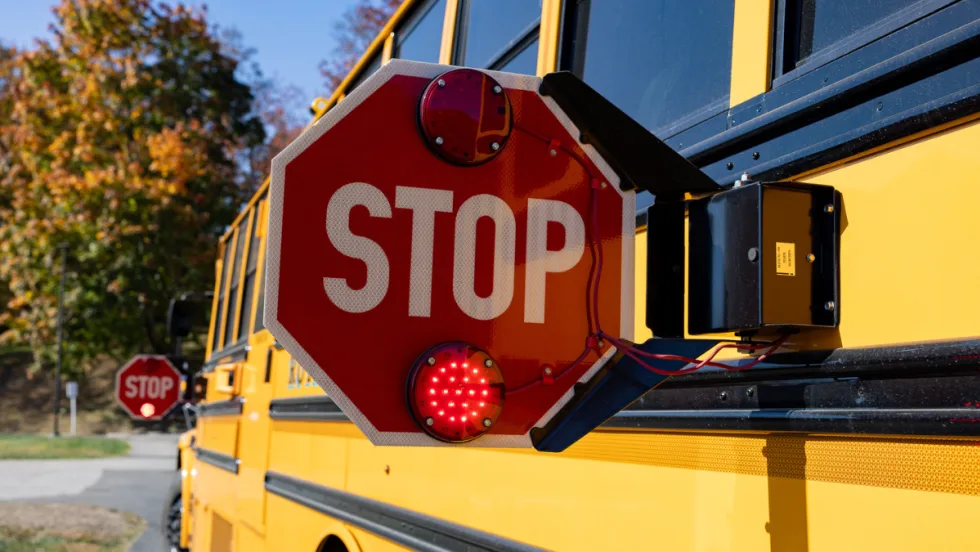
Illegal School Bus Passing Drops 24% in New York Districts
With fewer than 5% of citations involving repeat offenders, Westchester County officials said enforcement, education, and community partnerships are helping change driver behavior.
Read More →
School's Back. Here's What Happened to Traffic, Speeding & Distraction
What happens to traffic when school resumes? New data analysis examines changes in distracted driving, congestion, and speeding around schools.
Read More →
Geotab Expands Fleet Safety Tools With Video Coaching, Risk Insights
New safety and video capabilities aim to help fleet managers assess risk, support drivers, and take targeted action through video coaching, red-light violation detection, and more.
Read More →

How to Build a Better School Bus Driver Training Program
Is it time to strengthen your driver training? Here’s how to pick the right talent and improve recruitment, retention, and safety. This video is brought to you by IC Bus.
Read More →
Recent School Bus Accidents Leave 2 Dead, 2 Injured
Four school bus crashes in Florida, Illinois, and Georgia highlight risks in transportation lots, at bus stops, and during student loading and unloading.
Read More →
When Every Second Matters, Clarity Keeps Routes Moving
From routine delays to urgent incidents, strong communication practices help drivers, dispatchers, schools, and families respond with confidence.
Read More →
What Happens When a School Bus Catches Fire — and What Can Help
School bus fires are rare but can be devastating. Learn how advances in fire suppression and asset protection help fleets detect fires earlier, reduce damage, and improve safety.
Read More →
Geotab Launches Tool to Help Fleets Investigate Road Incidents
Geotab Investigations combines telematics data, video, documents, and other evidence to help fleets reconstruct incidents, resolve claims, and determine what happened.
Read More →
Texas Sixth Grader Wins 2026 National School Bus Safety Poster Contest
Sai Darshana Yekolu of Moseley Middle School in Prosper, Texas, was named the newest winner for her artwork, bringing the theme of “Safe Rides, Everyday Heroes” to life.
Read More →
Doing More With Less: How Transportation Directors Can Prioritize Safety Amid Budget Uncertainty
With diesel prices soaring and nearly one-third of transportation directors expecting budget cuts, maintaining student safety has never been more challenging. Download this guide to learn how leading districts are prioritizing risk, funding critical safety technology, and building stronger budget cases with data.
Read More →