





Making the School Bus Ride Easier for Students With Autism in 7 Steps
Accessible and Inclusive: The Latest in School Bus Assistive Tools & Tech
Explore innovative assistive technologies transforming school buses to support students with diverse needs, from behavioral aids to sensory tools and communication devices.
January 27, 2025
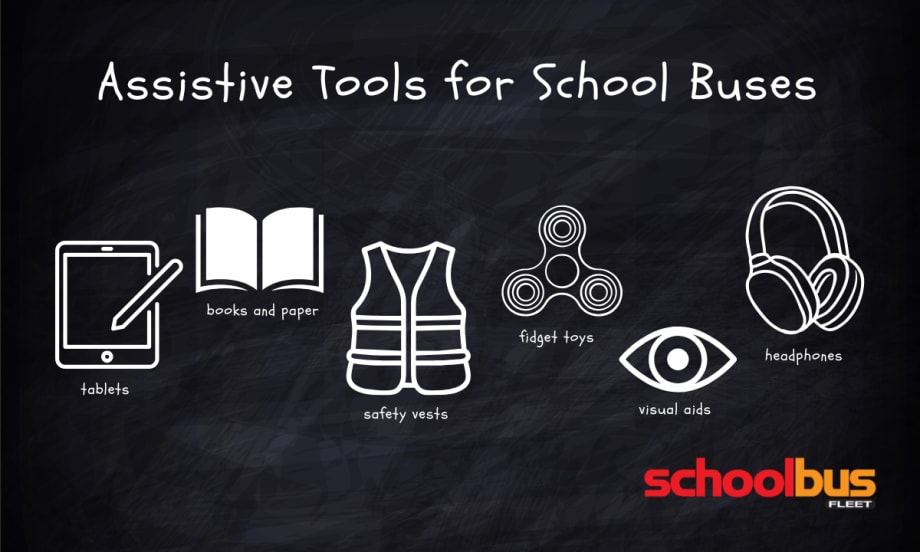
Assistive technologies and adaptive equipment like safety vests, communication tablets, and sensory tools (and more) are enhancing safety and fostering inclusivity by meeting the diverse needs of all students on school buses.
Photo: SBF/Canva
8 min to read
When we think of assistive technologies aboard the bus, most minds likely go to wheelchair tie-downs, occupant restraints, and lifts. Yet, only a fraction of students with special needs use a wheelchair.
As passengers with a broader range of needs increase on the bus, so must the tools we use to accommodate them.
The Role of the IEP
As more children are identified with autism spectrum disorder and other cognitive disabilities (and other factors are at play in society, too), it’s becoming more common to see children having trouble sitting still on the school bus.
To provide proper accommodation, transportation departments must be in contact with the district’s IEP and SPED teams to know what tools are available and approved. It’s important to never use a securement device or other equipment on a child without an IEP.
Keeping Busy Bodies Focused
Interestingly, the evolution of assistive technologies is paradoxical. “While technological advancements have been invaluable, the ultimate goal of special education is to promote independence,” Will McDermott, head of student services for First Student, said. “Therefore, we prioritize recommending the least complex solution that a student can manage independently as an adult.”
Some students may not (yet) have an IEP, but struggle to behave on board. So, what can the bus driver do to keep them seated and safe?
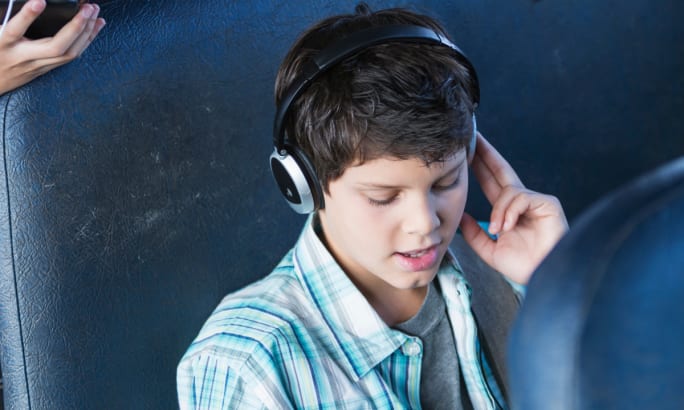
Penny Evert, transportation supervisor at Whitehall (Mich.) District Schools has learned the value of keeping a couple of MP3 players with headphones on hand for students who need to be distracted by light music or audiobooks to get to school.
Tablets can serve dual purposes on a bus, offering a communication tool and allowing students to stay focused.
Photo by kali9/Canva
Evert also recommends “fidget bags” made up of small toys, books, fidget spinners, pop-its, etc., to keep kids busy while riding. Several of her drivers have purchased small, handheld video games that they hand to kids who need distractions to be safe on the bus, which must be returned while unloading.
For younger students, Evert says her social workers often make storyboards — small, laminated posters — that show acceptable behavior on a bus and place them in the seat for students needing reminders.
Alexandra Robinson, behavioral specialist and president of A. Robinson Consulting, recommends any technology that a child — especially a child on the spectrum — can use that enhances their ride. “Having some sort of tablet on the bus that not only serves as their communication board, but something that they interact with while they're on the bus, has always been very successful,” she said. “If social interaction isn’t going well, portable technology gives them something, instead of someone, to interact with.”
Robinson has also shared GPS tools with students so that they can see where the bus is going on a map. “Sometimes, just showing them where they are along the ride can help them stay more focused,” she said.
“Many of our students with autism respond to a visual schedule,” Shutrump added. “[The speech pathologist] can provide this on the bus so that they're aware and know what’s coming next, because that's going to make a world of difference in how comfortable they are on that bus.”
The most effective strategies involve consistent application across multiple environments — the bus, classroom, and home, McDermott shared. “A cornerstone of [the First Student] approach is the use of an ‘About Me’ form, which provides essential, non-confidential information about the student. This tool enables the development of individualized, multi-environmental interventions, maximizing their impact on the student’s overall well-being.”
Accessibility for Hearing & Visual Impairments
At West Shore Educational Service District, Transportation Director Katrina Morris recommends tablets for non-verbal students. Riders can select icons to help them communicate, and buses without tablets can use laminated pictures on a ring.
“It’s the same thing that they use in school, so if they use it there, I need it on the bus,” Morris said. “If it is in school, and it is to help this student progress, and that’s what's in the IEP, I’m an extension of that classroom. Then it’s the same, consistent language in the classroom and on the bus, and that’s what our kids need to succeed.”
Morris also praises one of her drivers who learned sign language to better communicate with passengers who are deaf or have cochlear implants.
For children with visual impairments, easy modifications can be made to provide larger bus numbers on the exterior or place textured pads on the edge of a seat so they can find their spot by touch.
Sensory Sensitivities & Other Needs
Susan Shutrump, a retired PT/OT supervisor and consultant, said that before deciding on what accommodations to make for a child with cognitive or behavioral disabilities, we first need to understand the trigger. Many times, sensory sensitivity is at the root of the problem.
“If a child has, let's say, sound sensitivity, riding that school bus can be like being at a rock concert,” she said. “For them, it can be loud and painful.”
Children with sound sensitivity can be reactive to loud sounds as well as quiet ones — the ones others can filter out. A pair of good headphones can make a world of difference in this instance.
Shutrump points out that some may hesitate to give a child anything that impedes their ability to receive instruction in an emergency. But, many headphones still allow just enough sound to come through. That child can also have a seat buddy to alert them of announcements, or they can be seated closer to the driver for extra awareness of commands.
"A lot of the time, one of your biggest aids or accommodations will come in the way of customizing the seating plan,” Shutrump said. “I don't think transporters fully recognize how effective a tool it can be."
For students with light sensitivity, driving past rows of buildings or trees can produce a strobe light effect and can even induce a seizure-like response in some. You can put up window clings in their seat to dampen the light or allow those passengers to wear a hat and/or sunglasses.
And for students with touch sensitivities, it’s important to be aware that often it is light touch that causes adverse reactions, with some perceiving it as painful. Shutrump recommends providing firm pressure, as for many it can be comforting like being swaddled as an infant.
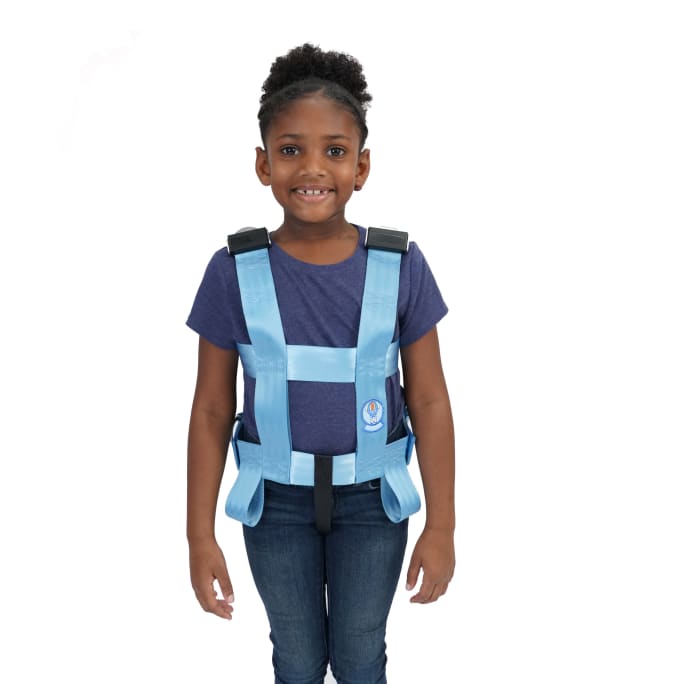
The Max2 vest from EZ-ON is great for “Houdinis” who tend to remove their safety gear while riding the bus, the company says.
Photo: Easy Way Safety Services
“Firm pressure is calming to the nervous system as it’s carried by old neural tracks that were in the embryo,” she explained. “One way to provide this deep pressure is through riding in a well-fitted child safety restraint system because they provide that pressure over the shoulders and hips over every bump along the ride. It also prevents them sliding around on the seat, which is a source of light touch.”
For these students, safety vests can provide a calming, grounding effect. Tom Sackett, president of Easy Way Safety Services says that he’s seen increased demand since COVID. In fact, he’s even got orders coming in for use in passenger vehicles too, as drivers and parents realize the benefits of securement.
“Safety vests and school bus-specific child safety restraint systems (CSRS), such as the Pro Tech IV, allow students with a wide variety of special needs or disabilities to use the yellow school bus,” Aaron Harris, national sales manager at BESI, Inc. added. “These products can be used for a variety of reasons, from extra crash protection to simply helping a passenger to sit up correctly. As more and more students with disabilities are transported to school every year, training on selecting and proper usage of the appropriate CSRS for each passenger is imperative.”
Electric and propane-powered buses, which tend to be quieter, can also help students with sensory sensitivities.
On the OEM side, Micro Bird says they have worked to improve bus insulation to reduce noise and vibration, which creates a more enjoyable ride for children who experience sensory overload.
Speaking of training, alternative transportation provider HopSkipDrive mentions the importance of driver onboarding. Their CareDrivers in passenger vehicles are provided with education and resources on how to best support students with limited mobility and disabilities, as well as trauma-informed care. Rider notes reflect student preferences, such as what music a child prefers (if any), whether windows should be down or up, and preferred topics for discussion.
Standards & Safety
To learn about current or coming assistive device standards, we checked in with the Rehabilitation Engineering and Assistive Technology Society of North America (RESNA). While they didn’t have much to share for non-wheelchair standards for school bus use, Stephanie Schnorbus Stephens, chair of the AT Standards for Cognitive Accessibility Committee, suggested watching the International Organization for Standardization (ISO) TC173 WG10 Cognitive accessibility, noting that “the ISO 21801-1 standard details design considerations will help make products and systems more cognitively accessible. This could be applicable to creating or evaluating systems for helping children with cognitive impairments on the school bus, although it would take some focus and dedication to apply it in this way.”
As far as safety of assistive tools, manufacturers are required to self-certify that their products meet all applicable Federal Motor Vehicle Safety Standards. NHTSA also noted that the “Demonstration to Address Accessibility & Student Behavior Trends on School Buses” is in progress. This project aims to develop an inclusive toolkit to help reduce unsafe situations on school buses and encompasses the broad needs of students, including those who may have accommodation or accessibility needs.
Types of Special Needs
RESNA defines cognitive impairment to include conditions such as attention disorder, brain injury, cerebral palsy, Down’s syndrome, learning disability, and stroke.
The Individuals with Disabilities Education Act (IDEA) defines the following 13 disability categories:
Autism Spectrum Disorder
Hearing Impairment
Deafness
Visual Impairment/Blindness
Deaf-Blindness
Emotional Disturbances (including anxiety, bipolar, compulsive disorders, and depression)
Specific Learning Disability (including dyslexia and audio processing disorder)
Intellectual Disability
Orthopedic Impairment
Speech or Language Impairment
Traumatic Brain Injury
Multiple Disabilities
Other Health Impairment
The world is changing rapidly, with new research, tools, and information constantly evolving and improving to help us better understand how to meet the needs of our school bus riders and the diverse needs of passengers with physical, cognitive, and emotional disabilities. We mustn’t forget to train and educate drivers and aides on how to accommodate different types of passengers for the best possible experience. More on that soon.
Subscribe to Our Newsletter
More Special Needs Transportation
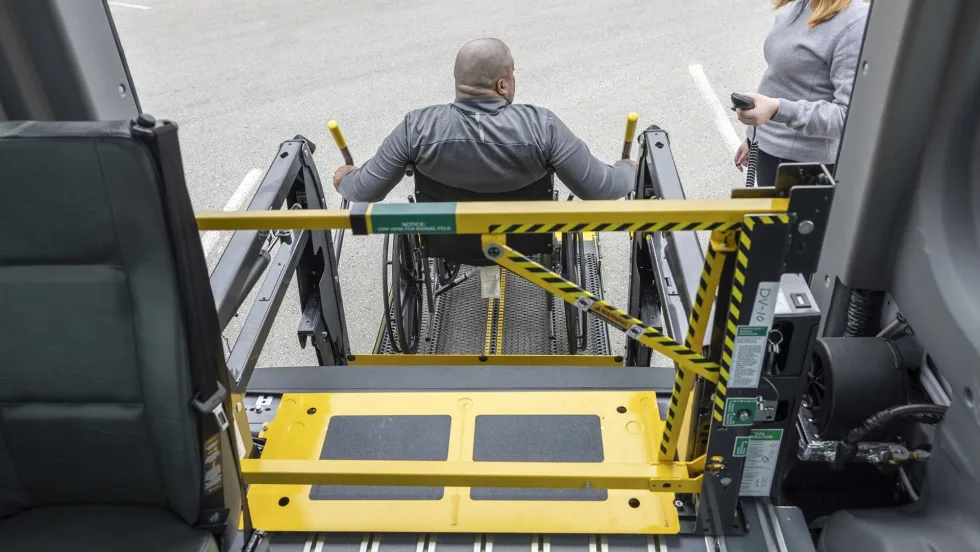
BraunAbility Introduces New Safety Barrier for Wheelchair Lifts
LiftSentinel is designed to add another layer of protection during wheelchair loading and unloading and can be retrofitted to many existing commercial lift installations.
Read More →
HopSkipDrive Launches New Safety, Driver Consistency Features for 2026-27 School Year
The company’s free ride recording, live ride tracking, and consistent driver assignments aim to improve safety and continuity for diverse student transportation needs.
Read More →
The Most Common Wheelchair Securement Mistakes on School Buses (and How to Fix Them)
Small missteps in wheelchair securement can have serious consequences. Here are 32 tips from experts to reduce risk and increase student safety on the bus.
Read More →
Inside AMF Bruns’ New Showroom: School Bus Securement Solutions Explained
Go inside AMF Bruns America’s new Ohio showroom with Maritza Valentin to see its FutureSafe technology, driver training tools, securement systems, and seating innovations.
Read More →
What AMF Bruns’ New Facility Means for Customers [Video]
Inside AMF Bruns’ new Stow, Ohio, operations: See how expanded space and innovation will enhance customer support and operations.
Read More →
AMF Bruns Expands in Ohio, Investing in Growth and Community
With expanded production space, local investment, and a growing workforce, AMF Bruns is scaling its U.S. presence. Here’s an exclusive first look inside the new Stow, Ohio, HQ.
Read More →
Inside AMF Bruns of America’s New Ohio Manufacturing Facility [Photos]
Take a behind-the-scenes look at AMF Bruns of America’s new 41,000-square-foot Stow, Ohio, headquarters, featuring advanced manufacturing, expanded space, and future-ready mobility solutions.
Read More →
First Student Boosts Student Support in Wichita & Texas
First Student and Wichita Public Schools are using behavioral support strategies to improve student ride experiences, while a separate initiative expands access to after-school programs through a bus donation.
Read More →
2026 Special-Needs Transportation Survey
What’s changing in special-needs transportation? This year, student transportation operators report a rising need, easing driver shortages, growing tech adoption, and evolving challenges. Sponsored by AMF Bruns of America.
Read More →
The Lived-Experience Gap in Mobility Tech: An Expert Take on Safe Student Transportation
Brianna Pauwee, a product application specialist at AMF Bruns of America and a wheelchair user, drops in to The Route to share practical securement and training insights, plus the story behind the new “Beyond Mobility” podcast. The Route is sponsored by IC Bus.
Read More →